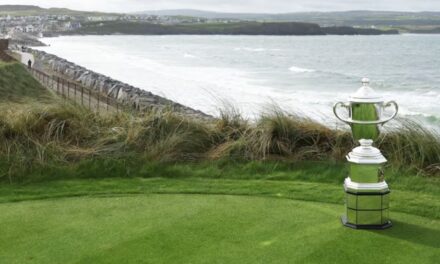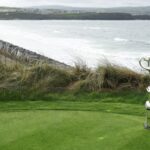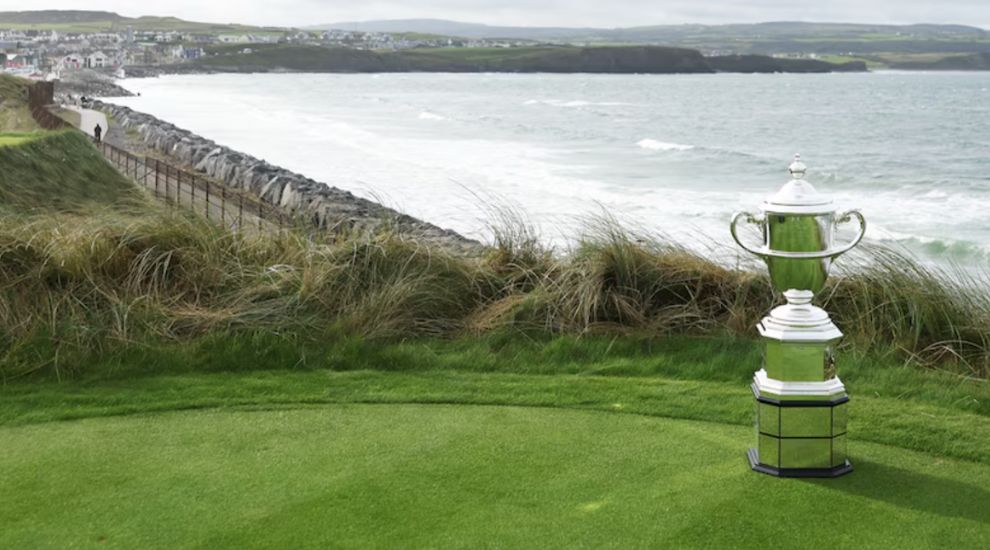
The Walker Cup arrives at Lahinch this weekend. It is a top class sports event but it is also a historic tale in which Ireland has played a major part. From Joe Carr, perhaps the defining amateur golfer of his generation, through Pádraig Harrington and Rory McIlroy to the record Irish contingent of 2015 and Stuart Grehan today, Irish golf has been woven through the competition for more than a century.
The Walker Cup was conceived in the aftermath of the First World War as a means of strengthening golfing ties across the Atlantic. George Herbert Walker, USGA President in 1920 and grandfather and great-grandfather of future US presidents George H.W. Bush and George W. Bush, was central to establishing the contest and provided the trophy which still bears his name. The inaugural match was played at National Golf Links of America in New York in 1922, with the United States winning 8-4.
More than a century later, it remains the pinnacle of men’s amateur team golf. The USA has been the dominant force, leading the series 40-9 with one match tied going into this weekend’s 51st staging at Lahinch.
Irish Influence
Ireland’s first Walker Cup representative was Charles Hezlet of Royal Portrush in 1924. He returned in 1926 and 1928, establishing an Irish presence which would become increasingly significant. John Burke of Lahinch represented GB&I in 1932, a neat historical connection as the competition now comes to his home club almost a century later.
The first great era of Irish influence arrived through players such as Cecil Ewing and Jimmy Bruen. Ewing appeared six times between 1936 and 1955, while the brilliant Bruen played in 1938, 1949 and 1951.
But one name towers above every other Irish contribution to Walker Cup history.
Joe Carr – the Irish giant of the Walker Cup
Joe Carr was selected for 11 consecutive Walker Cups between 1947 and 1967, playing in ten of them, still the record for playing appearances by a GB&I golfer. He played 20 matches, won five and halved one at a time when American amateur golf was extraordinarily dominant.
Carr faced many of the era’s outstanding American amateurs, including Jack Nicklaus in 1961. He was captain in 1965, when GB&I earned an 11-11 draw at the Baltimore Country Club — at that stage, an exceptional achievement against the Americans — and returned as playing captain in 1967.
There was a satisfying family sequel in 1971. Roddy Carr, Joe’s son, was part of the GB&I side which beat the United States 13-11 at St Andrews, only the second Walker Cup victory in GB&I history.
Roddy, his brother Marty and nephew Cian Branagan remain at the heart of Irish golf, and so the legacy is a living one.
Irish players continued to make their mark. At Cypress Point in 1981, 17-year-old Ronan Rafferty and Philip Walton won both of their foursomes matches together, an early glimpse of two men who would later enjoy substantial professional careers.
Eight years later came one of the most important Walker Cups of all.
GB&I travelled to Peachtree in Atlanta in 1989, having won the competition only twice since its foundation. A team containing Garth McGimpsey and Cork’s Eoghan O’Connell secured a famous 12½-11½ victory — GB&I’s first ever on American soil. O’Connell contributed two wins and two halves, including a crucial halved encounter with a young Phil Mickelson.
It was evidence that the competitive balance was finally beginning to shift.
Portmarnock 1991
Two years later, the Walker Cup came to Ireland for the first time.
Portmarnock hosted the 1991 match during the centenary year of the Golfing Union of Ireland, an event sufficiently important nationally that An Post issued commemorative stamps.
There were three Irishmen in the GB&I team: Pádraig Harrington, Paul McGinley and Garth McGimpsey. On the American side were future world No 1s Phil Mickelson and David Duval.
The USA prevailed 14-10, but the match provided an early glimpse of golfers who would play major roles in the professional game. McGinley partnered Liam White to a foursomes victory over Mickelson and Bob May, while the 20-year-old Harrington was at the beginning of a Walker Cup career that would encompass three appearances.
Harrington helps turn the tide
Harrington returned in 1993 and again in 1995 at Royal Porthcawl, where he and fellow Irishman Jody Fanagan played important roles in a famous 14-10 GB&I victory.
Harrington and Fanagan won both of their foursomes together, the second against a pairing containing Tiger Woods, while Fanagan finished the week with a perfect 3-0 record.
Other Irish players followed through a particularly strong era for GB&I: Paddy Gribben was part of the victorious 1999 team, Graeme McDowell played in the 15-9 win in America in 2001, and Garth McGimpsey captained the 2003 team to a 12½-11½ victory at Ganton, with Colm Moriarty and Noel Fox among his players.
Rory at Royal County Down
The Walker Cup returned to the island in 2007 at Royal County Down.
This time Ireland supplied two players with significant local interest: Rory McIlroy and Jonathan Caldwell. The American team was formidable, featuring Dustin Johnson, Webb Simpson, Rickie Fowler and Billy Horschel.
McIlroy and Caldwell halved their opening foursomes against Dustin Johnson and Colt Knost, and McIlroy later defeated Horschel 4&2 in the Sunday singles. GB&I mounted a furious final-day challenge, but the USA escaped with a 12½-11½ victory.
Perhaps the strongest demonstration of Ireland’s depth came at Royal Lytham & St Annes in 2015.
For the first time, five of the ten GB&I players were Irish: Paul Dunne, Gavin Moynihan, Cormac Sharvin, Gary Hurley and Jack Hume. The previous Irish record had been four players in the larger 12-man teams of 1949 and 1951.
GB&I produced a record 16½-9½ victory. Sharvin was unbeaten, Hurley won his Sunday singles and Dunne’s half, with Maverick McNealy supplying the point that mathematically secured the Cup.
It remains the most recent GB&I Walker Cup victory.
A new Irish generation
Irish representation has continued strongly. Paul Cutler went unbeaten with three wins and a half in the 2011 victory at Royal Aberdeen. Gavin Moynihan and Kevin Phelan played in 2013; Conor Purcell and Caolan Rafferty were among the Irish contingent in 2019; and John Murphy and Mark Power represented Ireland at Seminole in 2021.
At St Andrews in 2023, there were four Irish players — Alex Maguire, Matthew McClean, Liam Nolan and Mark Power. Power’s Walker Cup record across 2021 and 2023 stands at an exceptional six wins from eight matches.
Stuart Grehan and Gavin Tiernan then represented Ireland at Cypress Point in 2025.
And so the story comes to County Clare.
Lahinch becomes the third course on the island of Ireland to stage the Walker Cup, after Portmarnock in 1991 and Royal County Down in 2007, and the first to do so for 19 years.
There is a neat historical circle to it. Lahinch golfer John Burke played in the Walker Cup in 1932. Generations of Irish golfers followed him, from Bruen and Carr to Harrington and McIlroy. Now the club which has staged the South of Ireland Championship since the nineteenth century gets to host the contest itself.
Stuart Grehan is the sole Irish member of the 2026 GB&I team, returning after his Walker Cup debut at Cypress Point last year and doing so as the reigning Amateur Champion following his victory at Royal Liverpool this summer.
Ireland has supplied the competition’s record GB&I player in Joe Carr; provided important figures in many of its greatest upsets; produced future Major champions Harrington, McDowell and McIlroy; supplied half of the last victorious GB&I team; provided two GB&I captains in Carr and McGimpsey; and now hosts the match for a third time.
For Irish golf, the Walker Cup has never simply been somebody else’s competition. Ireland has been part of its story almost from the beginning — and Lahinch this weekend adds another significant chapter.


 Golf Ireland, Carr Golf, the K Club and ForeFront Sports are full members of Sport for Business. KPMG are partners of our Golf coverage.
If you would like to be part of the Sport for Business community and see your organisation in our content, on our stages, and in the conversation happening every day around the commercial world of Irish Sport, email us today and let’s see what is possible.
Image Credit: Golf Ireland

ABOUT SPORT FOR BUSINESS
Sport for Business is Ireland’s leading platform focused on the commercial, strategic and societal impact of sport. It connects decision-makers across governing bodies, clubs, brands, agencies, and public institutions through high-quality content, events, and insights.
Sport for Business explores how sport drives economic value, participation, inclusion and national identity, and how your story can be part of ours.
Through analysis, storytelling and convening the sector, it helps leaders understand trends, share best practices, and make better-informed decisions. It positions sport not just as entertainment but as a vital contributor to Ireland’s social and economic fabric.
Find out more about becoming a member today.
Or sign up for our Daily Sport for Business Snapshot email bulletins to get a flavour of the material we cover.
Sign up for our News Bulletins here.