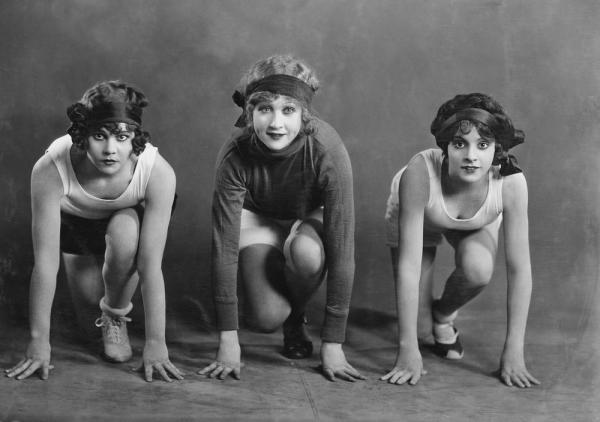
 Women’s sport is seen as a lesser version of Men’s. That is the case in terms of media, sponsorship and some would say, public interest.
Our belief, and it is one shared by many is that this is wrong and needs to change. Public interest is changed through public awareness. 100 years ago Women could still not vote in general elections. The right to vote was extended to Women only in 1918. In Switzerland it did not happen at all levels of democracy until 1990.
An anti suffragist called Grace Saxon Mills wrote in 1914 that:
“Women should not get to vote because all government rests ultimately on force, to which women, owing to physical, moral and social reasons, are not capable of contributing … and there is little doubt that the vast majority of women have no desire for the vote.”
That was written 100 years ago.
This week I came across a great book called ‘Girls with Balls – The secret history of Women’s Football’. It tells the story of a St Stephens’ Day match involving two teams of Women from local factories that was played at Goodison Park in Liverpool in front of an audience of 53,000 spectators. That’s right, 53,000 people.
Why then did that not continue? Well on December 5th 1921 the English Football Association unanimously passed a resolution banning Women’s football from all professional football grounds. It took until 1971 to overturn the ban.
Theresa Bennett
Was that the end of inequality? In 1975 a 12 year old girl called Theresa Bennett was picked to play on merit for a local boys team. The FA stepped in to ban her. It went to court and was rightly overturned but then appealed to the highest court in the land where Lord Denning, the Master of the Rolls and the highest, supposedly most knowledgable legal mind in the country, upheld the FA appeal banning boys and girls from playing together. His reasoning:
Women have many other qualities superior to those of men, but they have not got the strength or stamina to run, to kick or tackle and so forth. The law would be an ass and an idiot if it tried to make girls into boys so that they could join in an all boys’ games.
We have hopefully come some way since these wise minds dictated that Women were less capable of doing ‘manly things’ like governing and sport. And yet, yesterday we wrote about the inequality that persists across Irish and International sport in terms of representation at the highest levels.
Role Modelling
If Women are excluded from decision making where does that leave role modelling for the next generation. Is Women’s sport always to be patted on the head and told to run along there…?
We were told in debate afterwards that it wasn’t discrimination, that Women didn’t put themselves forward for these positions so what could be done. Echoes of 1914 there again.
Sport for Business does not believe in any basis for advancement other than merit. And yet in order to get to a position of merit, work must be done on creating the right context and environment for Women to advance.
We similarly take no pleasure in pointing fingers at organisations who fall short on women’s representation.
25% by 2018
We want to look to the future and from next week we will ask each sports governing body for a response to a new call issued today that each sporting body in Ireland in receipt of public funding should pledge its agreement in principle for now for a minimum 25% representation of Women on Governing Boards by the year 2018, four years from now.
In Britain it has been suggested that funding will be withheld from organisations that do not adhere to this hopefully temporary need for a voluntary target. We are not in a position to demand that but if bodies are willing to engage the idea of equality then that is at least one step forward.
Next week we will bring forward more initiatives so that parity of esteem can become real rather than just an idea.
We hope you will support us for the sake of every young girl who currently is in danger of drifting away from sport because she sees it as something for boys.