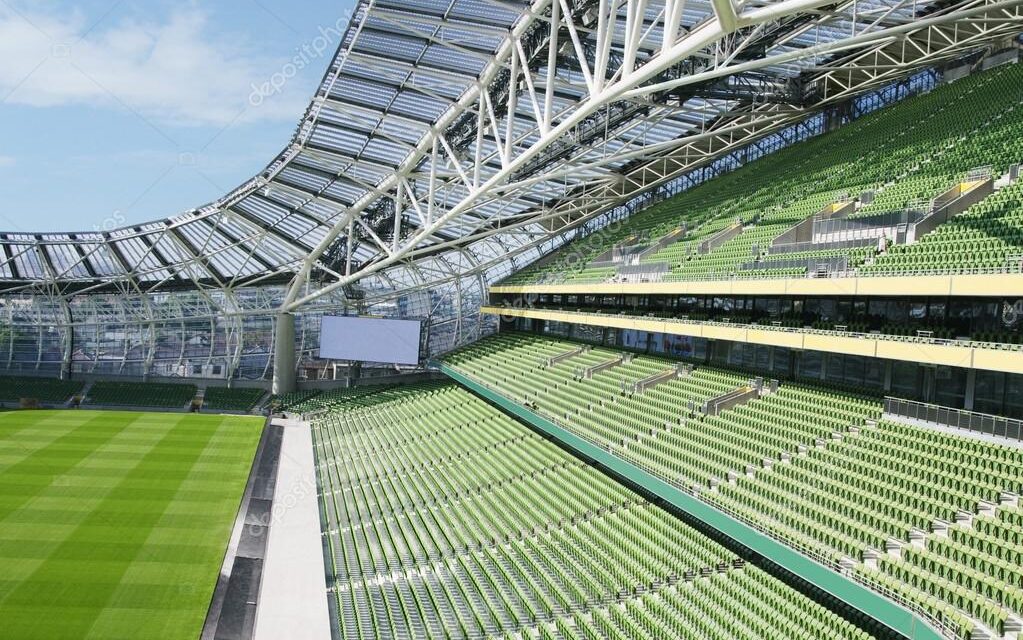
With both Government Sports Ministers saying they will not be attending, the FAI is between the proverbial rock and a hard place – how to manage the Republic of Ireland’s UEFA Nations League home fixture against Israel at the Aviva Stadium on October 4th, given both major political sensitivities and binding sporting obligations.
With the team in the spotlight this week ahead of this evening’s fixture against Qatar, pressure has been mounting from supporters, campaigners, political voices, and elements within football for the Association to take a stronger stance amid the ongoing conflict in Gaza.
Yet the reality facing the governing body is considerably more complicated than many public calls for a boycott acknowledge.
Absolutism is easy to get behind and has strong moral foundations. Nobody in their right mind can hear the Israeli Government spokespeople defend their actions on our radio stations and fail to have their blood boil in anger at what is being done in their name.
Omar El Akkad’s book “One Day Everyone Will Have Always Been Against This” is a damning indictment of how we all make small adjustments to feel right but fail to do what is ultimately right.
But we live collectively in a rules-based society, whether we accept that or not. Benjamin Netanyahu ignores the rules, Vladimir Putin ignores the rules, and Donald Trump ignores the rules. But if we all ignore the rules as a means of protest against others doing similar, then where is the end game?
This is not a friendly fixture that can be cancelled at will. It is a UEFA competition match, governed by tournament regulations and binding obligations that significantly limit the FAI’s room for manoeuvre.
At present, the Association appears committed to fulfilling the fixture while continuing to express political concern through UEFA channels. It is an uncomfortable middle ground, but it may also be the only realistic one available.
The FAI has already supported calls for Israel’s suspension from UEFA competition structures. That position aligned Ireland with a growing number of sporting and political voices internationally seeking greater sanctions against Israeli participation in international sport.
However, UEFA has shown no indication that such a suspension is forthcoming.
Unless UEFA changes its position, the FAI remains bound by competition regulations and by its own constitutional obligations as a member association.
Legal advice reportedly received by the Association indicates that a refusal to play could expose Irish football to sanctions, fines, and significant reputational damage within European football structures.
The idea of simply refusing to fulfil the fixture has a strong emotional appeal, but it would represent a major escalation with uncertain consequences.
Historically, UEFA and FIFA have taken a hard line against associations that fail to complete scheduled fixtures. Sporting penalties can range from forfeiture and fines to broader disciplinary action. At a time when the FAI is rebuilding relationships and credibility within European football governance, that risk is not insignificant.
With Dublin scheduled to host five games in the European Championships in 2028, and the qualification period for that tournament wrapped up with this very National League tournament, the potential consequences are raised to a much higher level.
Any sanctions affecting rankings, competition standing or future qualification pathways would carry genuine football consequences beyond the politics of the moment.
That does not mean the pressure disappears.
Far from it.
The closer the fixture moves, the greater the scrutiny is likely to become. Questions around supporter protests, player statements, sponsor positioning, security operations and political messaging will only intensify through the summer and into the autumn.
There remains the possibility that circumstances could change dramatically before October. Peace would be the ultimate positive change but a deterioration in the security environment or new government advice is perhaps more likely. That could result in a postponement, relocation or additional restrictions. But absent a major change, UEFA is unlikely to approve moving the fixture solely due to political opposition.
This ongoing situation highlights the FAI’s central dilemma: it must reconcile substantial pressure from segments of Irish public opinion opposed to hosting Israel with the strict obligations imposed by UEFA membership.
On one side sits a growing body of public opinion in Ireland that is deeply uncomfortable with hosting Israel during the current conflict. On the other hand, sits the practical reality of UEFA membership and the obligations that come with participation in international competition.
The most likely outcome may ultimately be an attempt to separate participation from endorsement.
That could involve humanitarian initiatives, symbolic gestures, anti-war messaging or broader engagement around the fixture that acknowledges the sensitivities involved without breaching UEFA regulations. Taking a fine for a political statement is easier than taking a ban for failing to fulfil a fixture.
Whether that satisfies anyone is doubtful.
For some, anything short of refusing to play will be viewed as a failure of principle. For others, fulfilling the fixture while maintaining political pressure on UEFA represents the only credible route open to the Association.
Staging a game behind closed doors may not be possible, but putting it on fans to boycott the game makes it a personal choice that everyone can support and no-one can blame the FAI for. It’s a financial hit, obviously, but there will be ways to lessen it.
Asking the media not to cover the football but to focus instead on the humanitarian issues that it raises increases the temperature on those engaged in acts of inhumanity.
The FAI General Assembly is reported to be considering an attempt to force the FAI not to play, but that again brings us back to the rules-based order in which we live, and how important that is in the face of bad-faith actors who ignore those rules. Do we win by doing the same, even if it is the morally right thing to do?
What is clear is that the FAI is operating within a far narrower set of options than public debate sometimes suggests.
This has never been simply a football decision. It is one that will be buffeted and barged one way and another by morality, diplomacy, governance and popular opinion — and whatever course is taken, criticism is inevitable.
 The FAI and the Department of Culture, Communications and Sport are full members of Sport for Business.
If you would like to be part of the Sport for Business community and see your organisation in our content, on our stages, and in the conversation happening every day around the commercial world of Irish Sport, email us today and let’s see what is possible.
Image Credit: Sport for Business
ABOUT SPORT FOR BUSINESS
Sport for Business is Ireland’s leading platform focused on the commercial, strategic and societal impact of sport. It connects decision-makers across governing bodies, clubs, brands, agencies, and public institutions through high-quality content, events, and insights.
Sport for Business explores how sport drives economic value, participation, inclusion and national identity, and how your story can be part of ours.
Through analysis, storytelling and convening the sector, it helps leaders understand trends, share best practice and make better-informed decisions. It positions sport not just as entertainment but as a vital contributor to Ireland’s social and economic fabric.
Find out more about becoming a member today.
Or sign up for our twice-daily bulletins to get a flavour of the material we cover.
Sign up for our News Bulletins here.