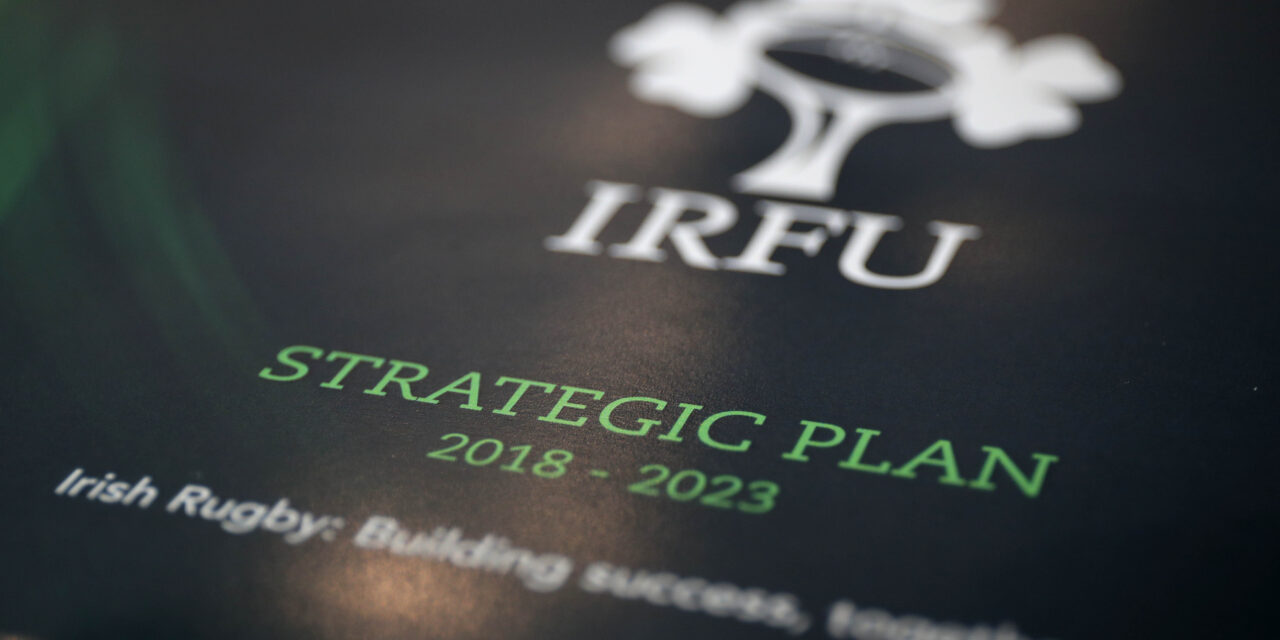
Irish Rugby has published a strategic plan for the next five years which gives special prominence to the development of the Women’s game.
The headline figures all relate to the international team’s performance but it is in the detail of club development and player pathways to widen the pyramid of players coming into the game that perhaps contains the greatest levels of lasting impact.
There is, of course, a link between success on the field of play at the highest level and encouragement of players but success can be fickle and it is in planning for when the trophies aren’t coming through the door every season that the greatest challenges lie.
The IRFU has targetted for the Men’s team to make it to the semi final stage of the World Cup in 2019 and 2023. It has also tagged the words ‘or better’ to that ambition in a statement that mirrors the rising expectation around Joe Schmidt’s side ahead of next year’s tournament.
Two or more Six Nations titles, two or more European titles and two or more PRO14 titles are also on the list of targets set out for those who currently hold the shirts at the highest level and while they are a stretch, as they should be, there is no reason to be any less ambitious.
Over the coming days we will look in detail at some of the levels of engagement being sought below the top level and at how the sustainable growth that is needed can be achieved.
Launching the plan in Dublin CEO Philip Browne recognised some of the challenges faced by the sport, not least in terms of funding in order to grow.
“The increased profile of rugby driven by on-field success has resulted in an increase in participation, especially through age-grade and the use of modified formats.”
“But of course we recognise the many challenges the game faces and we have sought to address these in this Strategic Plan as part of our effort to ensure the game, over the next five years and beyond, will be put on an even stronger footing for the generations to come.”
“The game continues to expand at every level and central to this expansion is funding. Currently, our professional teams, at national and provincial level, account for 93% of the game’s revenues, of this some 80% is generated by the men’s international team.”

“This stark statistic is reassuring and concerning in equal measure; the former as it recognises the phenomenal attraction of our senior international team to television rights holders, sponsors and supporters alike, while the latter highlights the extremely narrow base from which every other strand of the game must be funded.”
The tricky balancing act is starkly highlighted when looking at the expenditure which is made possible by that income. Only 16 percent goes directly towards the international teams that generate the 80 percent, with 39 percent going towards the Provincial structure, 14 percent towards the domestic game and 11 percent towards elite player development.
The full document runs to 40 pages and is an impressive laying out of the principles behind the targets as well as how the growth and sustainability can be created.
In terms of player numbers, the sport is looking at an overall 8 percent growth in registered numbers to 210,000 by 2023, catered for by a growth of 11 percent in teams from 1,706 to 1,900 over the same period.
Commenting on the performance goals outlined in the plan, IRFU Performance Director David Nucifora said: “The focus will be to drive alignment across the game and ensure the talent pathways feed the high performance side of the game with a particular emphasis on Sevens and the interface between clubs and schools and the professional game.”
“Key areas of focus will be further advancement of the player management programme, coach education, talent development, investment in research and data analytics and the recruitment and retention of world-leading experts across the range of high performance disciplines. The delivery of a world class high performance centre will be a key element in driving the performance goals targeted over the next five years.”
Over the coming days, we will look in detail at some of the levels of engagement being sought below the top level and at how the sustainable growth that is needed can be achieved.


Image Credit: Dan Sheridan, Inpho.ie