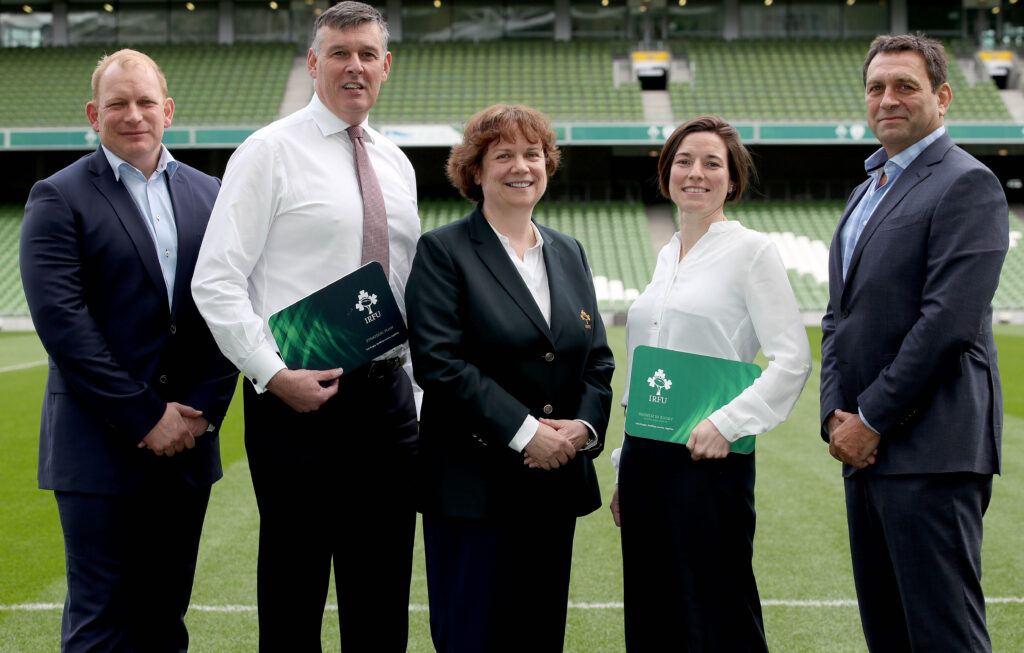
Women’s Rugby features as a major part of the IRFU’s Strategic Plan for the next five years with a set of ambitios targets laid out in relation to both performance and participation.
Women to the Fore in Rugby Strategy
The sport has achieved a high profile in recent years with the hosting of the Women’s Rugby World Cup, Grand Slam Success and a leading role in the major development of Women’s sport in an overall context.
It has not been without a few significant bumps in the road though. A poor performance at the World Cup exposed the low base of players from which to choose and some ill timed references with regard to coaching staff brought matters to a head.
The mark of a winning organisation though is to recognise where you have fallen down and take steps to rectify it.
A major review of all aspects of the Women’s game, led by Su Carty and Mary Quinn could have been seen as an exercise on containing criticism but ultimately fizzling out as attention shifted elsewhere.
The emphasis on the Women’s game and a specific action plan as part of the development of the sport over the next five years shows today that this was not the case.
Over the coming days we will look at the plan in detail but it is worth starting with the four principles that have underpinned the actions.
They are:
It is in that detail beyond the performance of the national team that the greatest gains can be made and in which there is genuine prospect of moving away from the strong ‘boys club’ appearance that has been a previous hallmark of the sport.
“To achieve our objectives for female rugby, we recognise the need to build from grassroots to create a sustainable model for the game,” said IRFU CEO Philip Browne who will himself sit on the Committee overseeing progress.
“This entails attracting more adult and young female players into the game and providing sustainable and accessible opportunities to play the game through both 15s and Sevens.”
“We aim to create a structured pathway which attracts young female players to club rugby where they can progress their rugby careers through Under-14, Under-16 and Under-18 levels towards the senior Women’s game,” added Mary Quinn, Chair of the IRFU Women’s Sub Committee, spoke about the creation of a female player pathway, stating:
“In schools we are committed to creating opportunities for female students to experience rugby through an Rugby7s and Sevens pathway.”
“Increased participation through a quality player development pathway that enables players to achieve their full potential. This, in turn, will support an increased flow of talent through the Women’s All-Ireland League and provincial panels into national squads.”
Speaking about driving competition at representative level and growing female participation in volunteerism and game administration Su Carty, IRFU World Rugby representative, added: “We aim to build depth to drive greater competition for representative places which will propel Ireland’s representative sides towards consistently strong performance levels on the international stage.
“We want to grow the number of female volunteers working in support of these programmes as coaches, referees, managers and administrators. Furthermore, we want this growth reflected in the governance of the game at club, provincial and national level.”
Join us in the coming days as we explore the plan in greater detail.


Image Credit: Morgan Treacy, Inpho.ie