The Irish Sports Monitor is an annual survey of more than 8,000 adults into their sporting and physical activity habits and engagement.
There is a wealth of data to absorb. We thought it would be useful to run a series over the coming days looking in specific detail at how the data relates to specific population cohorts and what it might mean for future policy development.
Today we focus on what the research says about Gender.
Spotlight on Gender – Sports participation
- Sport participation among women (46%) reached an all-time high, increasing by 6 percentage points since 2022 (40%). Sports participation among men (49%) increased by 4 percentage points (45%).
- The gender gap in sports participation narrowed to 3 percentage points, compared to 5 percentage points in 2022. The gap was previously at 3 percentage points in 2019.
- The three most popular sports were the same among men and women; personal exercise, swimming, and running. Personal exercise was the most popular sport, with similar participation levels among both men (17%) and women (18%). Swimming was more popular among women (9%) than men (7%), and conversely running was more popular among men (8%) than women (6%).
- For the first time participation rates in Gaelic Football were similar for men and women in 2023 (3%) whilst participation in soccer still remains much more common amongst men (7%) than women (1%).
- Over a third of both men (38%) and women (34%) participated in sport to a vigorous level of intensity (defined as an effort of activity enough to make you out of breath). This proportion increased among both groups compared to 2022 (Men 34%, Women 30%).
- Gyms and sports centres remained the most popular location for sports participation with 28% of both men and women using these facilities, marginally unchanged since 2022 (Men 28%, Women 29%). Almost one in five women (19%) participated in sport at home compared to 14% of men. Men (15%) were more likely than women (11%) to participate in sport at sports clubs.
- The percentage of both men (9%) and women (5%) taking part in their sport through organised competition increased since 2022 (from 7% and 3% respectively).
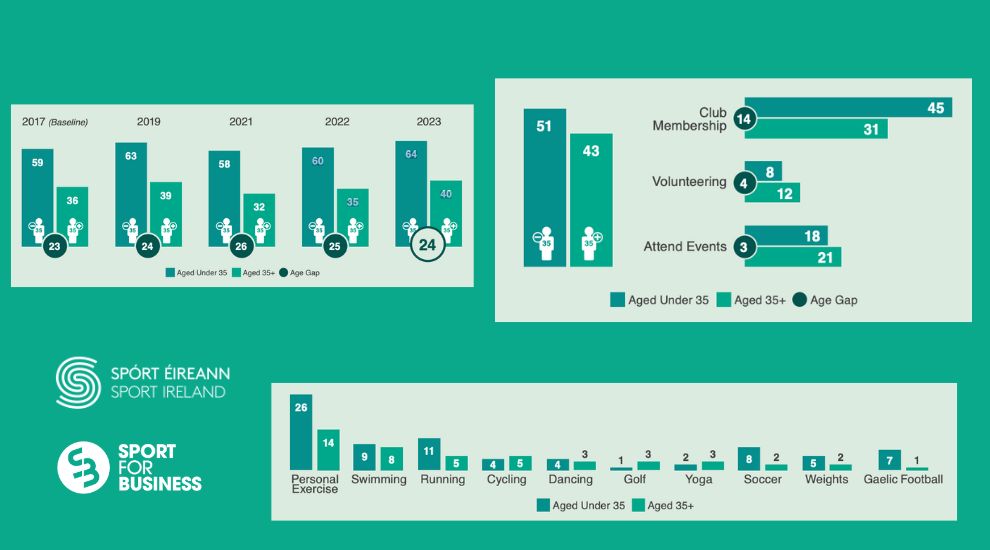
Spotlight on age – Social participation
- Half of all men (50%) and two in five women (41%) were involved socially in sport, an increase of 6 and 4 percentage points respectively since 2022 (Men 44%, Women 37%).
- Throughout the ISM series men have consistently been more likely than women to participate socially in sport. Despite the overall increase in social participation, the gender gap widened slightly to 9 percentage points, after narrowing to 7 percentage points in 2022. The gap remained narrower than 2019 (13 percentage points).
- Volunteering among men (12%) increased by 2 percentage points, while among women (9%) this figure remained broadly unchanged since 2022 (10% and 8% respectively).
- Among volunteers, 55% of men and 35% of women were involved in coaching roles, an increase of 5 percentage points among men and 6 percentage points among women since 2022 (Men 50%, Women 29%).
- Provision of transport was the most common role among women who volunteered (28%), compared to 13% of men.
- Gaelic football was the most common sport coached by both genders, accounting for 47% of activities coached by men and 34% of activities coached by women.
- Club membership rates increased among men (41%) and women (30%) since 2022 (37% and 27% respectively). However, men’s club membership levels remain behind 2019 (2019: men 43%, women 29%).
- Event attendance continued to grow by 3 percentage points among men (21%) and 2 percentage points among women (18%) since 2022 (Men 18%, Women 16%).
Spotlight on age – Broader physical activity
- The percentage of men (66%) and women (73%) walking for recreation has stabilised in the past year, although there was a slight rise in walking for recreation among men increasing by 2 percentage points (2022: Men 64%, Women 72%). This follows a decline of 5 percentage points among men and 6 percentage points among women between 2021 and 2022 after sharp increases were seen during the pandemic period.
- Across all age groups, women were more likely than men to walk for recreation, with the largest difference among those aged between 16 and 24 with 75% of women and 61% of men walking regularly.
- Walking for transport decreased among men (44%) and women (47%), following the increase that occurred in 2022 (Men 53%, Women 55%). The percentage of men and women walking for transport roughly returned to the level seen in 2019 (Men 43%, Women 46%).
- Men in many age groups were twice as likely as women to cycle for transport. Among those aged between 16 to 24, 18% of men and 9% of women cycled regularly for transport.
- For the first time in the ISM series, an equal proportion of men and women were classified as highly active (39%). This was due to a 4 percentage point increase in men who were highly active since 2022 (Men 35%, Women 38%)
- The percentage of highly active men increased across all age groups, but the widest increase was among older men. Around a third of men aged 65-74 (34%) and aged 75+ (32%) were highly active, an increase of 4 and 11 percentage points respectively since 2022. A notable increase of 9 percentage points was also seen among men aged 35-44 (40%) (2022: 31%).
Tomorrow’s spotlight will be on Socio-Economic Status
Sport for Business in partnership with Lidl Ireland and AIG will hold the 2024 Sport for Business Women in Sport Conference on Thursday, November 28th, one of ten events currently planned for the remainder of 2024.
Register your interest to attend a Sport for Business event here.
AIG, the Ladies Gaelic Football Association, TG4, Lidl and Future Proof Media are all full members of the Sport for Business Community.
The Sport for Business Membership comprises nearly 300 organisations including all the leading sports and sponsors, commercial and state agencies.
Find out more about joining us today.

Check out our upcoming events to discover ways of connecting in person with our membership.