We had the pleasure of spending time yesterday at the launch of a new research report from KPMG and the 30% Club KPMG, a long-time documenting Irish businesswomen’s attitudes toward the role that sport has played in their professional development.
The research, commissioned by KPMG and conducted by iReach, emphasises the importance of sport in the daily lives of Irish businesswomen.
The study was conducted entirely with key female decision-makers in businesses nationwide, with 75 percent of respondents citing that they have participated in sport at some level. This increases to 90 percent participation in sport for CEOs.
That tracks a 2015 survey published by ESPN which also highlighted that former athletes amongst women also attracted a seven percent lift in salary.
Having research specific to the Irish business environment is a valuable addition to our knowledge base and a strong commendation for the benefits of sport on a career as well as mental and physical wellbeing.
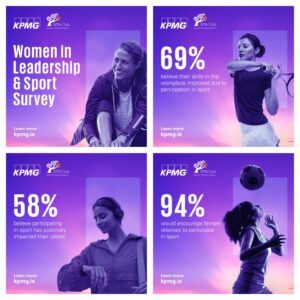
The research uncovered a wealth of interesting insights, with 88 percent of those surveyed believing that the skills they have learned through sport are transferable to the workplace, and 94 percent of women in business saying they would encourage a female relative to participate in sport.
It was launched at a gathering of female business leaders (and some male supporters but perhaps not enough) and the impact which the words of panelists Vera Pauw, Mary O’Connor, Sinéad Aherne, Sarah O’Connor, and Paul McCabe was profound.
We sat beside one senior director who decided on the spot that she was going to step from the sidelines of her daughter’s team to find a role in coaching and mentoring. It was empowering and when Vera Pauw came over to say hello after the event, she was visibly moved. It was a brilliant moment and one to which we shall return in time.
Mary O’Connor explained how she developed her strategic thinking through playing sports. She accepted she was never going to be the fastest but made up for that by reading the game ahead of her opponents. She channeled a famous football quote that “I may not be the fastest from A to B, but I don’t always start at A.”
Sinead Aherne paid tribute to the power of using sport as an icebreaker and a conversation starter with clients and colleagues in KPMG. She also highlighted that it was not easy to do everything at the top and there was no zen state of keeping everything spinning.
“I had pulled my hamstring in the All Ireland semi-final in the first year of Covid. We had four weeks to the final which is a tight turnaround and December when the final was being held behind closed doors is a busy time in the world of accountancy. I was doing physio at 6 AM, and spending time in the hyperbaric chamber to aid the rehab which worked because it had wifi and I was able to close a deal with much of the work done from there, three days before winning the All Ireland.”
It looks impressive and the power of sports to teach you resilience, teamwork, problem-solving and so much more is like the best combination of university learning.
Learning from sport and taking it into leadership is becoming more natural for women. The generation of young girls who will be inspired by the Republic of Ireland competing at the FIFA World Cup this year will play, work and live in a different world than those who have gone before but the work is only part-way done.
Vera Pauw highlighted that only ten of the 32 teams who have qualified for Australia and New Zealand are managed by Women, but that every major championship-winning team in the last decade has been led by a female coach.
We learned in the research that 44 percent of those who played did so in a team sport, 20 percent in an individual one, and 36 percent in both. It also emerged that 45 percent of senior management and 37 percent of CEOs were still playing active sport.
Teamwork was the skill most identified as transferrable from the playing arena to the business one, followed by confidence at 86 percent, communication at 74 percent, and leadership at 71 percent.
You can download the full report by clicking on the image below and it is worthwhile with other gems such as the percentage of those who actively look for sporting engagement on CV’s.
The publication of this research is an extension of KPMG’s ongoing commitment to the development, advancement, and empowerment of women’s sport in Ireland. Having previously supported the 20×20 campaign, KPMG has strived to create a #LevelGround between women’s and men’s sport through its continued support of the Dublin Ladies Gaelic Football Team, KPMG Women’s Irish Open, Leona Maguire and Rachael Blackmore.
Speaking about the release of the research, Rio Howley, partner in KPMG said: “KPMG is delighted to be involved in carrying out this research. We have seen first-hand the impact that sport has on the lives of women in this country through our sponsorship of the KPMG Women’s Irish Open in 2022 and previous Women in Sport initiatives like the 20×20 campaign. We are thrilled to see how sport has influenced the careers of so many women in business, and we hope that those who see these results will be encouraged to participate in sport – regardless of standard or level – so that they, too, can advance their careers and reach their full potential.”
Sport for Business Perspective:
This is a special report that will become common currency in the ongoing emphasis on the benefits of sport for women as well as the benefits for sport of having more women involved. It will be a key reference point for our Annual Women in Sport Conference to take place in May, in Partnership with Lidl, and in other exciting initiatives we have planned for this space as the journey continues.