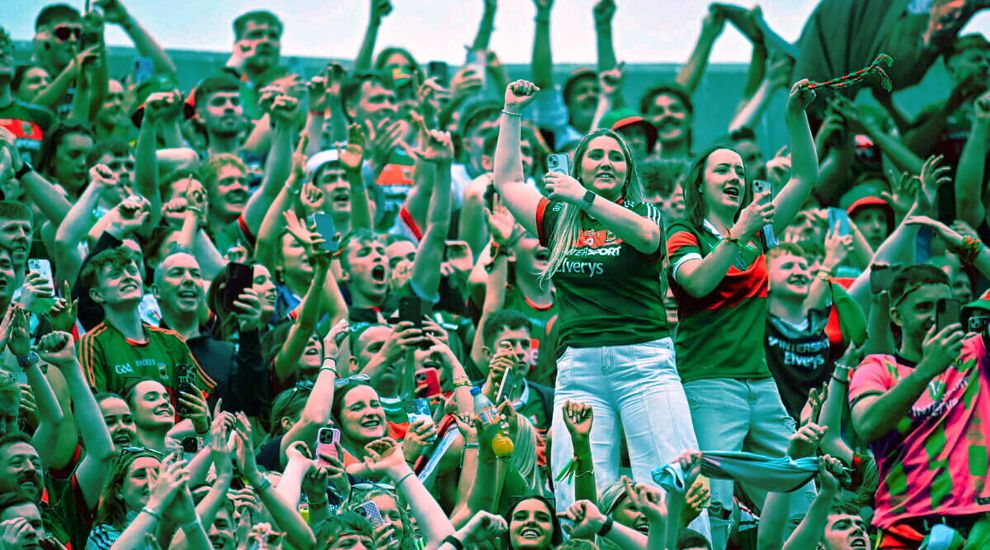
Mayo’s historic All-Ireland Football Final victory delivered one of the largest Irish television audiences of 2026, with an average of 944,000 viewers watching RTÉ’s live coverage from Croke Park.
The audience represented an extraordinary 82 per cent of everyone watching television at the time, illustrating the extent to which Mayo’s first Sam Maguire Cup success in 75 years became a genuine national moment.
Viewing peaked at 1.1 million at 5.11 pm as the closing seconds approached and the scale of what Mayo were about to achieve began to register around Croke Park and across the country.
There have also been 566,000 streams of the final on RTÉ Player to date. RTÉ’s social media coverage across the GAA Championship generated 6.7 million engagements, 86.4 million video views and 125 million content impressions.
Still Not Quite Matching the World Cup
The television figures place Mayo’s victory among the most-watched sporting occasions of a year that has also included the Republic of Ireland’s dramatic FIFA World Cup playoff, the World Cup itself and two All-Ireland Finals.
The most-watched sporting broadcast — and the most-watched television programme of 2026 so far — remains the Republic of Ireland’s FIFA World Cup playoff defeat to Czechia in Prague in March.
An average of 1.37 million viewers watched Ireland lose 4-3 on penalties after a 2-2 draw, representing 78 per cent of the available television audience.
Viewing peaked at 1.6 million as Czechia converted the decisive penalty, while the game generated 1,059,000 streams on RTÉ Player, setting a new record for a single event on the platform at the time.
Compared with that extraordinary audience, the Mayo final was 426,000 viewers lower on average, with a peak audience 500,000 below the Ireland game. The World Cup playoff also generated 493,000 more streams.
Mayo’s victory, however, surpassed the Czechia game in one significant measurement.
Its 82 per cent audience share was four percentage points higher than the 78 per cent recorded for Ireland’s playoff. The national football team drew the larger absolute audience, helped by a primetime slot and the possibility of World Cup qualification, but Mayo commanded a greater proportion of everyone watching television at that time.
The FIFA World Cup Final between Spain and Argentina was the second most-watched programme on Irish television this year.
RTÉ’s coverage attracted an average audience of 1.037 million, peaking at 1.16 million. It also generated more than 1.4 million streams on RTÉ Player, with the television audience representing a 65 per cent share.
Mayo’s television average was therefore 93,000 below the World Cup Final, while its peak was approximately 60,000 lower.
Once again, however, the audience-share comparison is striking. Mayo against Kerry secured an 82 per cent share, 17 percentage points higher than the World Cup Final.
The difference reflects the varying nature of the two events. The World Cup Final was a global sporting spectacle in a primetime slot, attracting substantial audiences across both television and streaming. The All-Ireland Final remained primarily a shared live television occasion, dominating the available Irish audience to an exceptional degree.
England’s meeting with Argentina averaged 949,000 viewers, only 5,000 more than Mayo against Kerry, but had an audience share of 60 per cent. Spain’s semi-final victory over France averaged 873,000 viewers and secured a 61 per cent share. The two games generated 985,000 and 1.03 million RTÉ Player streams respectively.
Across the tournament, RTÉ Player recorded 23.4 million streams, almost three times the 8.5 million achieved during the 2022 World Cup.
Streams measure individual plays rather than unique viewers and should not simply be added to average television audiences. They do, however, demonstrate how major international football increasingly generates substantial viewing away from the traditional television screen.
Ahead of Last Year’s Football Final
Mayo’s victory also delivered an increase on the audience for Kerry’s win over Donegal in the 2025 All-Ireland Football Final.
Last year’s final attracted an average television audience of 933,000, representing a 79 per cent share. Viewing peaked at 1.033 million, while the live programme, including Sunday Game Beo, generated 378,000 streams on RTÉ Player.
This year’s football final was therefore 11,000 viewers higher on average; three percentage points higher in audience share; approximately 67,000 higher at its television peak; and 188,000 streams ahead on RTÉ Player, an increase of almost 50 per cent.
The increase in the average television audience was relatively modest, but the rise in streaming, peak viewership and audience share demonstrates the additional interest generated by Mayo’s story.
Well Ahead of the Hurling Final
The football final also substantially outperformed the 2026 All-Ireland Hurling Final between Limerick and Galway.
An average of 778,000 viewers watched the hurling decider, with the television audience peaking at 862,000. The game also generated around 350,000 streams on RTÉ Player.
Mayo’s victory therefore delivered an average audience 166,000 higher than the hurling final, an increase of more than 21 per cent.
Its peak audience was almost 240,000 higher, while the RTÉ Player total was more than 200,000 streams ahead.
Some of the difference can be explained by the contrasting nature of the games. The one-sided conclusion to Limerick’s victory affected the hurling audience as the match progressed, while Mayo against Kerry retained tension, uncertainty and emotional power until the closing seconds.
RTÉ Across Every Platform
RTÉ’s coverage extended beyond the main television broadcast.
Joanne Cantwell was joined pitchside by Lee Keegan, Niall Morgan, Peter Canavan and Tomás Ó Sé, with Marty Morrissey and Éamonn Fitzmaurice providing commentary and Damian Lawlor reporting from Croke Park.
Pauric Lodge and Paul Flynn carried the final live on RTÉ Radio 1, while Sunday Game Beo provided full Irish-language coverage on the RTÉ News channel and RTÉ Player.
Gráinne McElwain was joined by Gary Brennan and Mícheál Ó Cróinín, with commentary from Garry Mac Donncha and Dara Ó Cinnéide. Conall Ó Ciobháin and Seán Ó Domhnaill led the coverage on RTÉ Raidió na Gaeltachta.
An average of 314,000 viewers later watched The Sunday Game, representing a 37 per cent audience share, with 71,500 streams on RTÉ Player.
Up for the Match – Live from Croke Park had attracted an average of 324,000 viewers on Saturday night, representing a 38 per cent share, alongside 57,000 streams.
“The Mayo victory — and the response to it — shows just how much our national games mean to us as a nation,” said RTÉ Head of Sport Declan McBennett.
“On television, on RTÉ Player, on radio, online and on social, RTÉ’s coverage was exceptional across the board and a compelling example of the enduring role of public service media.
“The hurling fed our passion this year, and football rediscovered its soul. RTÉ captured every moment and served the nation brilliantly.”
A National Moment
The World Cup playoff drew the biggest crowd, but Mayo’s victory came closest to stopping the entire country.
Those final seconds in Croke Park were watched by generations who had carried the hope, hurt and history of Mayo football. Marty Morrissey and Pauric Lodge found the words to capture the emotion across television and radio, while the images of players, families and supporters provided the latest addition to Ireland’s archive of unforgettable sporting moments.
The audience figures confirm that the occasion extended far beyond the county itself.
Ireland stopped to watch — and Mayo finally got to celebrate; they are still celebrating, and the rest of us are still on a high from watching their joy unfold. That’s the power of sport.



 The GAA and Athletics Ireland are full members of Sport for Business.
If you would like to be part of the Sport for Business community and see your organisation in our content, on our stages, and in the conversation happening every day around the commercial world of Irish Sport, email us today and let’s see what is possible.
Image Credit: GAA and Sportsfile

ABOUT SPORT FOR BUSINESS
Sport for Business is Ireland’s leading platform focused on the commercial, strategic and societal impact of sport. It connects decision-makers across governing bodies, clubs, brands, agencies, and public institutions through high-quality content, events, and insights.
Sport for Business explores how sport drives economic value, participation, inclusion and national identity, and how your story can be part of ours.
Through analysis, storytelling and convening the sector, it helps leaders understand trends, share best practices, and make better-informed decisions. It positions sport not just as entertainment but as a vital contributor to Ireland’s social and economic fabric.
Find out more about becoming a member today.
Or sign up for our Daily Sport for Business Snapshot email bulletins to get a flavour of the material we cover.
Sign up for our News Bulletins here.