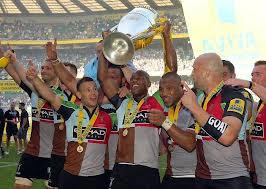
 The power struggle between clubs and unions in rugby ramped up considerably yesterday as both European Rugby Cup Limited and the English clubs competing in the Aviva Premiership announced major new TV deals. A board meeting of ERC scheduled for next week will need to clarify an apparent clash with both Sky and BT Vision claiming now to have exclusive rights to broadcast European games played by the English clubs.
It was a day of high drama in the sport. First came the surprise announcement in London that Premiership Rugby and BT Vision had signed one of the biggest broadcast deals in the history of club rugby. The deal to show 69 matches per season from the Aviva Premiership, all matches in the JP Morgan Asset Management Sevens and all matches of Aviva Premiership teams in any future European tournaments is worth £152 million (€190 million). Coverage on the new network will start from the beginning of next season for domestic games and the season after for the European competition.
Then, in a fresh twist last night, European Rugby Cup and Sky announced a four year extension to their exclusive rights to broadcast live matches from the Heineken Cup and Amlin Cup. The finals of both of those competitions will take place in Dublin next year.
Sky have been established broadcasters of club as well as international rugby for the past number of years though some games have been sold to ESPN over the last two seasons. The original deal between Sky and English Rugby dates back to 1994, only two years shortof the relationship between the broadcaster and the Barclays Premier League.
The new kid on the block signalled its intent by bidding £738 million (€920 million) for 32 Premier League games a year in each of three seasons.
Despite such massive buys however, including exclusive rights to the French Top 14 rugby scene as well, BT have not as yet got a platform to show them on.
Speaking to Sport for Business last night a BT spokesperson said ““BT will confirm its distribution plans for the channel in time. However our aim is to distribute the content as widely as possible.”
In Ireland as well as Britain this will mean going on to Sky, UPC, Virgin media and others as additional premium content. Sky dominates this arena and it is an expensive gamble that people will pay again for sporting content. One clearly though that BT Vision believes is worthwhile as it expands its own bundles of phone, broadband and broadcast entertainment from a current subscriber base of only around 700,000.
“BT is delighted to have secured this deal. Rugby Union is entering a thrilling phase with the World Cup being staged here in 2015 and rugby returning to the Olympics in 2016,’ said Marc Watson, BT Vision CEO.
‘We plan to bring the excitement of the very best matches to as wide an audience as possible. We will also be bringing all of the action together in one place and will look to distribute it on a variety of platforms.’
An attractive part of the new deal is the commitment to upgrade infrastructure in each of the club grounds, a point covered in last week’s Sport for Business Round Table on Technology and Sport; as well as an investment in school and community programmes. It is also a 50% increase on the previous deal.
Premiership Rugby’s Mark McCaffery was at great pains to point out that this deal would be good for all clubs competing in rugby across Europe, including the Irish clubs and provinces.
“I want to emphasise that our objective is to remain in the Heineken Cup,” he said. “The television deal we have agreed with BT will increase the size of the pot for everyone in Europe. What we want is to increase the size of the cake rather than argue about slices.
“We are ambitious for rugby in Europe. We do not want to go down the Anglo‑French Cup route, but if nothing changes it is something we would have to do. We have come up with a financial solution and now we have to get a rugby one.”
Tuesday’s board meeting of European Cup Rugby is bound to be fractious. The key element of the new contract is the exclusive rights to ‘future’ European games. This indicates that English clubs, who have long resented the dominance particularly of Irish teams in the Heineken Cup will now have a financial as well as a rugby incentive to negotiate hard, or walk away.
Whatever happens at the meeting, the rugby landscape has changed dramatically with clubs now, as they do in soccer, holding a very strong hand over the traditional power base of the governing associations.
View all the latest news on the commercial side of Irish sport
Find out more about how Sport for Business can be of benefit to you
Subscribe today for the free Sport for Business daily news digest
Rugby on collision course