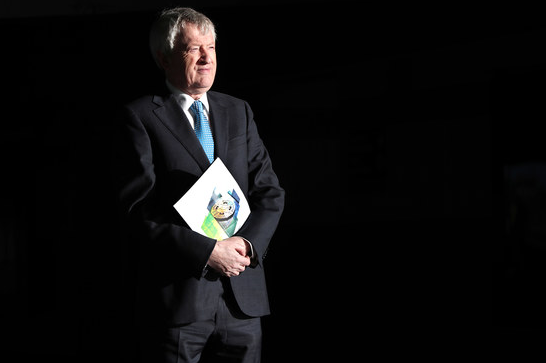
 Yesterday in Croke Park, Director General of the GAA Paraic Duffy delivered his eleventh and final Annual Report on the workings and activities of the Association.
Elsewhere this morning we look at ten distinct themes and points to arise from the report which runs to over 70 pages and is a good annual snapshot of where the world of Gaelic Games has come from over the past twelve months and is heading in the coming years.
Because it was the final roundup, the end of an era of great change and massive advances, there is perhaps more much to be gained from reproducing Duffy’s conclusion to the report.
Sport rolls on. His successor will be appointed in the coming weeks and a new head will wrestle with the challenges and opportunities that come from heading up Ireland’s largest sporting and indeed social organisation.
It is though worth pausing a moment and looking at how Duffy himself sees what has been a decade at the top…
“History teaches us that many epochs have considered theirs to be the time when things were changing more quickly than ever before. But one wonders if there has ever been a time when tradition – and culture – changing advances occurred at the furious pace that they do today.
New technologies arrive at a tempo we can barely keep up with, leaving governments, organisations and individuals with the feeling that they are no longer leading things but simply trying to catch up with them.
We sense this most in communications, where the extraordinary expansion in methods of communication allows anyone who so desires to become a public commentator, analyst, critic, pundit.
One aspect of this is the greater degree of scrutiny to which public organisations are exposed, which in turn has led to an unrelenting pressure on them to meet higher standards of competence, governance, ethics and good practice.
A good deal of what the GAA does, and a good deal of the time we spend and of the initiatives we undertake, is a consequence of the higher standards that society demands of its public bodies. This is all to the good.
Yet it does have significant implications for the operation of the Association at all levels.
It is important that our members understand this, as it may well explain what may seem to some or many of them to be an increasing and unnecessary bureaucracy imposed on them from Croke Park.
An obvious example of this is the obligation on the GAA to comply with the laws of the land. One thinks of the General Data Protection Regulation (GDPR) or the vetting requirements where child protection is concerned.
Complying with such legislation substantially increases the workload on our volunteers, and particularly at club level where the burden is likely to fall on fewer people.
Another example of an external expectation we must meet (but which is also an internal obligation we wish to place on ourselves) is that of good governance, in other words, ensuring that our affairs, at all levels of the Association, are well and efficiently managed. Hence our new Governance Guide for our officers, but hence, too, more work for these officers.
The purists like to ignore such vulgar considerations, convinced, for example, that the GAA has piles of money to throw around, or that, for example, it should not try to get a fair price for its broadcast rights.
And these new external pressures are in addition to the already considerable demands on volunteers inherent in the day-to-day task of running a club, such as the permanent effort they make to raise funds, both to meet the club’s running costs (repairs and maintenance, insurance, payments to the injury scheme) and to develop the club’s facilities.
The concern here is that this increasing workload will deter volunteers (if it is not already doing so) and precisely at a time when, for the reasons just outlined, we need more volunteers.
We can be greatly encouraged by the motivation clearly visible in GAA units, for example to improve their facilities, but we must be aware that there is only so much we can ask or expect of our volunteers.
Elsewhere, we can never escape the constant pressure in the area of finances.
The purists like to ignore such vulgar considerations, convinced, for example, that the GAA has piles of money to throw around, or that, for example, it should not try to get a fair price for its broadcast rights. But the GAA has to meet the financial challenge of, among many other things, improving provincial, county and club grounds and facilities.
A successful Rugby World Cup bid would have provided funding to improve several major grounds, including Fitzgerald Stadium, Killarney and Pearse Stadium, Galway. But this was not to be.
So, the task for Central Council remains as exacting as ever: to find the funds to keep our stadiums and grounds infrastructure in a modern and attractive condition, an essential requirement in the marketing of our games as we seek to increase match-attendance levels, to encourage people to attend matches and not simply watch them on television.
Other ongoing issues that I find myself mentioning in every recent Annual Report have not gone away.
I will only note them here as they are so familiar to us by now: rural depopulation and decline, and the parallel trend of urban growth; improvement of match officiating; the retention of young players; the strengthening of our presence in schools.
Our approach to dealing with these issues will be outlined in the Association’s new strategic plan, to cover the years 2018-2020, which is currently in preparation.
2017 brought to the forefront a problem that we could not have envisaged a relatively short time ago: we still cannot be certain that there will not be a hard Brexit, an outcome that would make life so much more difficult for our players and supporters.
The GAA is a 32-county organisation; the return to a hard border would be problematic, and particularly onerous for the GAA community in Ulster.
On another front, we will need to continue to invest in IT. The technology area can often seem to be a double-edged sword. We marvel at and benefit from what technology allows us to do, yet at the back of our minds is the thought that, because so much more can now be done, so much more must be done.
But a primary goal of the IT investment in the GAA is to make life easier for and to protect our volunteers in the roles they carry out, by reducing the amount of time and money they spend on administration.
The IT dimension of our activities reminds us that the world around us demands that we be modern and that the GAA be in tune with the expectations of the society and culture within which it operates.
All the above, itemised as they are here, may seem to reduce our daily efforts to a painful graft of problem solving. But all it takes to dissolve this false idea is to think for an instant about what we know the experience of our work in the GAA to be truly about, and why we carry on undeterred.
“The GAA is nothing if not a means of bringing individuals together to function better as a community. Has it ever been more important than now to do so?”
Problems are many, yes, and must be tackled, but these are all part of the task we willingly undertake to make the GAA better, and to make it better where the GAA makes its most telling contribution, namely in our local communities.
The Healthy Club project is an inspiring example of this. This initiative is not about winning matches and titles, but about addressing the health and wellbeing of the wider community; it is not about learning how to shoot with the outside of the foot or to score from a sideline cut, but is all about emotional wellbeing, physical activity for non-playing members, healthy eating, smoke-free clubs, gambling, drug, and alcohol education, and community engagement and development.
GAA clubs grow out of communities; it is right that clubs close the circle and come back to look after their communities.
It has never been easier to blank out one’s immediate physical surroundings. For some, reality isn’t as enticing and awe-inspiring as virtual reality.
Others prefer to communicate with their mobile device rather than with people. Tweets replace discussion, Facebook replaces conversation.
We have all probably had the experience of looking around us to see the four or five people in our immediate vicinity staring into a screen, oblivious to the real world of people and things around them.
In important ways, new technologies cater to and incentivise the individual rather than the community experience. Added to this threat to community is the decline of Irish rural communities created by our economic policies and structures, which bring new jobs mostly to large urban areas.
The devastation – the word is not too strong – caused to small Irish towns and villages by our economic model seems, unhappily, to be considered an acceptable price to pay in the pursuit of greater national goals.
So where, then, does that leave the notion of community, and rural Irish communities in particular? Rural Ireland is learning that the help it needs is unlikely to come from outside.
But the localist, community and environmental movements have shown that the best terrain on which to fight back is right where you live.
There is where you can make a difference, there is where your contribution truly counts.
And in making that contribution, you are doing so with your neighbours and friends in the common goal of making your local area a better place in which to live.
When I think of the GAA, and of my life in it, I end up thinking of people, and of people working together. The GAA is nothing if not a means of bringing individuals together to function better as a community. Has it ever been more important than now to do so? Is this not a valuable contribution to make? And is this not why we are all in the GAA?
Powerful words and a reminder that what we have in sport is special but needs to be managed for the good of all. That is not an easy challenge to meet but what of anything that was worthwhile was ever that.
Farewell Paraic, thank you for your service.
Ask us today for a bespoke quote on Sport for Business membership for your organisation and let’s see what we can do together with these great organisations