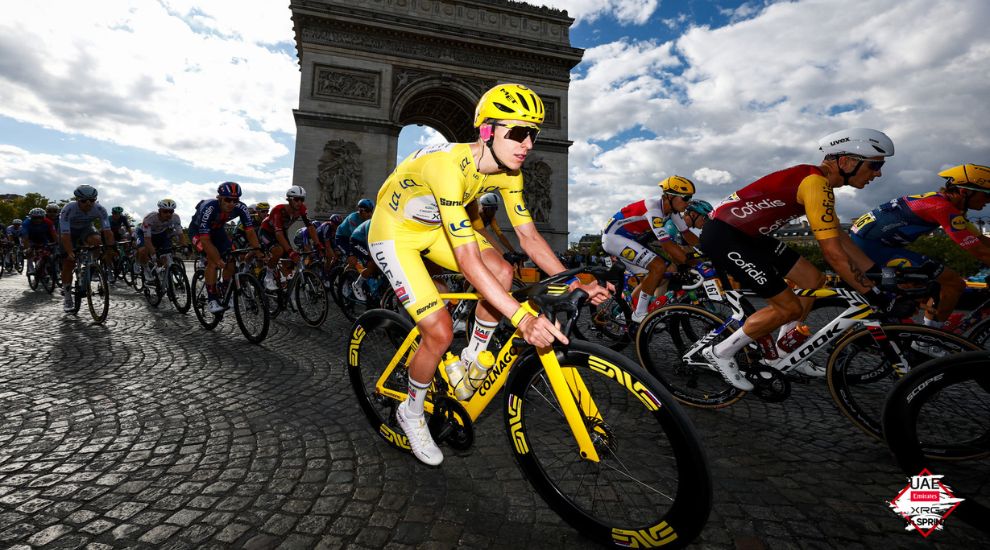
Tadej Pogačar’s fifth Tour de France victory was built not only on exceptional power but on an extraordinary ability to absorb effort, recover and produce it again the following day.
New data released by WHOOP following the Slovenian’s record-equalling triumph provides a rare look inside the sleep, strain and physiological stability behind one of cycling’s most dominant performances.
Pogačar completed the 2026 Tour with five stage victories and a winning margin of 6 minutes and 26 seconds over Remco Evenepoel. It was his third consecutive Tour success and fifth in seven years, bringing him level with Jacques Anquetil, Eddy Merckx, Bernard Hinault and Miguel Induráin at the top of the all-time list.
WHOOP analysed approximately 1,400 nights of data collected from Pogačar and six of his UAE Team Emirates-XRG teammates.
The analysis compared his numbers with those of ordinary WHOOP members, his own teammates and his personal physiological trends through the final preparation period, taper and three weeks of the Tour.
The central finding was that Pogačar did not begin with a dramatically superior physiological baseline to the other elite riders around him.
His greatest advantage appeared to be the speed and scale of his response to reduced training, followed by an ability to keep his physiology remarkably stable while the accumulated strain of the Tour increased.
Following the Tour de Suisse, his WHOOP Recovery score had fallen to 43 per cent, with heart-rate variability of 88 milliseconds. By the beginning of the Tour, that had rebounded to a 78 per cent Recovery, HRV of 121 milliseconds and a resting heart rate of 38.2 beats per minute.
According to WHOOP, Pogačar’s Recovery increased by 79 per cent during the taper period. The next-strongest response among teammates completing the same programme was 44 per cent.
That suggests that the important difference may not simply be how fit Pogačar becomes, but how effectively his body responds when training stress is removed.
The Value of Consistency
Perhaps the most revealing measurement was his day-to-day HRV variability.
Pogačar recorded variability of 13.4 per cent during the Tour, compared with a teammate average of 19.4 per cent. In simple terms, his physiological condition fluctuated less from one day to the next.
WHOOP and UAE Team Emirates-XRG describe that quality as durability: the ability to continue producing close to peak power after hours of racing and several days of accumulated fatigue.
UAE Team Emirates-XRG Head of Performance Dr Jeroen Swart has described Pogačar as having an exceptional ability to recover, enabling him to repeat workloads that can leave other riders significantly depleted. The team combines wearable information with power data, heart-rate response, blood testing, medical information and the riders’ own wellness reports.
The numbers also underline the importance of sleep during competition.
Pogačar increased his average sleep from 6.9 hours during his taper to 8.1 hours during the Tour, recording an average WHOOP Sleep Performance score of 88 per cent.
Even after one heavily disrupted night in which he slept for only four hours, he returned a 62 per cent Recovery score the following morning.
By July 25, he had recorded only one red Recovery day during the entire Tour, while maintaining an average resting heart rate of 42 beats per minute.
The Work Behind the Stage Victories
The data also provides context for what Pogačar was asking his body to produce.
On stages he won, WHOOP calculated that he completed an average of 89 minutes of work above his physiological threshold. Teammates riding the same route averaged 34 minutes.
That represents approximately 2.6 times more high-intensity work.
His fifth stage win came on Alpe d’Huez, where he completed the ascent in a record 35 minutes and 26 seconds before carrying the yellow jersey safely through the final weekend.
The significance of the WHOOP numbers is not that they uncover one secret metric explaining Pogačar’s supremacy.
Instead, they show how the different components of elite performance connect: training load, tapering, sleep, recovery, fuelling, reduced decision-making away from the bike and the ability to remain stable when the competitive environment becomes increasingly unstable.
Sport for Business Perspective
For WHOOP, this is also a powerful demonstration of what a modern performance partnership can deliver.
The company became the Official Health and Performance Wearable of UAE Team Emirates-XRG under a two-year agreement announced earlier this year. The partnership was designed not only to support team decision-making but to create broadcast, digital and social content explaining the physiological demands of professional cycling.
That turns sponsorship from logo exposure into proprietary storytelling.
WHOOP can use Pogačar’s performance to explain its Recovery, Strain, Sleep, and HRV measurements in a setting understood by millions of fans. UAE Team Emirates-XRG gains another layer of insight into its riders, while broadcasters and supporters receive information that makes the physical demands of the Tour more visible.
The figures are WHOOP’s analysis of data produced through its own platform rather than an independent scientific study. Even so, they provide a compelling view of where the margins at the highest level may now be found.
Pogačar’s advantage was not merely that he could go harder.
It was that, across three weeks, he could recover more quickly, vary less and keep going hard when everyone around him was becoming progressively less capable of doing the same.


 Whoop and Cycling Ireland are full members of Sport for Business.
If you would like to be part of the Sport for Business community and see your organisation in our content, on our stages, and in the conversation happening every day around the commercial world of Irish Sport, email us today and let’s see what is possible.
Image Credit: Whoop and UAE Team Emirates – XRG

ABOUT SPORT FOR BUSINESS
Sport for Business is Ireland’s leading platform focused on the commercial, strategic and societal impact of sport. It connects decision-makers across governing bodies, clubs, brands, agencies, and public institutions through high-quality content, events, and insights.
Sport for Business explores how sport drives economic value, participation, inclusion and national identity, and how your story can be part of ours.
Through analysis, storytelling and convening the sector, it helps leaders understand trends, share best practices, and make better-informed decisions. It positions sport not just as entertainment but as a vital contributor to Ireland’s social and economic fabric.
Find out more about becoming a member today.
Or sign up for our Daily Sport for Business Snapshot email bulletins to get a flavour of the material we cover.
Sign up for our News Bulletins here.