Analysis of Committee Recommendations on Alcohol and Sport
Central funding on abuse education from sponsorship levy?
 Is it best to levy sponsorship income centrally in order to fund education programmes?
Last week the Oireachtas Committee investigating a proposed ban on alcohol sponsorship of sport ruled against the merit of a ban, suggesting a number of alternative measures in its place.
Day by day we are considering each of those recommendations, the basis on which it is made, how it might be put into practice and how it might have been put in place elsewhere around the world.
Today: A fixed percentage of all sponsorship received by each and every organisation (sporting, cultural, arts, music etc.) from the alcohol drinks industry, should be ring-fenced and paid into a central fund to be administered by an appropriate body. That fund should be used exclusively for Alcohol and Substance Abuse Prevention Programmes.
Levies are a popular tool within Governments for finding money to tackle particular issues. We have seen it in Ireland over the past decade with levies on personal taxes that people are familiar with, but nevertheless resistant to.
The proposal contained in the report suggests a fixed percentage be set aside centrally for programmes to tackle abuse.
It does not pin a number on what that percentage might be but look at the possibilities and see where it may have to be around.
A one per cent levy on the money that goes into sporting sponsorship from the alcohol industry would yield €350,000. That is across all sports. The Committee recommends that this be administered centrally which suggests an additional layer of management that would absorb most of that just in setting it up.
In order to get to €1 million the percentage figure would need to be over 3%.
In 2012 alone the GAA spent €2 million on initiatives and programmes relating to player welfare, outside of the injury fund.
Among the largest of these programmes was the ASAP which was developed and introduced in 2008 and is now an embedded part of every provincial and county unit within the largest sport in the country.
The programme was praised by the committee for its relevance and impact and should become a template for how programmes are rolled out.
At its heart is the idea that a coach has an influential role to play in the life of any young adult crossing the boundaries at which alcohol and drugs become a part of the life challenges they face.
The strength of ASAP as it is administered across Gaelic Games though is that it does not isolate teens as being a ‘special case’ for alcohol education but goes beyond that to involve whole clubs.
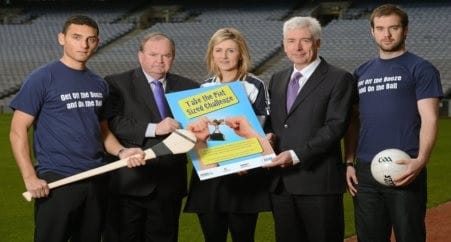
For the last two years January was a focus for ‘Off the Booze, On the Ball’ a programme which encouraged all club members to abstain from drink in January and went beyond that by encouraging all the non playing members of a club to get active in some form of fitness as well.
Tackling alcohol without placing it in the context of an overall healthy lifestyle is less likely to succeed and yet the idea of a levy may place it squarely in a particular category and cut off the more inclusive ways education can be most effective.
The recommendation is that the levy be centrally applied and programmes delivered across all forms of alcohol sponsorship from sport to music and the arts.
Again the idea of managing the return from that centrally suggests a ‘one size fits all’ approach to the education it would pay for.
This would also serve to lessen the impact because the most effective forms of peer education are those that are most relevant to the individual.
If the net is cast too wide and too thin it will not be as effective.
There is in any case an existing set up for the use of alcohol industry money, bolstered by philanthropic and other sources to provide education. Drinkaware was set up in Britain and Ireland in 2007 and receives about 20% of its funding in the UK from the drinks industry, likely a higher proportion here.
The establishment of a separate fund would run the risk of seeing this initiative replaced, and the responsibility shifting from the alcohol industry as a whole within society to a more specific smaller group within the area of sponsorship.
It is our view that the continued commitment to welfare and wellbeing of members of sporting bodies is best served through developing existing programmes, increasing funding to them and enabling best practice to be developed and applied.
There is little to be gained from tearing up an existing model and creating more administration and less execution.
Catch up with the rest of this series
Day One: Sponsorship by the Alcohol Drinks Industry should remain in place until such time as it can be replaced by other identifiable streams of comparable funding.
Day Two: A Code of Practice for the consumption of alcohol within stadia should be drawn- up by all sporting organisations.
Today: A fixed percentage of all sponsorship received by each and every organisation (sporting, cultural, arts, music etc.) from the alcohol drinks industry, should be ring-fenced and paid into a central fund to be administered by an appropriate body. That fund should be used exclusively for Alcohol and Substance Abuse Prevention Programmes.
Tuesday: Sponsorship of sports and sporting events should be treated in the same way as sponsorship of the arts, music and other festivals.
Wednesday: A Code should be introduced to make it mandatory for all brand owners and rights-holders to provide responsible training in selling, advertising and marketing and to promote responsible drinking at all sponsored events.
Thursday: All sporting organisations should be encouraged to support programmes which contribute to social inclusion in order to reduce the abuse of alcohol, particularly among young people.
Friday: A prohibition on sponsorship by the alcohol industry should only be considered if it is done on a pan-European basis in order to ensure that Irish sports and sporting organisations are not operating at a disadvantage relative to their international competitors.
The Committee report can be downloaded here
 Follow our coverage of the Alcohol and Sport debate
Join us for our Sports Tourism Seminar in September
Sign up for our Free Daily News Digest
Funding Alcohol Awareness