Welcome to the twelfth article in our Sports Economy series where today we take a look at the economic impact of Covid on youth unemployment in the sport sector.
Employment has been severely damaged by the Pandemic but the impact has been unequal across the different sectors and groups of the economy with Sport and young people among those disproportionately negatively affected.
This article presents the latest CSO labour statistics for Ireland showing the impact of Covid-19 related restrictions and examines youth unemployment in the context of Irish Sport.
Economic output (GDP) and employment in 2020
In the initial months of the pandemic Irish economic output for 2020 was predicted to decline substantially. Expectations improved thereafter and by Budget time in October, the decline for 2020 was expected to only be about 2%.
The recent March 2021 CSO data release, however, revealed that national output or Gross Domestic Product in fact increased by 3.4% in 2020. This is surprising because lockdowns were imposed, numbers on the Pandemic Unemployment Payment increased to hundreds of thousands, and sectors such as aviation, arts, hospitality and sport were devastated.
Looking at it another way, average employment levels in 2020 were 15% lower versus 2019 using the Covid-adjusted measure, but total output for 2020 was higher! This divergence needs to be explained before we look at sport and national unemployment data.
Gross Domestic Product is a scorecard of a country’s economic output and is a formula of ‘Consumption’ plus ‘Investment’ plus ‘Government Spending’ plus ‘Exports’ minus ‘Imports.’
Domestic consumption declined by 9.0% in volume in 2020 in Ireland. The decrease in the use of goods and services by households badly hit hospitality, sports and entertainment. Investment declined substantially by 32.3% but Government expenditure increased by 9.8%, financed by borrowing.
Exports, mainly from multinationals, did well increasing by 6.2% in volume and imports decreased by 11.3%. In fact, exports of medical and pharmaceutical products increased by 25.4% to €62.1 billion in value in 2020. When all of these are factored together it shows an overall increase in national output.
The export sectors that did very well had high levels of productivity whereas the sectors with large output declines were jobs intensive. Measures like Gross Domestic Product or Gross Value Added often don’t tell the whole story. For example, solely in terms of economic output one job in pharmaceuticals manufacturing can be equivalent to many jobs in hospitality or sport but and the impact of sport for example on society goes far beyond its direct and indirect economic contribution.
The youth unemployment crisis
The CSO reported that as of March 2021 unemployment in Ireland was 5.4% on the pre-Covid methodology. However, if all claimants of the Pandemic Unemployment Payment were classified as unemployed the unemployment rate would rise to 24.2%. Age-specific data from the CSO shows that on the Covid-adjusted measure of unemployment, the unemployment rate for those aged 15-24 years was a staggering 59.2%, 54.0% for males and 64.7% for females. Almost six of every ten persons aged from 15 to 24 years are unemployed where the Covid-adjusted unemployment rate for those aged 25 to 74 years in March 2021 was 20.3%.
Update on sport employment performance
The CSO’s monthly unemployment numbers are only available at a high level. For sector information, the CSO’s Labour Force Survey (LFS) is available at the end of each quarter, the latest refers to quarter four 2020 and was published in February 2021. The LFS’s detailed version of their quarterly series, in which data for sport is available, have not yet been published for Q4 but were made available for this article by the CSO on request.
Sports activities, amusements and recreation activities are classified together by the LFS and employment for this category dropped from 31,300 in Q4 2019 to 20,000 in Q4 2020. Sport is the dominant part of this classification. Using a method outlined in a previous article to calculate a sport only figure, we can estimate that at the beginning of 2020 27,500 people were employed in Irish sport. Within twelve months the number had fallen to 17,600, a drop of just under 10,000 or 36%.
How has sport fared vs other sub-sectors?
Ten Worst Hit Irish Sectors, % Decline in employment Q4 2019 to Q4 2020
1 Travel agency and related activities -51.69%
2 Security and investigation activities -38.61%
3 Office administrative & office support -38.12%
4 Sports, amusement and recreation activities -36.10%
5 Accommodation -28.89%
6 Warehousing / support activities for transport -27.70%
7 Repair / installation of machinery / equipment -26.76%
8 Food and beverage service activities -24.40%
9 Rental and leasing activities -22.14%
10 Manufacture of furniture -21.62%
Source: Labour Force Survey, CSO, Feb 2021, Q4 2020 numbers
Sport with a decrease of -36% in employment, has been the 4th most affected economic activity measured by the Labour Force Survey in 2020. These numbers confirm what is intuitively to be expected from the prohibition of crowds at elite sports and the cessation of most non-elite sports activities that sport, given its unique characteristics, is one of the sectors most susceptible to the negative effects of the pandemic.
I must acknowledge a measurement difficulty in definitively estimating the impact of Covid on employment levels. Not only does survey data always carry with it a margin of error but there are currently issues interpreting the LFS data. For example, someone who is temporarily not employed due to Covid closure could still consider her/his self as employed but just temporarily not in that job. Hence the figures are subject to interpretation as opposed to an unambiguous statement of trend.
Sport Employment Demographics
As noted above, according to the CSO, as of March 2021, national unemployment among the 15-24 age bracket was 59.2% on the Covid-adjusted basis.
Unemployment, if it is long term in nature (i.e. 12 months or more) can affect young people more significantly than other age groups. The negative implications include decreases in life satisfaction and optimism about the future and the increased risk of social exclusion and mental health problems.
Given that it would be reasonable to assume that sport’s workforce would make it a relatively young sector compared to others it is worth examining the demographics of sport employment in Ireland given the national youth unemployment situation outlined above.
Eurostat, the statistical agency of the European Commission, provides demographic information which allows us to identify the age profile of those employed in Ireland vs EU peers. Data is available for 2019 and allows us to understand the dynamics of the labour force pre Covid. For example, a larger proportion of total employment in Ireland was accounted for by the 15-24 age bracket than the EU average (11% vs 8%). Eurostat data also allows us to examine which sectors in Ireland had the largest share of young people within its sectors total employment. The data do not distinguish between full and part time jobs.
Ireland, 15-24 age group as % of total sector employment, 2019 data
Accommodation and food service activities 31.19%
Arts, entertainment and recreation 20.52%
Wholesale and retail trade; repair of vehicles 20.08%
Other service activities 12.72%
Construction 10.42%
Agriculture, forestry and fishing 10.03%
Source: Eurostat
Sporting activities belong to the category called ‘Arts, Entertainment and Recreation’ which pre-Covid had the second highest share of 15-24’s year olds within total sector employment.
Furthermore, Eurostat has also carried out a specific study for sport alone. According to the Eurostat definition, 38% of those employed in Irish sport were aged between 15-29 as of 2019. Ireland had the 8th highest percentage of this age group employed in Sport in the EU. The EU average was 34%.
% of Total Sport Employment aged 15-29 (2019 data, Ireland vs EU Peers)
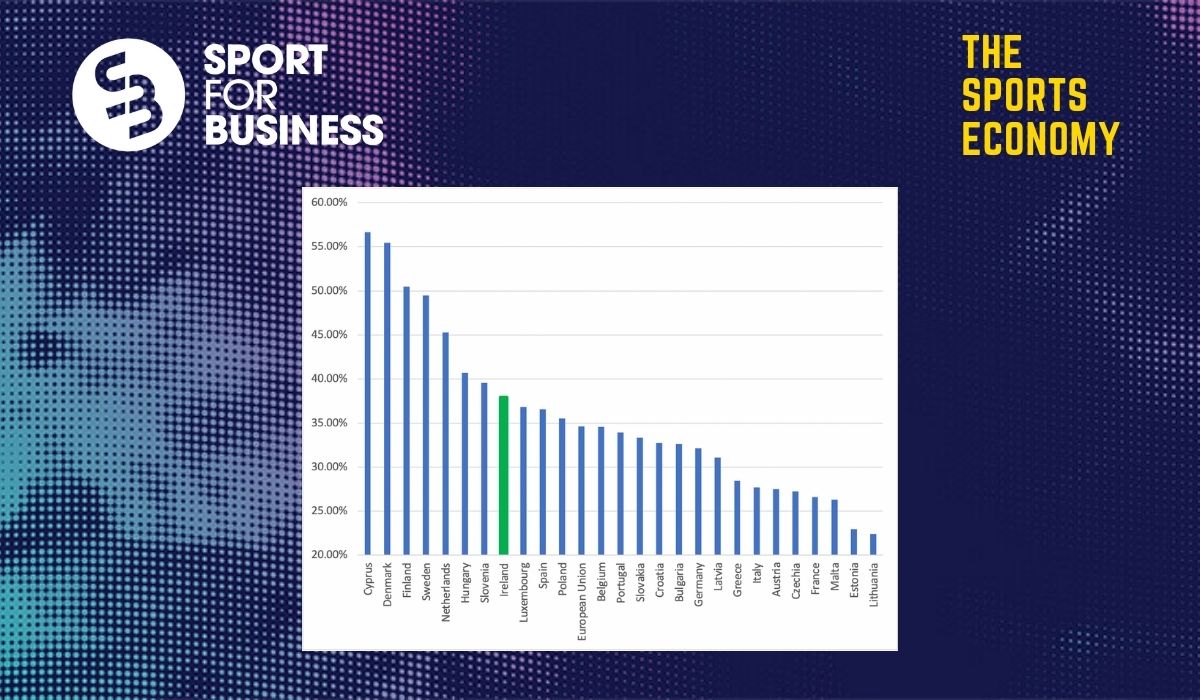
• Eurostat data for 26 EU countries (Romania excluded due to lack of data)
Youth unemployment is an issue taken very seriously by policymakers due to its negative economic and social consequences, but it is not a new problem in Europe. Most of Europe experienced widespread youth unemployment brought about by the Global Financial Crisis of 2007-2009 and youth unemployment numbers peaked in Ireland by 2012 at 40.3% and 26.3% of age brackets 15-19 and 20-24 respectively.
Irish youth unemployment numbers in the past were affected by large numbers staying in or returning to, education and due to emigration. It is, therefore, more telling to look at the number of young people who lost their jobs. A research report from Eurofound, an agency of the European Union, identified that between 2007 and 2012 total employment of 15-24-year-olds fell by 54% in Ireland while the comparative decline for those over 25 years was 7%.
In Italy and Spain for example, high youth unemployment persisted long after the crisis but Ireland was amongst a grouping of European countries where long term youth unemployment had rebounded to medium levels by 2020.
In summary, the true extent of job losses caused by the pandemic will not come to light until vaccination is complete and the economy is operating without covid related restrictions.
In this article we have identified from official statistics that Sport has been among the worst affected sectors of the economy with employment falling 36% during 2020. Furthermore, Covid, just like the Great Financial Crisis before it, has hit young age groups particularly hard with a large amount of claimants of the Pandemic Unemployment Payment being young.
Most of the recent discussion surrounding sport and its need for financial support from the State has centred around the mental wellbeing element of exercise and sport and the financial fallout from the prohibition of crowds at elite sports and the cessation of most non-elite sports activities.
Given that Irish Sport, prior to Covid, also had a relatively high allocation of young people working in the sector, the cohort most affected by recent labour market conditions, we can add demographics to the list of unique features of Irish Sport that has made it so susceptible to the negative effects of Covid and offer the view that Sport is a sector which can particularly assist in the effort to reduce youth unemployment.
Dive Deeper into our Sports Economy Series
 Conor Foley has a business degree from Trinity College Dublin, an MSc in finance from DCU and is a Chartered Financial Analyst. Over a 12-year professional career, Conor has experience of advising clients such as institutions, charities and bodies in the areas of global strategy, project management, asset allocation and financial structure. Conor will be working with Sport For Business to produce The Sport Economy, a regular piece, offering insights from the domestic and international sporting worlds of finance, economics and business, aims to bring Sport For Business members lessons and information from around the world to aid you in your strategy, financial affairs and business decisions. Conor has worked in leading financial institutions both at home and abroad and is committed to the growth and development of professional and amateur sport in Ireland.
Sport for Business Partners
[logo_carousel_pro id=”51608″]