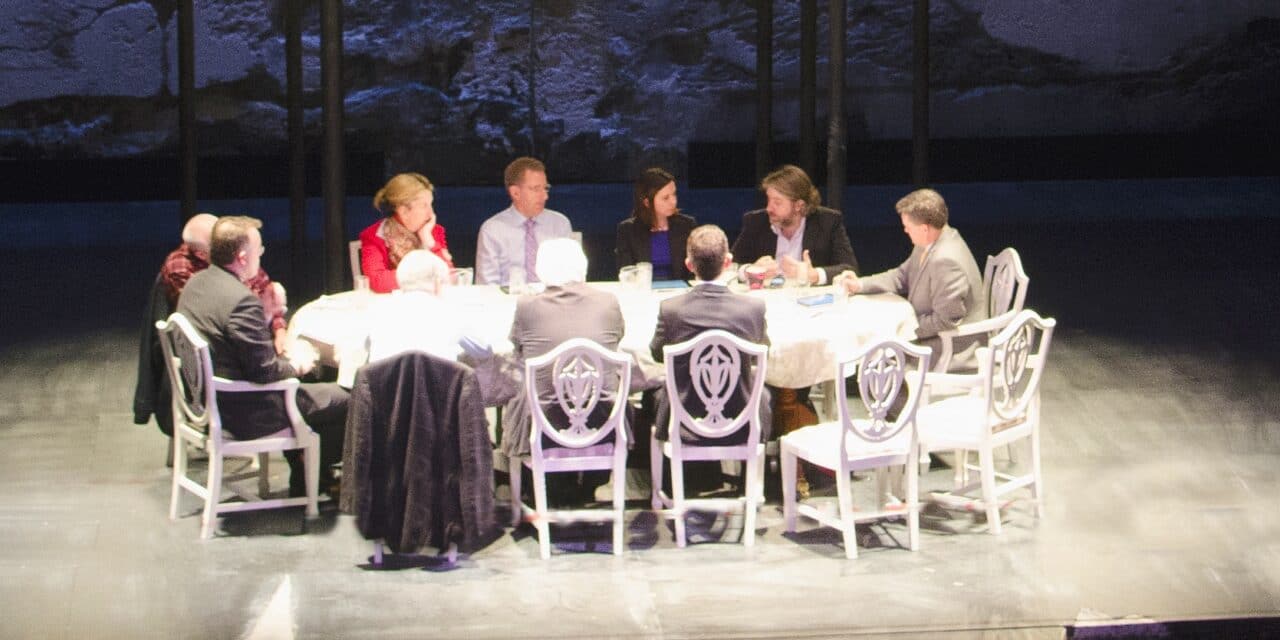
 “Speak what we feel, not what we ought to say.” Words written by William Shakespeare for King Lear and appropriate to the Sport for Business Members’ Round Table on Culture and Sport which yesterday took place amid the wonderful setting of the play upon the Abbey Theatre stage.
The Abbey served as wonderful hosts on the day and brought in the table used on the set of James Joyce’s The Dead so that we could sit and speak our mind rather than tread the famous boards throughout our near two hour session.
It was indicative of the quality of thought leadership and innovative thinking that we mostly forgot the splendour and history of where we were, so wrapt were we by the ebb and flow of conversation served up by representatives of the Abbey itself, the Department of Transport, Tourism and Sport, Wilson Hartnell PR, European Cup Rugby, Sport against Racism Ireland, the Royal Dublin Society, An Post, the UCD Smurfit Business School, Business to Arts and Sport for Business.
This is a selection of the take-aways that emerged as well as a number of initiatives we will look to progress in the coming months. After all, “it is not in the stars to hold our destiny but in ourselves.”
- Culture and Sport are interwoven in many areas not least through their collective appeal to human emotion and the powerful mix that adds to for sponsors but also through the increasing pageantry attached to sport. The opening ceremony of the Olympic and Paralympic Games were held as an example as well as that of CoisCéim who choreographed 75,000 participants in ‘A Dash of Colour’ as the centrepiece of the Special Olympics Opening Ceremony in 2003. It is often the case that a television audience does not see the full majesty of theatre as part of a sporting event as it so often cuts away to preview and analysis. A better blend of the ‘show’ might be encouraged to replicate better the experience of those in a stadium.
- It is not always the big event that can benefit from joined up thinking. When the Armenian national soccer team played here, fans were encouraged to visit the Chester Beatty Library where a wonderful collection of 124 volumes of Armenian manuscripts are housed. Making a connection for travelling fans can have a great multiplier effect in bringing them back again and spreading the word about Ireland as a holiday destination. Sport can be the key to unlock that potential.
- Arts organisations are often more focused on marketing each individual show or event and devote less attention to their brand which will be more important over time. London’s Globe Theatre or the New York Met is a destination in and of itself, regardless of the particular show.
- There is a lack of joined up thinking linking calendars of events. There would be great benefit for this in identifying ways that two individual organisations can act in concert. The Abbey Theatre has a costume display which it shows at the RDS Horse Show but will do more to reach out to that event’s annual 100,000 visitors. Small steps can achieve more than waiting for a bigger picture to come into focus and individual events can benefit from taking a small amount of time to look beyond the focus of each ticket sale.
- Kildare Village was highlighted as a commercial operation which links local sporting and cultural festivals and events to good effect placing itself somewhere in the mix, not necessarily centre stage, but deriving benefit from association nevertheless and delivering a marketing channel to both sport and the arts.
- Intelligent advance offers are a key way to build crossover. 5,000 ‘Golden Tickets’ were sold for this year’s Heineken Cup Final before last year’s game was played. Each was identified as a potential buyer through Ticketmaster and as part of the package have received a book of vouchers to different venues and institutions around Dublin.
- We queried the single minded purpose of a travelling sports fan as being only interested in ‘the game’ followed by ‘the pub’ and for many this is the case but evidence from Smurfit Business School around visitors to Dublin suggest that those who travel as partners on a sporting trip actually spend more when they are here, and that overseas visitors can leave behind over €800 per head. Segmentation of markets is a key part of the future of event marketing and crossover can be a real benefit for all in certain cases.
- The creation of a central database may give rise to Festivals around an event. The UK has gone from less than 20 music festivals in the past 15 years to more than 500 in 2013. A performance of Alone it Stands at the Sydney Opera House during the Rugby World Cup in Australia played to packed houses as it appealed to the travelling fans as well as the hosts keen to immerse themselves in other aspects of that event. Such short run performance events can be marketed as having a direct relevance to the ‘main event’ that people are travelling for whether it be in rugby, horse horse sport, soccer, gaelic games or many of the smaller sports that can still attract major numbers of visitors. The British Irish Chamber of Commerce are looking at a number of areas that will be relevant to this point.
- Specific Gaelic events, in sport and culture, can provide fixed points around which other related organisations can seek to associate and make for an overall richer experience. The All Ireland Finals that run through September could be one on the sporting side. The Fleadh Ceoil is another from the arts that appeals to participants many of whom will be active in many fields, as well as those returning from overseas who are drawn by the lure of a culture steeped in history and lore.
- Sometimes it will be brands that can better activate and spark conversation among their customers through the medium of events. Creating imaginative ways in which those conversations can extend beyond the final whistle or curtain call will add value and deepen the commercial partnership between smart rights holders and progressive brands.
The purpose of Sport for Business and the Round Table programme is to spark innovation and make things happen that will improve matters, even if only by one per cent.
Three initiatives to arise from the event on Culture and Sport are:
- To design a working relationship between tourism, local authority sport and business organisations that will give a central focus to potential multi venue marketing opportunities and make it easier for visitors to discover the rich tapestry of events that are ongoing. NYC Go was held up as an example of this and Sport for Business, Business to Arts and the Department of Transport, Tourism and Sport will consider ways in which this can be done.
- This central point can act as a broker between different organisations, a number of whom from yesterday will now look to foster initial one off partnerships that will set a template for future co-operation.
- Discussions will take place over the situation on cultural and sporting visas and on how sporting and cultural organisations can become involved in future strategy on tourism.
Great thanks are due to the Abbey Theatre who were such gracious hosts for this special occasion; to its Director Senator Fiach MacConghaill who joined us prior to the event and Eileen Collins who made everything work so splendidly; to Helen for refreshments and to Joseph for a spellbinding short history of the theatre and the staging of King Lear; also to Oonagh who made the first connection but then was on a train to Galway as we gathered.
King Lear runs for another month and you really should fight to get a ticket from the Abbey Theatre Box Office.
Our next Sport for Business Members’ Round Table will take place in London on or around March 20th. Our subject will be the relationship between sport and the Irish abroad. Please do get in touch if you would like to join us and play your part in making a difference.