On Saturday the GAA will gather, mainly in person at Croke Park, for a Special Congress convened since February to discuss a number of motions. There are a number of technical ones and an important one on the creation of a mandatory audit and risk committee in each county. But the heat and noise has been around the proposals of the Fixture Task Force for the reshaping of the Senior Football Championship.
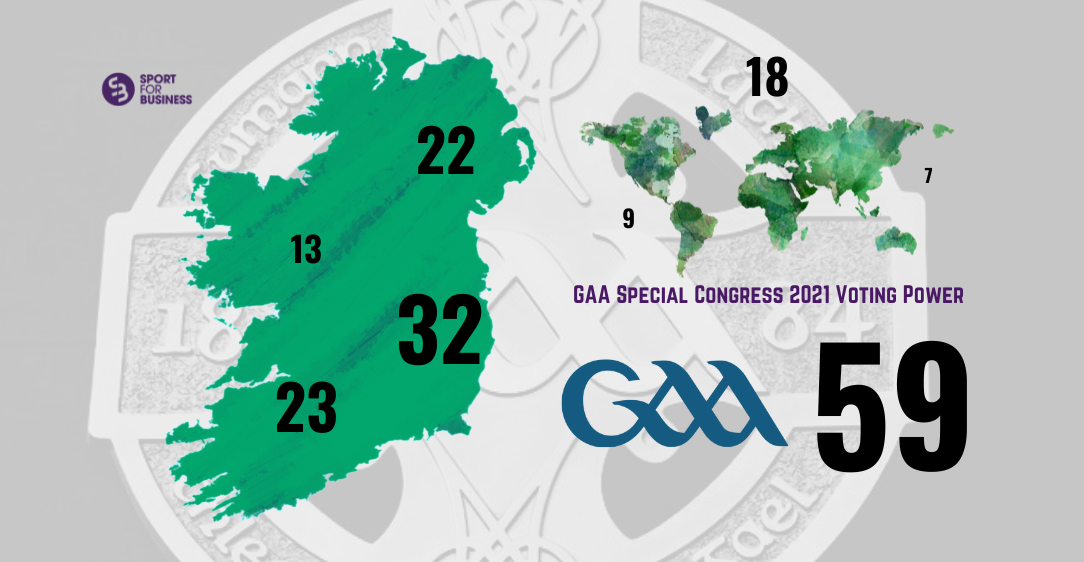
There will be 183 Voting Delegates drawn from across the Association and outlined in our map above. In order to pass, any of the motions require a majority of 60 per cent.
If there were a ‘War Room’ a la House of Cards the magic number of delegates to shift into the Tá or Níl columns is therefore 110.
Before we get to the possible voting intentions though, let’s have a quick recap on the process and the formats.
Motion 18 is Proposal ‘A’. It will be discussed first and voted on. If it passes the 60 per cent line then it will be adopted and will be the format from 2022. Motion 19 will be withdrawn.
If it is defeated then Motion 19, Proposal ‘B’ will be discussed and voted on. As above if 110 votes are cast in favour then it will be passed and become the format for the Championship next season.
If it is defeated then the status quo will remain part of the Official Guide and we will be as we were before the disruption of Covid 19.
So what are the options in a nutshell?
Option A
Retention of the Provincial Championships as the bedrock of the All Ireland but reshaping them to become four tournaments with eight teams in each.
That means teams from Leinster and Ulster will be moved to the Connacht and Munster Championships.
Each ‘Province’ will then play in two round-robin groups of four with the Winners meeting each other in the Provincial Final. The 16 teams that come second or third will go straight to the first round of the qualifiers for the All Ireland series, where they will be joined by the losing provincial finalists at the third and final round.
Four teams will emerge from the qualifiers to play the Provincial Champions in the Quarter Finals and then there will be Semi-Finals and a Final all complete before the end of July.
The eight teams that finish fourth in each of the Round Robin Groups will play in the new Tailteann Cup.
Pros and Cons – Each county will have at least four games to play across the summer and there will be a logical and symmetrical path towards the Final. On the flip side, retaining provinces but moving counties is playing with fire. It worked in Hurling, moving Antrim and Galway to Leinster but the numbers playing at Senior level are so much fewer and without the shift, there would not have been Provincial Championships in Connacht or Ulster. It also does little to reduce the one-sided nature of many of the early-stage games.
Chance of Success – Very limited
Option B
This combines the current format of the Allianz Leagues as the basis for the All Ireland Series. Each of the Divisions one to four are based broadly on the ability of the teams at each level and ensures that the games are broadly competitive.
Each County will play seven games in the early part of the season. The top four teams in Division One will go straight to the Quarterfinals of the All Ireland Series where they will be seeded to play against the fifth team from the top flight, the Champions of Division Two, and two teams to emerge from a preliminary round between the second and third teams in Division Two and the Champions of Divisions Three and Four.
In 2019, the last full season of an Allianz Football league this would have meant Kerry, Mayo, Tyrone and Dublin meeting Galway, Meath and two from Donegal, Fermanagh, Westmeath and Derry at the Quarter Final Stage.
They would then similarly progress to Semi-Finals and a final before the end of July.
The Tailteann Cup would be played between counties from the Third and Fourth Divisions who did not progress to the All Ireland Quarterfinals.
Pros and Cons – The Allianz League format is very strong in that you get teams of broadly equal ability playing against each other. It would provide seven competitive games in the first half of the County season and everyone would have meaning in providing a path towards the All Ireland Series. Promotion as Champions would potentially be a double-edged sword giving a shot at the All Ireland one year but then a likely harder path to do the same again. It is based on ability though, rather than geography and therefore is stronger from a sporting perspective. Critics would argue that it damages the cultural fabric of local rivalries and there is a challenge in that a team who comes sixth in Division One is out while the team at the top of Division Four goes forward. In recent years this would have excluded Monaghan twice, Mayo, Tyrone and Kerry, despite Kerry in 2015 beating Donegal and Dublin. In the phrase of the moment, there are anomalies. This has been roundly endorsed by the Gaelic Players Association as providing their optimum way forward.
Chance of Success – Getting Stronger
The breakdown of the voting
Most of the Leinster Counties have either confirmed or are leaning towards Option B. Ulster is strongly against either of the options for change put forward. Munster and Connacht Counties are a mix.
The number of delegates who will vote from each county is determined by the number of clubs that are registered there. It means that Dublin and Cork have five delegates each while Carlow and Cavan have two.
From the counties, we might estimate that 70 per cent of Leinster delegates will vote for Option B, fifty per cent in each of Munster and Connacht and 15 per cent of Ulster. That would give 43 votes from the 90 available on the island of Ireland.
The emphasis then switches to the overseas delegates who number 18 from the rest of Europe including Britain, nine from the Americas and seven from Australia, Asia and the Middle East. GAA President Larry McCarthy has expressed his personal preference for Option B which should sway things in favour of Option B in the America’s at least. If we give all nine votes from there and say 60 per cent from the other international voters that means an additional 24 votes in the Tá column.
Of the seven former Presidents of the GAA with a vote, I am going to give five to the momentum behind the change, bringing the number up to 72.
Getting to the required 110 would then require 38 of the 59 votes held by the Central Council, made up of national and provincial figures. The National voters may favour the preferred personal choices of President Larry McCarthy and Director General Tom Ryan. The Provincial Councils will be hard-pressed to vote for the downgrading of their own controlled Provincial Championships to potential pre-season competitions.
This is where the vote will likely be won or lost.
On our calculation, it will require 65 per cent of Central Council votes which leaves it very much in the balance.
All of this is speculation, albeit informed speculation. With 48 hours to go though, and many voices still to be heard, it is still very much in play.
Join us later for an analysis of what this means from a sponsorship and a financial perspective, but also at why they are not the most important factors.
“A powerful and influential network of information and collaboration”

Download our latest membership brochure here.
Sport for Business Partners
[logocarousel id=”56327″]