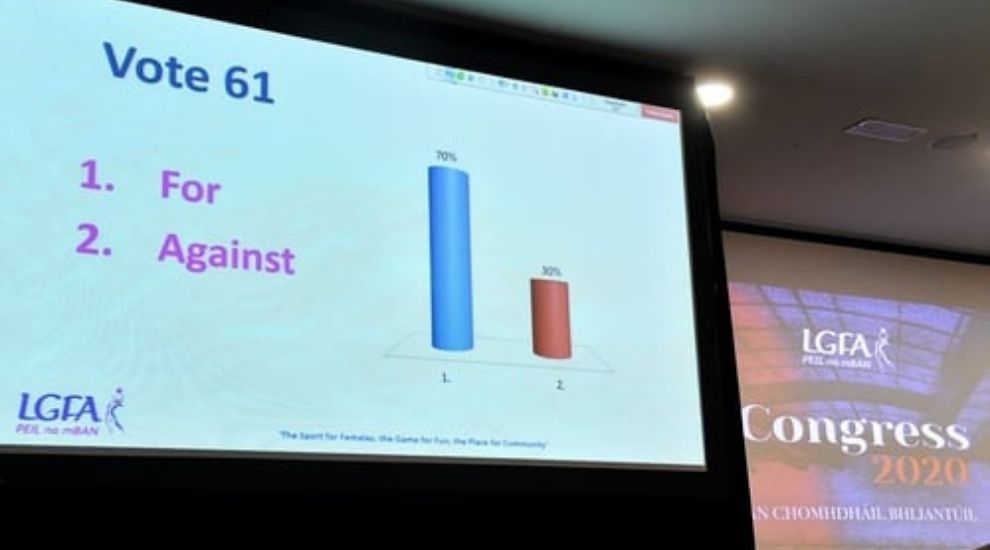
The next stop along the way towards momentum behind a single Gaelic Games body will be put to the floor of the Ladies Gaelic Football Association congress taking place this weekend in Belfast.
A motion from the Galway County Board seeks to change Rule 13 in the rule book from a commitment “to co-operate with other organisations with aims similar to its own” to a more overt statement of intent to “unite with the GAA with the aim of becoming a partnership of equals.”
At the GAA Congress in Mayo, a similar motion was passed with a ninety per cent majority and the Camogie Association has already published a similar motion for its congress to take place in four weeks’ time.
The LGFA debate will be interesting to watch in order to determine how much real support there is on the ground, or at least in the minds of the delegates that will be representing counties.
Player Support
The players have come out strongly in support, with a Gaelic Players Association meeting of 31 inter-county captains saying on Tuesday night that “We believe that passing this motion would signify a firm commitment on behalf of the association to prioritise full integration.”
At national level CEO Helen O’Rourke has stressed that “matters relating to integration at all levels of the Association would need to be debated and ironed out prior to the formation of a new incorporated body.”
Reading the nuance in that statement it suggest that this should not be something that is brought to life on a wave of enthusiasm and optimism, but rather it will be a process where there will be a lot of finesse needed to ensure that all sides believe it to be in their best interests.
There will be a challenge in that Ladies Football has seen a surge of interest over the past five years and probably has a stronger looking future for further growth than almost any other sport in the country.
Lidl Commitment
Lidl’s commitment last month to a four-year extension of its partnership, backed by an additional €5 million investment, together with strong long term partnerships with big brands like TG4, Sports Direct, Current Account, Yoplait and AIG are the envy of pretty much every challenger sport in the country.
In terms then of potential, of excitement, of the promise of a future fulfilled, the delegates at this weekend’s congress might yet be more wary of ceding independence for the greater good than you might think.
The real key lies in pitches and facilities. There have been improvements over the past four years in particular with County teams playing matches in GAA County and national grounds like Croke Park, Pairc Uí Chaoimh and tomorrow Pairc Tailteann. But it is always on pitches that are owned by the GAA.
At the club level, this works by virtue of the one club model where facilities are shared on a broadly equal basis in the best-case scenarios.
The bigger challenge lies not so much in securing a pitch but in managing the relationship with Camogie where dual players are often forced by fixtures to play two games on a single weekend across both codes and sometimes two on a single day.
That doesn’t happen in the Men’s game because there is a unified approach to fixtures at the club and county level.
Resistance
The surge of Ladies Football has not yet been matched by the numbers playing Camogie and there will be resistance in certain quarters to being seen as equals but in fact, being part of a sport that is growing at a faster rate.
We are familiar with arguments that giving up every second week to Camogie would be a disservice to Ladies Football and that the current system works fine for the one code that administrators are currently responsible for.
Then there is the very human response that a merged single body would operate under one County Board as opposed to three, with one group of officials rising to the highest level as opposed to three and with only one-third of the seats that are around the table remaining so.
Sports administration is a largely thankless task but one that is an essential part of the amateur sporting ethos.
Gaining some recognition as an officer is about the only thanks that are ever received and now there will be a danger in some eyes that this is being taken away.
In politics it is always easier to be in opposition, to bemoan the fact that things are not as they could be. The challenge is greater in Government where the focus switched from identifying problems to creating solutions.
We do not know how the debate or the vote will go this Saturday but it will be a more complex discussion than being able to say yes, let’s do this.
Questions were asked of the GAA Congress as to who were the 10 per cent that voted against the motion and how could their opposition be justified.
It may be that tomorrow’s motion because it is aspirational rather than details, could be carried unanimously on a wave of support. But it could also produce a higher number that remain to be convinced.