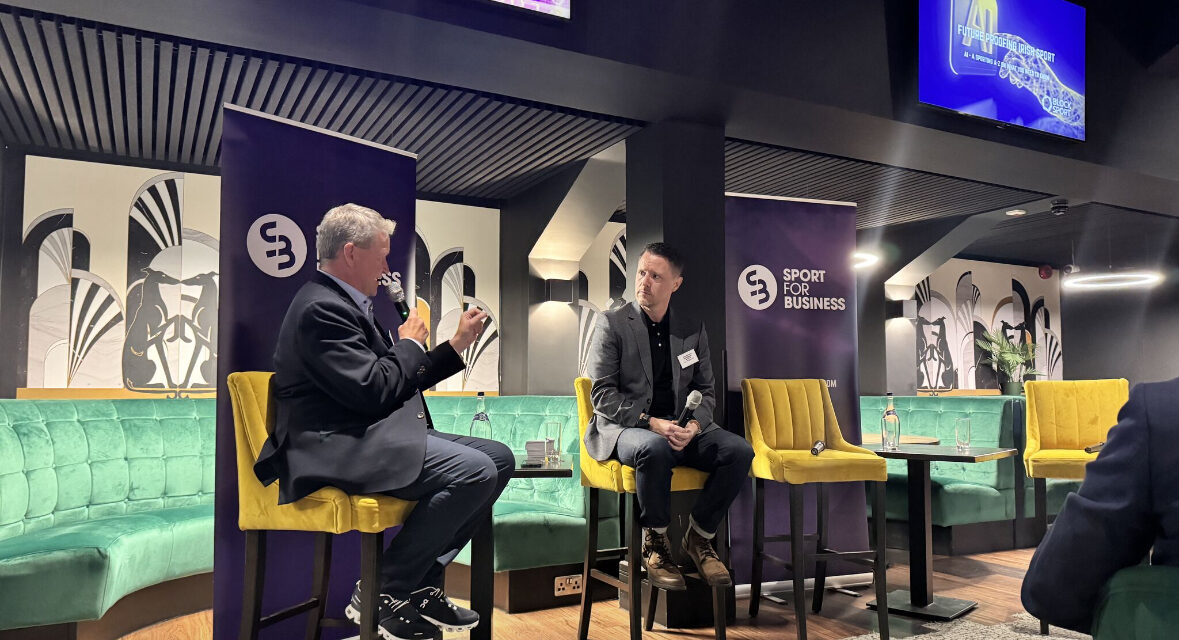
This morning’s Sport for Business Future Proofing Irish Sport event at Shelbourne Park set an energetic tone from the start.
Rob Hartnett framed the challenge: future-proofing Irish sport is ambitious, but the clock won’t stop, and the question is what can we do better now so it still works a year from now, and decades beyond.
The first conversation was with Ger Perdissat of Acuity AI, whose career arc from Microsoft to hands-on AI advisor has given him a useful allergy to hype.
His pivot point, he admitted, was COVID, not as a tech breakthrough, but as proof that behaviour can change overnight when the world forces it to.
For years, AI languished in the “interesting, later” pile; then all at once, it became part of normal conversation. The tech didn’t magically transform; our willingness to try did.
Perdissat’s core message was a relief for every volunteer in the room: start small, start boring, and you’ll get the biggest wins.
Clubs don’t need moonshots; they need their evenings back. He told of a local club that went from “AI’s not for us” to running an “admin GPT,” a “sponsorship GPT,” and an “events GPT” in a matter of weeks—no code, just some documents and clear prompts.
The lesson: the work you like least is the work AI likes most. Merge three messy membership lists? Draft the first pass of a report? Cross-check expenses? Let the machine do the work; you reserve the judgment.
None of this, he warned, removes responsibility. Always check outputs. Be careful with sensitive data. Choose EU-hosted options for GDPR. Keep a human in the loop. And watch for the biggest bias in modern systems, not politics, but people-pleasing. These models are trained to satisfy; if you don’t push them, they’ll tell you what you want to hear. Ask better questions. Make them show their workings.
His most practical advice: stop typing and start talking. Voice agents let you explain complex problems quickly, say, scheduling for a national games programme, then iterate with a spreadsheet or a photo when you’re ready.
The real upside isn’t a magic tactic you’ve never heard of; it’s the ability to track decisions over time without ego.
Try a change, capture the context, measure the outcome, and teach the system what to remember next time. That’s how you chip away at the 60% of “work about the work” that chokes so many sports organisations.
He also widened the lens to the physical world. Why not link pitch-lining robots to fixtures and weather, and heaters in dressing rooms to occupancy, so a ground is match-ready without a midnight dash?
None of these blocks is sci-fi. They’re Lego. Click a few together and the week gets lighter.

From Artificial to Business Intelligence
From artificial intelligence, we slid into business intelligence. Hartnett welcomed Vladimir Liulka of Blocksport and James Wynne of Playbook Sponsorship to talk about a different kind of future-proofing: owning the relationship with your fans rather than renting it from Silicon Valley.
For fifteen years sport has poured craft and creativity into social media, they argued, and it’s been useful for reach, but the platforms own the data, the algorithms, and the paths towards increased revenue.
If you can’t say who your fans are, where they live, how they behave, and what they buy, you can’t credibly price sponsorship or personalise offers. You’re guessing.
The Blocksport proposition is a “digital home”, a club super-app where first-party data, content, commerce, ticketing, streaming, loyalty, and partner activations sit under one roof.
It’s not a static app that spikes at launch then flatlines; it’s an ecosystem stitched to incentives.
Gen Z lives on their phones, multi-screens everything, and wants to be recognised, to create, to collect, to vote.
So the app should reward participation: polls that decide a third-kit design; fan missions that trade profile info for points; loyalty marketplaces where points become discounts or experiences.
Done right, consent isn’t a pop-up; it’s a value exchange.
Liulka was blunt: “Data is the new currency.” Without it, sponsors will drift to properties that can do precision marketing—because their CFOs demand lower acquisition costs and higher lifetime value, not just branding on a hoarding.
With it, you can segment properly (“Dublin, 18–24, checks tickets weekly, hovering over the new jersey but not buying”) and trigger helpful nudges at the right moment.
Crucially, native apps avoid the cookie cliff that’s kneecapping the web; users opt in, and they can delete their data.
Wynne, for his part, addressed the elephant in every Irish boardroom: resources.
Yes, building a super-app sounds lofty when you’re short on staff and cash. But the model isn’t “buy software and hope”; it’s a partnership that stays in the trenches, and it can be sponsor-funded when the fit is right.
Think how Formula One’s app is powered by Salesforce because it aligns with their core business. Ambition, he suggested, is a better starting point than fear.
Ireland can top the table on mobile fan engagement if we align tech, content, and commercial goals and stop giving away the crown jewels for free.
Future-proofing isn’t predicting 2050. It’s reclaiming the hours and the insights today: letting AI clear the undergrowth so humans can coach, create, and decide; moving fans from anonymous followers to known communities you can serve and sustain; designing systems that learn with you.
Tradition still matters, the lore, the colours, the friendships, the weekly rituals. But the next chapter belongs to the clubs and bodies that pair that heartbeat with a brain that remembers.
Image Credit Martin Fallon and Eva Nolan
Further Reading for Sport for Business members:
Check out more of our Sport for Business coverage of Technology
SPORT FOR BUSINESS AUTUMN EVENTS

On September 25th we will host our Annual Children in Sport Conference,
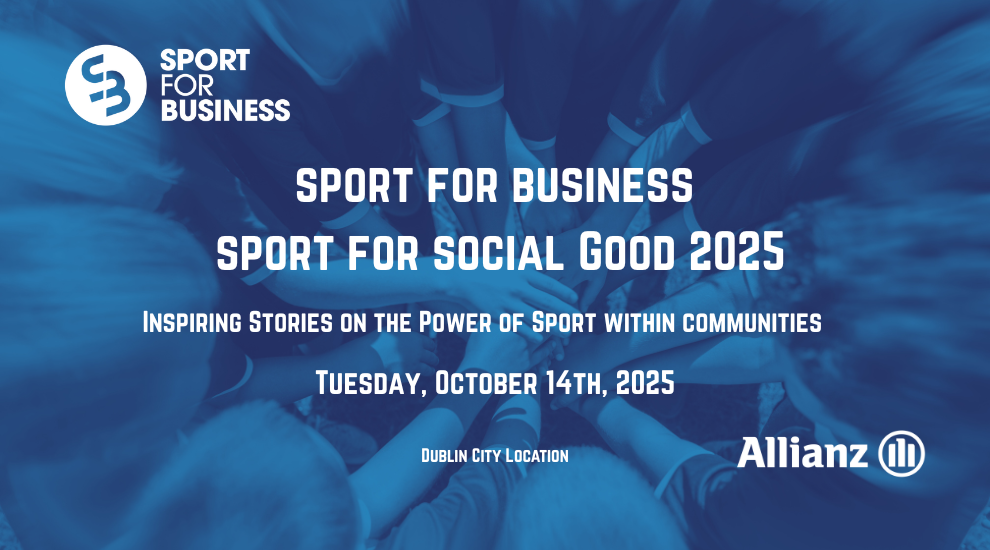
On October 14th, our Annual Sport for Social Good Event will shine a spotlight on good work being done through the medium of sport across the country.
Then in November a new event focused on Sustainability in Sport and in December our 12th Annual Women in Sport Conference, in partnership with Lidl.
Find out More about Our Sport for Business Events Programme Here
BOOK YOUR EARLY BIRD TICKETS FOR THESE EVENTS HERE
The Latest Sport for Business Podcasts
MEMBERSHIP AND EVENTS
Shelbourne Park Stadium, Blocksport, Acuity AI and Playbook Sponsorship, as well as all the leading sporting and business organisations in and around the world of sport are among the 300+ members of the Sport for Business community.
This includes all of the leading sports and sponsors, as well as commercial and state agencies, individuals interested in our world, and an increasing number from beyond these shores taking a keen interest in Ireland.
Find out more about becoming a member today.
Or sign up for our twice-daily bulletins to get a flavour of the material we cover.
Sign up for our News Bulletins here.