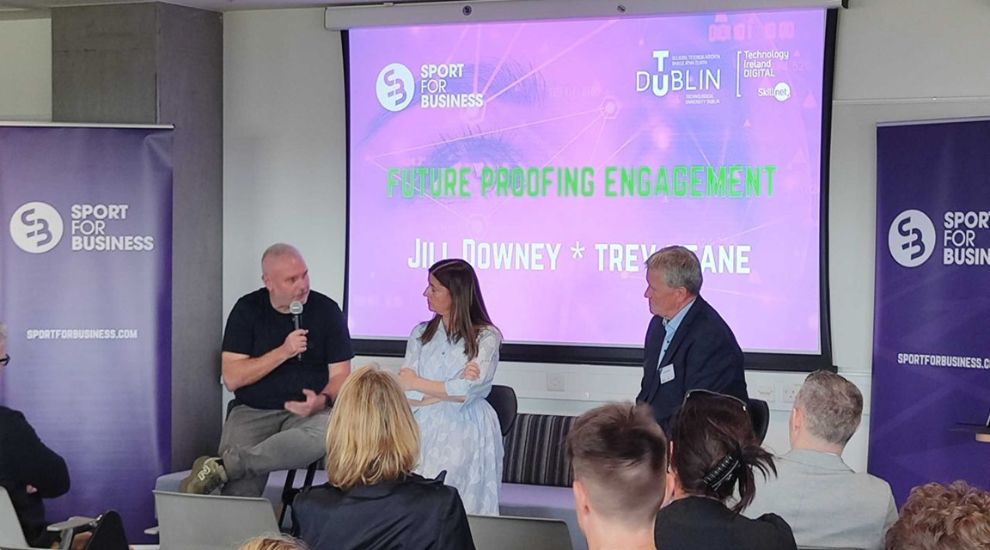
This is a guest review written by Bren Byrne, Creative Director at the wonderful This is Catapult, who, apart from helping to shape much of what we will see at the FIFA World Cup, took time out to join us at yesterday’s Future Proofing Sport event at the TUD Grangegorman Campus.
We will have reports on each of the discussions, including the final important one on how we embrace sport ethically, over the coming days, but for the moment, I thought this piece, originally published yesterday on LinkedIn, really captured the essence of what we were talking about.
I spent today at TU Dublin’s Grangegorman campus for Sport for Business’ Future Proofing Irish Sport conference, there in my role as Creative Strategist at This Is Catapult.
The topic to be addressed throughout the day was AI and data in sport. Now, depending on your level of optimism, this can sound either like the future arriving or the world ending. The truth, as always, was more interesting than that. Because the strongest thread running through the day was not that technology will transform sport on its own. It was that technology only matters when people know what to do with it. That might sound obvious. But in sport, as in brand experience, it is easy to mistake more information for better understanding. Data needs interpretation. It needs context. It needs judgment. It needs people.
That was clear from the first session, focused on performance. Sarah Hawkshaw OLY, Irish Women’s Hockey captain and Operations Director of Danu, spoke about using technology as a tool for preparation. The goal was not to think more during the game. It was the opposite. The data helps prepare the athlete so that when the moment arrives, they are in flow, running on instinct and able to perform without conscious overload.
That is a useful distinction. The best use of data is not always to add more thinking. Sometimes it is to remove friction, build confidence and allow people to act with clarity when pressure arrives. Sarah also spoke about how data can motivate in the moment: coaches using it at half-time to provoke a response, sometimes creatively. That raised a smile, but it also exposed something important. Data is rarely neutral once it enters a human environment. It becomes a story. It becomes a lever. It becomes a way to shape belief, behaviour and momentum.
That came up again and again throughout the morning. Data is not the answer. It is part of the story we tell about what is happening, why it matters, and what we should do next.
Jason Smyth MBE, now working as a Performance Architect after a career that brought 21 gold medals at the highest level of Paralympic sport, put it more sharply.
“There is no one way to run successfully,” he said, “just like there is no one way to engage fans.”
That line stayed with me. Because everyone can have access to data, everyone can see patterns. Everyone can measure. The difference lies in how those patterns are read, interpreted and applied. Jason talked about creating the environments in which data can actually be used successfully. Not just collecting information, but asking how we tweak, learn, understand and apply it. Too much information, he reminded us, does not always add up to greater impact. That is true in performance. It is also true in fan engagement.
At Catapult, we deal with this constantly. We work in the space where sport, brands, fans and live experience meet, and the question is rarely “can we get more information?” The better question is: what will this information help us do? Will it help us design a better environment? Will it help us understand behaviour more clearly? Will it help a fan feel seen? Will it help a sponsor add genuine value? Will it help a new audience find a way in? Will it help a participant stay involved for longer? Because data without application is just noise wearing a smarter jacket.
The fan engagement session brought that to life in a different way. Jill Downey of Core Sponsorship used a phrase I absolutely loved: “data and tears.”
That is probably the best three-word summary of modern sport I heard all day. Because that is where the future of fan engagement lives. Not in data, instead of emotion. Not in emotion without accountability. But in the intelligent meeting point between the two. Jill spoke about how better technology can bring more and different fans into sports. Statistics may draw in one fan. Another by personal stories. Another behind-the-scenes access. Another by community, identity or a single player’s journey. The opportunity is not to force every fan into one model of fandom. It is to understand the different ways people find meaning.
That matters because fandom is no longer a neat, inherited, one-dimensional thing. Trev Keane of Feenix Group made the point that early drives to build audiences became obsessed with followers and scale, forgetting the niche communities that sit beneath real fandom. Followers are easy to count. Community is harder to understand. But community is where the value lives.
“Second-screening” is now part of live sport. Trev shared his experience of attending live sports events with his kids. He noticed that they possess so much more information about the players and the game than he does. But are they less engaged in the game itself? That tension feels important. Younger fans are not disengaged. They are engaged differently. They are watching, checking, comparing, sharing, reacting and interpreting all at once. The risk is assuming that because they are looking down, they do not care. The bigger risk is building experiences that give them more information but less feeling.
That is where sponsors and rights holders have to be more thoughtful. Jill made the point that brands now have greater access to fans, but that access comes with a higher responsibility to add value. Better sponsors understand how to become part of the community. They know they have to earn the right to be there.
That is a sentence more brands should sit with.
Sponsorship is not a shortcut to belonging. It is an invitation to prove usefulness.
For rights holders, the pressure is just as real. Fan insight is no longer a nice-to-have. It is a sellable asset. A commercial asset. A strategic asset. But only if it is actually understood. One stat referenced during the session suggested that sports organisations know only 24% of their fanbase. If that is even close to true, it should make everyone involved in sports pause. Because you cannot meaningfully serve, grow or monetise an audience you barely understand. But again, the answer is not simply more data capture. It is better listening. Better interpretation. Better design.
Benny Cullen from Sport Ireland Institute then widened the lens beyond elite sport and sponsorship into participation. His provocation was one of the most important of the day: how do we discover the next generation of athletes and performers if young people fall out of sport? That shifted the conversation from technology to pathways.
If participation drops between 16 and 25, the issue is not only who becomes elite. It is who gets lost before they ever have the chance to find out what sport could become for them. Benny’s line about needing to “hack the pathway” felt right. No one knows where the next great talent, volunteer, fan, coach, organiser or community leader is coming from. So the system has to keep more people in play for longer. That is not just a performance challenge. It is an experience challenge. How do we make sports easier to stay in? Easier to return to? Easier to belong to? Easier to enjoy if you are not already confident, visible or winning?
Across the day, that was the real lesson for me.
AI and data will absolutely shape the future of sport. They already are. They will change how athletes prepare, how teams perform, how fans engage, how sponsors measure, how rights holders sell, and how organisations plan. But the future will not be won by the people who simply collect the most information. It will be won by the people who can turn information into environments where humans perform better, participate longer, connect more deeply and feel more meaningfully involved.
That is where Catapult sits. We are not a data company. We are not a technology company. But we are very much in the business of understanding how people behave around sport, culture and brands, and how experiences can be designed to make those behaviours more valuable. The work is not to make sport more complicated. The work is to make it more human.
To use data to see people more clearly. To use technology to remove barriers, not create distance. To help brands earn a role in communities, not simply buy visibility. To understand that fans are not a single audience, participants are not a single pathway, and engagement is not a single behaviour.
There is no one way to run successfully. There is no one way to be a fan. And no one future of sport will be solved by technology alone.
The future will belong to those who can read the patterns, understand the people behind them, and design the environments where all of it can come to life.
Thanks to Rob Hartnett for organising and hosting.
 This is Catapult, TUD, Core, Feenix Group, Paralympics Ireland, and Sport Ireland are full members of Sport for Business.
If you would like to be part of the Sport for Business community and see your organisation in our content, on our stages, and in the conversation happening every day around the commercial world of Irish Sport, email us today and let’s see what is possible.
Image Credit: Iddo Diamant
ABOUT SPORT FOR BUSINESS
Sport for Business is Ireland’s leading platform focused on the commercial, strategic and societal impact of sport. It connects decision-makers across governing bodies, clubs, brands, agencies, and public institutions through high-quality content, events, and insights.
Sport for Business explores how sport drives economic value, participation, inclusion and national identity, and how your story can be part of ours.
Through analysis, storytelling and convening the sector, it helps leaders understand trends, share best practice and make better-informed decisions. It positions sport not just as entertainment but as a vital contributor to Ireland’s social and economic fabric.
Find out more about becoming a member today.
Or sign up for our twice-daily bulletins to get a flavour of the material we cover.
Sign up for our News Bulletins here.