The GAA and the LGFA have formally marked the submission of their application to have Gaelic football recognised by UNESCO as part of the Intangible Cultural Heritage of Humanity.
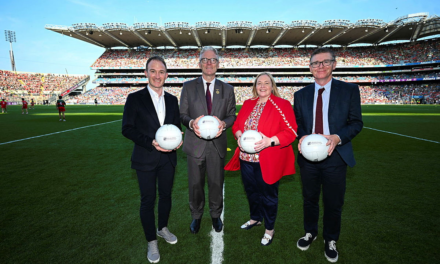
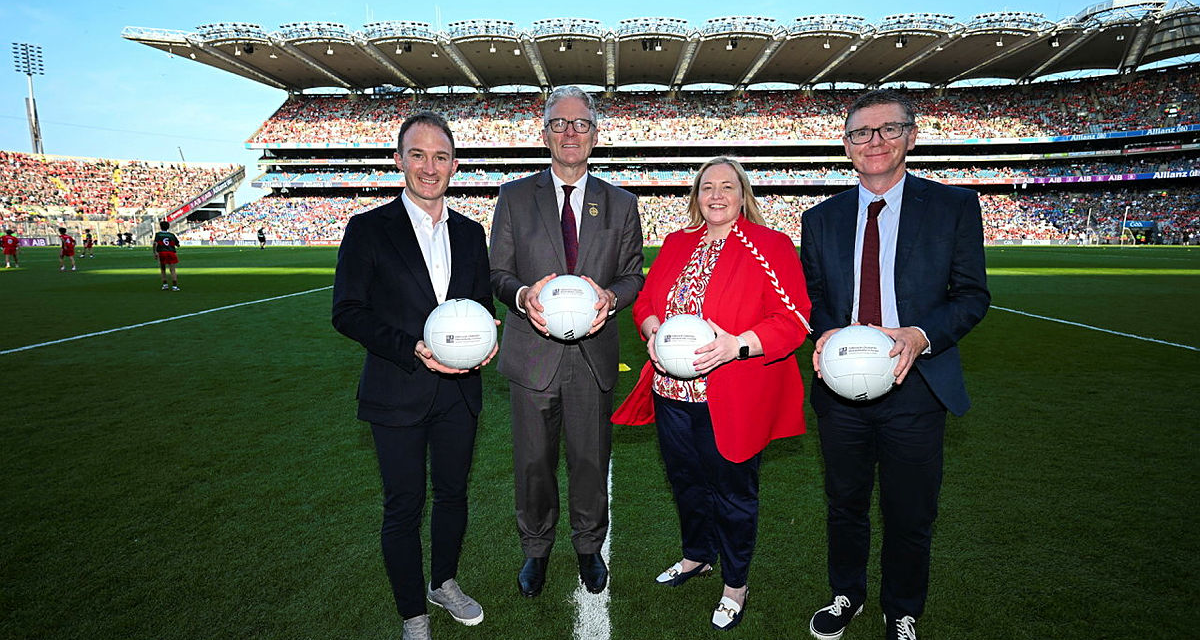
The milestone was celebrated at Croke Park on Saturday, where GAA Ard Stiúrthóir Tom Ryan, GAA President Jarlath Burns and LGFA CEO Lyn Savage hosted Minister of State Alan Dillon and officials from the Department of Culture, Communications and Sport during the Tailteann Cup Final and the All-Ireland Senior Football Championship semi-final between Mayo and Louth.
The submission has been prepared with the support of the Department of Culture, Communications and Sport, whose backing is required for Ireland’s nomination to UNESCO.
The application traces the origins of Gaelic football to documented forms of football played in Ireland from the 16th century before highlighting the codification of the modern game following the foundation of the GAA in 1884 and the establishment of the Ladies Gaelic Football Association in 1974.
It also underlines the scale of the sport today, with approximately 2,000 clubs across Ireland and a further 500 overseas, reflecting the game’s deep roots within Irish communities and its growing international reach.
Minister for Culture, Communications and Sport Patrick O’Donovan said the Government was proud to support the application.
“As we saw with the recognition of hurling in 2018, UNESCO’s Intangible Cultural Heritage of Humanity listing is a powerful statement of international recognition for the importance of our living culture to the world’s shared heritage,” he said.
“The Government is happy to support the GAA and LGFA’s application to secure UNESCO status for men’s and women’s Gaelic football. We also hope this will be an important milestone in the GAA’s ongoing work to grow the global footprint of our game.”
Former Mayo footballer and Minister of State Alan Dillon described Gaelic football as central to Irish identity.
“It’s far more than a sport; it’s at the heart of our communities, our identity and our culture,” he said. “I am proud to support the GAA and LGFA in seeking UNESCO recognition for a sport that has inspired generations and continues to bring people together at home and across the world.”
Jarlath Burns said international recognition would strengthen efforts to expand the game’s influence.
“Gaelic football is not just a sport but a way of life for people from Killarney to Kilcar and from Swords to Salthill and everywhere in between,” he said.
“Like hurling and camogie, these games are part of who we are. Achieving UNESCO status would grant international recognition of their cultural significance and greatly assist us in our efforts to grow our games at home and abroad.”
LGFA President Trina Murray described the submission as a landmark moment for the women’s game.
“Since 1974, we’ve built a game that now stands proudly alongside the men’s code, with thousands of women and girls lacing up every week from local pitches to Croke Park,” she said.
“UNESCO recognition would place our sport on a global stage it has long deserved and send a clear message to the next generation that their game matters, is valued and has a future without limits.”
Sport for Business Perspective
Recognition by UNESCO would be far more than symbolic. Hurling’s inscription in 2018 highlighted the cultural significance of Ireland’s indigenous games and provided an additional platform for international promotion.
For Gaelic football, UNESCO status would strengthen the sport’s positioning as a unique element of Ireland’s cultural identity while complementing ongoing international expansion through overseas clubs, the growing profile of the All-Ireland Championships and the increasing visibility created by global broadcast and streaming.
A successful application would also reinforce the value of Gaelic football as a cultural asset in tourism, education and international diplomacy, providing another powerful narrative around one of Ireland’s greatest sporting exports.
UNESCO is expected to consider the submission over the coming months, with a decision anticipated during 2027, coinciding with the 140th anniversary of the first All-Ireland Championships.

 The GAA, LGFA and the Department of Culture, Communications and Sport are full members of Sport for Business.
If you would like to be part of the Sport for Business community and see your organisation in our content, on our stages, and in the conversation happening every day around the commercial world of Irish Sport, email us today and let’s see what is possible.
Image Credit: Hawk-Eye Innovations
ABOUT SPORT FOR BUSINESS
Sport for Business is Ireland’s leading platform focused on the commercial, strategic and societal impact of sport. It connects decision-makers across governing bodies, clubs, brands, agencies, and public institutions through high-quality content, events, and insights.
Sport for Business explores how sport drives economic value, participation, inclusion and national identity, and how your story can be part of ours.
Through analysis, storytelling and convening the sector, it helps leaders understand trends, share best practices, and make better-informed decisions. It positions sport not just as entertainment but as a vital contributor to Ireland’s social and economic fabric.
Find out more about becoming a member today.
Or sign up for our Daily Sport for Business Snapshot email bulletins to get a flavour of the material we cover.
Sign up for our News Bulletins here.