When Declan Rice and Harry Kane walk out at Atlanta Stadium tonight for England’s World Cup semi-final against Argentina, they will not be the only people involved in the occasion with strong Irish connections.
Watching closely from pitchside will be Stuart Wilson, the Bedfordshire native who has lived in Blackrock, Co Louth, for the past 14 years and who spent almost a decade and a half managing one of Irish sport’s most famous playing surfaces at Croke Park.
Now serving as FIFA Pitch Venue Manager in Atlanta, Wilson and his team have prepared the surface on which England and the reigning world champions will compete for a place in Sunday’s final.
In the latest instalment of Golf Ireland’s A Slice of Life series, Daragh Small traces Wilson’s journey from the fairways of Woburn Golf Club to Arsenal, the Aviva Stadium and GAA headquarters, before the biggest assignment of his career.
Preparing a Surface for a World Cup Semi-Final
By Daragh Small
There will be 17 members of the ground staff sitting pitchside, ready to respond should the unforeseen happen.
Were either set of goalposts to be damaged, they would have five minutes to bring replacements from the tunnel and install them.
This is the World Cup semi-final between reigning champions Argentina and England at Atlanta Stadium, with an enormous global audience watching and no margin for error for Stuart Wilson and his team.
The Bedfordshire native, who has lived in Blackrock, Co Louth, for the past 14 years, began his journey as an assistant greenkeeper at Woburn Golf Club.
All-Ireland Hurling Final week would ordinarily have looked very different for the former Croke Park Pitch Manager, but Wilson left the GAA headquarters in April to take up the role of FIFA Pitch Venue Manager for an intensive eight-game World Cup schedule in Atlanta.
Tonight brings the biggest challenge yet.
It is the latest chapter in one of international football’s great rivalries, arriving 40 years after Diego Maradona’s infamous Hand of God goal and potentially representing Lionel Messi’s final appearance for Argentina.
“You have to sometimes pinch yourself when you’re looking at the superstars playing on a pitch you’ve produced. That’s where the pride comes in,” said Wilson.
“There’s anxiety and nervousness, without a doubt, because you just want them to be happy and comfortable on the playing surface you’re producing.
“But that’s down to the performance testing, the numbers and the work we’ve done to get to this point.
“I see no issues at all with what they’re going to be playing on and I’m very confident they’ll enjoy playing on this surface.
“When you see the superstars out there, it gives you goosebumps because you’re doing that for them. That’s why I love it.
“I’m still involved in sport, even though I’m not playing it. I feel like I’m a big part of what’s happening.”
Wilson followed his brother Jody into sports turf management, with both beginning their careers at Woburn. Jody would eventually become Course Manager at Mid Herts Golf Club in Hertfordshire.
Stuart moved on to Stowe School as Assistant Groundsman and Greenkeeper and later worked at St Paul’s Catholic School.
His major break came at Arsenal’s Emirates Stadium in February 2009, where he learned from Head Groundsman Paul Ashcroft.
“Paul is still in charge there,” said Wilson.
“I would be very fond of him and we’re still good friends. I look up to him and he’s very proud of where I am and what I’m doing.
“He was the person who set me on my way in terms of the real, high professional quality of sports turf management.
“His standards and attention to detail are some of the best you’ll see anywhere in the world.
“I’ve been fortunate to work at venues where the quality is so high. There were European Tour events at Woburn and then Champions League and Premier League games at Arsenal.
“That high-level quality becomes part of you, but I’m probably still yet to witness anything like the standards and attention to detail at the Emirates when I was there.
“It was through the roof. You were almost afraid to step on the playing surface.”
Wilson met his Irish wife, Sonya, while working at Arsenal and later moved to Ireland, joining the Aviva Stadium as Assistant Head Groundsman.
The opportunity to take charge at Croke Park followed in January 2012.
“I tried to raise the levels and we did that over time,” he said.
“We had to introduce some new things and there was a lot of hard work involved, but I was lucky to fall into the job.
“I got that position and spent nearly 15 years there.
“I’ve been very fortunate to work on some top surfaces and Croke Park really helped me with Atlanta because it is such a highly used playing surface.
“We had so many turnarounds over weekends and from one weekend to the next.
“You had minimal time to get the pitch turned around for huge games, and that experience is coming through now.
“Even though we’re not playing the same sports here, we’re still maintaining a playing surface.”
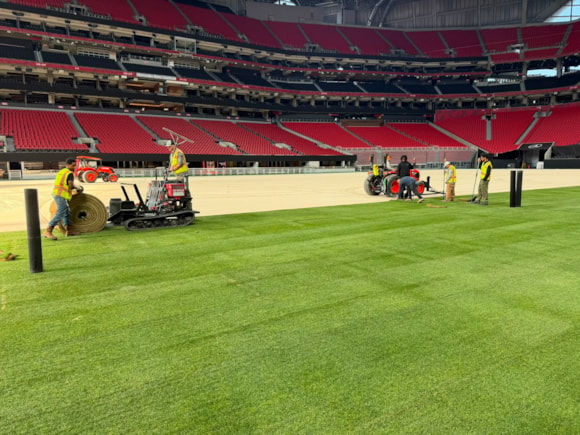
Wilson left Croke Park in April and arrived in the United States on May 14, three months after construction work on the Atlanta Stadium pitch had begun.
The task was considerable: transforming an artificial surface into a natural grass pitch capable of hosting World Cup matches inside an enclosed venue holding more than 70,000 spectators.
Extensive research was conducted into which grass species would perform best in the demanding environment, with Kentucky Blue smooth-stalked meadow grass eventually selected.
Spain and Cape Verde kicked off the stadium’s World Cup programme just four weeks after Wilson arrived.
“The pitch was constructed and when the actual turf was installed, I arrived and literally a day later we began laying it,” he said.
“After that work was completed, the pitch was stitched with hybrid fibres.
“It’s a hybrid pitch, what we call a stitched pitch. Every square inch has artificial fibres injected into it, giving the surface stability and providing better traction for the players.”
The fibres are injected to a depth of nine centimetres, with approximately 1.5 centimetres visible above the turf before being covered by the grass.
“I do a lot of performance testing on the pitch,” Wilson said.
“I measure firmness, traction and moisture every day, and the traction levels increased once we injected those fibres.
“When the players begin to interact with those fibres, the traction improves and they have greater stability.
“Without them, we would see a lot more damage and the wear and tear would be much worse.
“It holds the sand underneath together more tightly and the roots entwine around it. It gives you a stronger pitch.
“If you were to pull on the grass, it would be very hard to move it.”
Wilson and his team have already successfully negotiated seven fixtures, including England’s game against DR Congo and Argentina’s meeting with Egypt.
Tonight’s semi-final, however, carries a special significance.
The surface is being continually manicured and perfected, while England arrived at the venue on Tuesday for a familiarisation session.
Teams are not permitted to train on stadium pitches during the World Cup but are entitled to visit and get a feel for the surroundings.
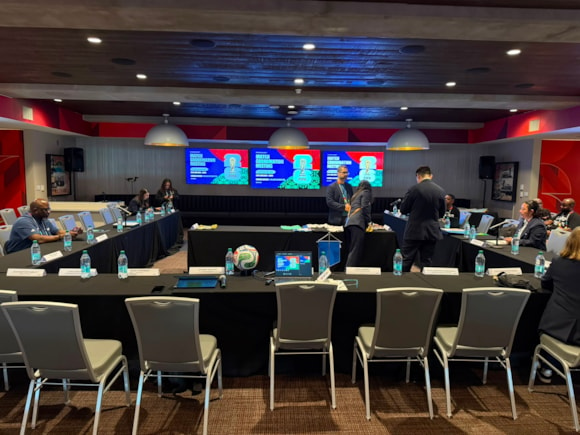
Wilson and his colleagues have also been working through the detailed operational requirements surrounding the game.
They attended a 97-slide presentation yesterday evening, with every aspect of the fixture examined.
“A presentation is given by the FIFA match director,” said Wilson.
“I’m responsible for pitch management, so I present on the pitch and explain the construction of the surface.
“I talk through the areas where we would like the teams to warm up, the temperatures inside the stadium and the watering process.
“We can water the pitch six hours before kick-off, three hours before, one hour before and 20 minutes before. We can also water at half-time and during hydration breaks if needed.
“What we find in an indoor environment is that we don’t need as much water because it doesn’t dry out as quickly.
“There isn’t the same need as there would be at outdoor venues where it is very hot.
“All of the different functional areas are represented, including broadcast, medical, football technology and the match director.
“They go through everything from the moment the teams leave the hotel. They even talk about the temperature at which the players want their drinks.”
Kick-off will be at 3pm local time, presenting its own challenges for the pitch team.
Everything must be completed by 9am, with the final preparations beginning at 5am.
The pitch will be mown from goal to goal and then from side to side. It will also be double-marked, with every measurement checked precisely.
“We take brushes out and try to remove as many footprints as possible to get the presentation looking as good as it can,” said Wilson.
“To be fair to the guys, I’m very lucky because everybody involved in doing anything on the pitch has been so supportive of protecting it.
“They make sure they walk the right way along the stripes. Even small things like that make a huge difference.
“We then go through the rehearsal process. We’ll brush the pitch and then we’re ready to go.
“The teams come in two hours before kick-off and then, just before they come out to warm up, we’ll put some water on.
“Before that, I’ll liaise with the coaches to try to get them warming up in the right areas and make sure the goalkeepers use the warm-up goals.
“Ninety per cent of the teams work with you.”
It will be another demanding day for Wilson, but the work will not end with the final whistle.
Once the World Cup programme in Atlanta is complete, the natural pitch will be removed and a new synthetic surface installed ahead of the NFL pre-season and the return of the Atlanta Falcons.

Wilson will then return to Ireland and continue developing his new business, Stuart Wilson Sportsturf Consulting Ltd.
He will be working with the NFL around its international games and with Arsenal ahead of the Premier League club’s pre-season visit to Ireland.
He has not ruled out returning to golf in a professional capacity either.
Wilson still plays regularly and, as a seven-handicap golfer, is looking forward to returning home and getting back onto the course at Dundalk Golf Club.
“I’ve got back into golf and I’m now playing off single figures,” he said.
“I joined Dundalk a few years ago and my boys both play.
“I’ve got two boys who are massively keen on sport as well and I love going up and playing nine holes with them during the summer.
“I can’t wait to get back and do that with them.”



 Golf Ireland and Vision Sports Ireland are full members of Sport for Business.
If you would like to be part of the Sport for Business community and see your organisation in our content, on our stages, and in the conversation happening every day around the commercial world of Irish Sport, email us today and let’s see what is possible.
Image Credit: Hawk-Eye Innovations

ABOUT SPORT FOR BUSINESS
Sport for Business is Ireland’s leading platform focused on the commercial, strategic and societal impact of sport. It connects decision-makers across governing bodies, clubs, brands, agencies, and public institutions through high-quality content, events, and insights.
Sport for Business explores how sport drives economic value, participation, inclusion and national identity, and how your story can be part of ours.
Through analysis, storytelling and convening the sector, it helps leaders understand trends, share best practices, and make better-informed decisions. It positions sport not just as entertainment but as a vital contributor to Ireland’s social and economic fabric.
Find out more about becoming a member today.
Or sign up for our Daily Sport for Business Snapshot email bulletins to get a flavour of the material we cover.
Sign up for our News Bulletins here.