The Euro 2022 Championships in England have generated record crowds, been televised to record audiences, and hit Gold last night when the hosts qualified for the Final this Sunday by beating top-ranked Sweden 4-0 in the semi-final.
An advertising campaign though, with a budget of only £1,000 is what will be providing much of the thinking in sponsorship offices across the 18 brands that are backing the tournament or indeed among others looking at entering the field of Women’s sport.
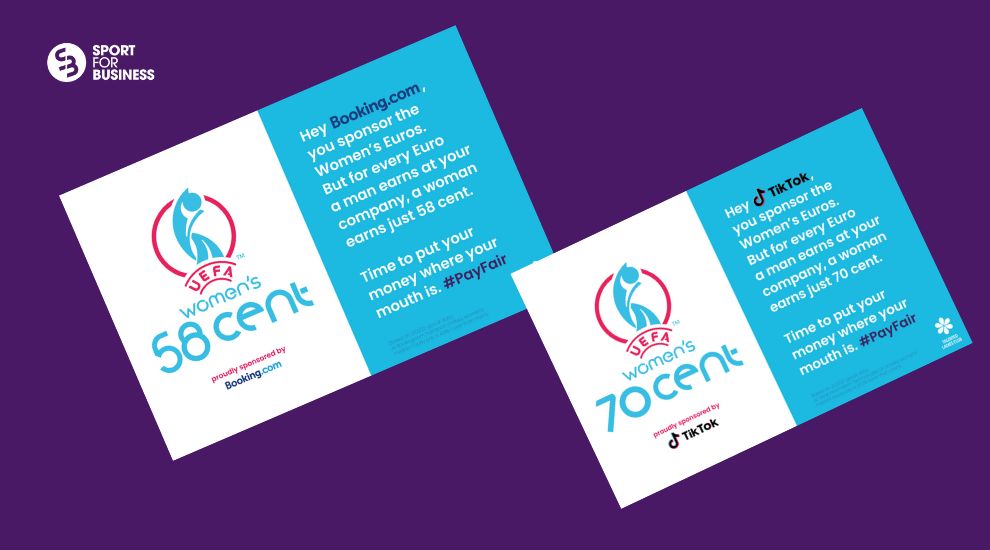
The campaign, by online publishing and training group the Talented Ladies Club has called out the gender pay gap that exists at six of the main sponsors and called on them to #PayFair.
It has visually altered the tournament logo to drive home the message as we have featured in the image above.
The six companies that have been targeted are Adidas, Linked In, Booking.com, Visa, TikTok and Volkswagen and the data id drawn from a UK Government website that carries published data on the Gender Pay Gap that exists in companies of a certain size that are legally required to provide the data.
A similar system is being introduced to Ireland with reporting due for all employers of more than 250 staff this year for the first time.
Held to Account
Much of the growth in popularity, interest, coverage and recognition of Women’s sport has been driven by the engagement of major sponsors and holding them to account for their own practices is something that cannot be criticised but which will cause others to perhaps think twice about stepping into the space.
That is a real conundrum.
The figures which the campaign use draws the data based on either mean or median hourly pay and uses the worst figure of the two to make the point.
As an example, the mean differential at Visa is 6.7 per cent in the most up-to-date figures but it is the median figure of 11.6 per cent that is used. The choice of number is reversed for Volkswagen with the mean figure of 20.2 per cent highlighted rather than the median of 15.0 per cent.
That selective use of data lessens the credibility but only for those who could bother to dive into them with more than a cursory glance.
As a means of creating something a little more incendiary on social media, that is hardly a consideration.
Double Edge
The selection of companies that have made the choice to support Women’s sports is something that also has a double edge.
It is clearly something that all companies should be comfortable with that they are backing projects and events and bringing a shared set of values to the table.
A zero per cent Gender Pay Gap should be the ideal and any company that has a deliberate policy of paying separate rates based on gender should not be anywhere near being welcomed as a supporter of any sporting event.
There is a responsibility on campaigners to play fair even when promoting a noble cause like to pay fair. In this case the gender pay gap context is subsumed to a degree beneath a snappy headline.
It begs the question of whether it is wrong to use tactics that are wrong to overturn an injustice of greater proportions and that again takes us into a grey area.
Context
Most of the companies that have been targeted will claim some form of context for what look like damning numbers. That in itself will be dismissed in the firefly world of social as equivocation in support of the unacceptable.
Using Volkswagen as an example here its equivalent figure for the mean gender pay gap in 2019/20 was 25.6 per cent so it is clearly moving in a positive direction.
Visa will be seen now by many as a poor standard in this space but the 11.6 per cent media gap that is used compares to that of Mastercard, a major sponsor within UEFA around men’s competitions, of 18.0 per cent.
Being ‘less bad’ is a low bar to set but it is a competitive world and if somebody switched preference from one brand to another because they have heard criticism without understanding the context, that is likely to become a factor when it comes to the decision making process for which event or campaign a brand might step towards.
If the critics encourage companies that are trying hard to try harder then they are doing good but if they only serve to scare off others that are looking to make a statement even if they are only part way on the journey towards nirvana then the unintended consequence might actually cause greater damage.
At least when the reporting comes into force in Ireland for this year, the strongest backer of Women’s sport through the Ladies Gaelic Football Association will take comfort from the fact that their media gender pay gap in the UK in the durrent cycle is at that magical figure of zero.