 With only three weeks to go before the need to send a formal letter of support, the Government is reported in today’s Irish Examiner newspaper to have signed off on a headline financial figure of €320 million to support Ireland’s bid to stage the Rugby World Cup in 2023.
The budgets for staging such major tournaments are generally beyond the reach of individual sporting bodies and it has become essential that the Government of a potential host signs up to be the backer should revenues from the staging of the event not match expectations.
The guarantee will come in two parts with €120 million needed to back the right to stage the tournament, a figure that has been in circulation for the past three years, and €200 million towards upgraded infrastructure costs and staging.
Island of Ireland
The tournament would be staged across the island of Ireland with the Northern Ireland Government putting up a reported 15 per cent of the full guarantee and the balance being met by Dublin.
The exit of Britain and Norther Ireland from the EU may prove a complication for the bid team as they seek to secure support against rival bids from France, Italy and South Africa but Ireland is still regarded as the front runner.
In terms of a business call, the amount of ‘risk’ being supported by the Government looks like a good investment with tax revenues from the 2015 Rugby World Cup generating almost exactly the same amount for the UK.
That would be in addition to a massive boost for tourism where 466,000 overseas visitors travelled to Britain for the duration of the games.
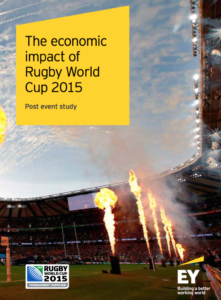
Read more about the impact of RWC2015
Tournament organisers will gain no material benefit from either the tournament sponsorship or broadcast rights as these remain with World Rugby but ticket sales and merchandising can be a big winner.
A total just short of 2.5 million tickets were sold for the 2015 World Cup.
The timetable for the bid is that the letter of formal support from Government will go in to World Rugby, whose headquarters are located in Dublin, next month.
The process of evaluation will take place across the following nine months and a decision announced in September of 2017 giving six years of a build up.
During that crucial period ireland will host the Women’s Rugby World Cup providing vital support for our credentials as a world class host.
Massive undertaking
It would certainly be the biggest international event ireland is ever likely to host and it is good to see that Government is willing to support what will be a massive undertaking across many aspects of society from the sporting community, through local authorities and business.
Four of Ireland’s main Rugby venues will be included on the roster of venues including the Aviva Stadium and the RDS, which may well be the Laya Stadium by the time of the decision, Kingspan Stadium in Belfast and Thomond Park in Limerick.
These will be backed up by GAA stadia including Croke Park which would host the Final, Pairc Uí Caoimhe in Cork, Casement Park in Belfast, Fitzgerald Stadium in Killarney, McHale Park in Castlebar, Pearse Stadium in Galway, Nolan Park in Kilkenny and Celtic park in Derry.
There being no requirement to build a new stadium is believed to be a big winner for the bid, reducing the cost impact considerably while the renovation process would be a boost for jobs, some 34,000 of which were credited to the Rugby World Cup in England last year.