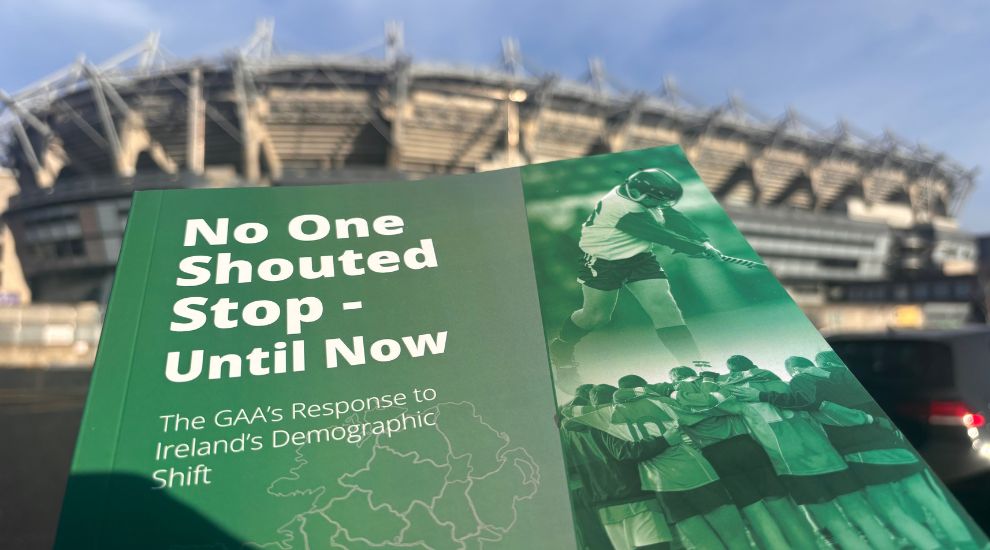
One of the most striking insights to emerge from the GAA’s newly published National Demographic Report is that 25 per cent of Ireland’s 0–5-year-old population lives within the catchment area of only 50 clubs.
In a country with more than 2,000 GAA clubs, that concentration of future members, players and volunteers underlines the scale and complexity of the demographic transformation taking place — and the challenge facing the organisation if it is to retain a meaningful presence in every community. As a further warning sign, the bottom 1,000 clubs share 22 per cent of that same age cohort.
Launched at Croke Park by GAA President Jarlath Burns, the report represents years of work and analysis. It lays out starkly the shifting population patterns that are reshaping the playing field for Gaelic games. Ireland’s population now stands at over seven million — the highest since 1851 — but it is increasingly urban and heavily concentrated along the east coast and in a small number of fast-growing hubs elsewhere around the country.
The GAA’s National Demographic Committee, chaired by Benny Hurl, has produced a clear-sighted assessment of what those changes mean for the Association’s future sustainability. Rural clubs are battling declining numbers, ageing demographics and reduced participation. Urban clubs, meanwhile, are bursting at the seams amid unprecedented demand, stretching volunteers, pitches and facilities to breaking point.
Burns framed the issue as the most significant strategic threat the GAA has encountered in the past century.
“In the last 100 years, no bigger issue has emerged as a threat to our ability to stay relevant to our members than the subject of demographics,” he said. “Many of these challenges are outside of the GAA’s remit to control. But what we must do is have a conversation about how capable we are to still have a foothold and pulse in our cities, towns, villages and rural communities.”
That sense of urgency is echoed throughout the report. While demographic shifts are often discussed as abstract trends for the future, this study defines them as a “present reality” with real-world consequences already evident in player numbers, competition structures, club volunteer workloads and — in some cases — the viability of clubs themselves.
The title of the report, “No One Shouted Stop – Until Now,” is a historical echo of a work published by John Healy in 1968 on rural decline in Ireland. We have known this was an existential threat, and now the GAA is leading on addressing it.
It is not just for the GAA though, a sidebar conversation with Director General Tom Ryan at yesterday’s launch was generous in saying that the Association had undertaken this work because it recognised the danger and was able to marshal the resources, but it was information that was now available to all sports and civic organisations.
The presence of Benny Cullen from Sport Ireland as part of the ecosystem behind the report bodes well for that extension of importance beyond the gates of the GAA club.
A Tale of Two Irelands
Among the most compelling data points are:
- One in three people in Ireland now lives in Dublin or within one hour of the capital, yet only 18 percent of GAA clubs are in this region.
- 52 percent of all 0–5 year-olds live in Dublin, Belfast, Down, Kildare, Galway and Cork.
- 78 percent of GAA clubs are in rural areas with declining populations.
- Birth rates have fallen consistently since 2010, accelerating rural decline.
- Urban clubs are struggling with “overcrowding, resource stretch, and player retention challenges.”
- Without accessible clubs and facilities in expanding urban areas, the GAA risks “losing potential players”.
What emerges is a demographic divide — not simply urban versus rural, but between clubs struggling due to excess demand and those struggling due to lack of it. In population growth centres, particularly in the east, clubs face the pressures of boom: too many children, not enough space, and an unsustainable burden placed on volunteers managing logistics rather than coaching and community-building. In large parts of the west and midlands, the challenge is the opposite: declining school enrolment, fewer teenagers, and difficulty fielding adult teams as the traditional drain of young people toward cities and abroad continues.
The report underscores that this is not a natural cycle that will reverse itself — the population follow-the-work trend has been consistent for decades — and therefore requires proactive planning and policy intervention.
A Roadmap for Renewal
The report’s recommendations are both practical and systemic. They include:
- Supporting clubs that struggle to field adult teams and assisting them to retain official status.
- Targeted growth and development of new clubs, especially in fast-growing urban corridors.
- Pilot projects in Kerry and Kildare, representing two counties dealing with opposite demographic challenges.
- Modified games structures, including 11-a-side and 9-a-side championships, and blitz-based competition models.
- Establishing a National GAA Facilities Strategy to safeguard and prioritise investment in pitches, lights, halls and indoor spaces.
- Development of new bye-laws that could allow players in high-density urban clubs to align with rural clubs, transfer based on family links, or restrict transfers into already full clubs.
- A commitment to multi-agency advocacy — North and South — to ensure the GAA’s contribution to social cohesion, physical and mental health, and local economic impact is reflected in planning and funding.
The creation of a new Club Support Unit at national and provincial level is among the report’s most significant proposals — a structural change aimed at ensuring that growth, sustainability and viability are strategically managed rather than left to the capacity of individual volunteers.
For Chair Benny Hurl, the conclusions are clear:
“This report paints a very clear picture of the dangers posed to us and the urgent need for action. Demographic change is not a future threat — it is a present reality. This provides a roadmap for renewal, ensuring Gaelic games remain inclusive, resilient and central to Irish life.”
Rule Changes, Congress Decisions, and the Long Road Ahead
Not all recommendations require rule changes, but two demographic-focused motions have already been approved for Congress 2026. The first would alter rules to make it easier for clubs to be maintained, retained and grown. The second would enable championship competition at fewer than 15-a-side, which could prove transformative for rural clubs who wish to remain competitive within their communities.
Congress next year will consider introducing fewer-than-15-a-side formats as a matter of policy rather than emergency exemptions. If approved, it could pave the way not only for survival but for reinvention in parts of the country where numbers dictate a different model for competitive play.
It is, in many ways, a recognition that the traditional structures — long considered immutable — were designed for a different Ireland.
What Happens Next?
The report positions the GAA at the intersection of community identity, national planning and social infrastructure. Its recommendations call for collaboration with government departments, local authorities and national agencies; recognition in planning frameworks; and the development of facilities strategies on an all-island basis.
The demographic challenge is profound — but so is the opportunity. A population of more than seven million brings scale, diversity and potential growth for Gaelic games on a level never before seen.
The question before the Association now is how best to adapt not just to population growth, but population change.
As Burns noted, the GAA’s history is built on resilience, reinvention and community. Demographics may be the greatest challenge to that tradition — but they may also be the catalyst for a new phase in how Gaelic games serve and sustain life in Ireland’s towns, cities and rural parishes for generations to come.
We are confident that this can be brought to reality, but the multiple mountains that need to be climbed along the way are scarily high.
Image Credit: Sport for Business
Further Reading for Sport for Business members:
Read our Sport for Business Coverage of GAA
SPORT FOR BUSINESS Upcoming Events


Sport for Business Podcasts

MEMBERSHIP
The GAA, as well as all the leading sporting and business organisations in and around the world of sport, are among the 300+ members of the Sport for Business community.
This includes all of the leading sports and sponsors, as well as commercial and state agencies, individuals interested in our world, and an increasing number from beyond these shores taking a keen interest in Ireland.
Find out more about becoming a member today.
Or sign up for our twice-daily bulletins to get a flavour of the material we cover.
Sign up for our News Bulletins here.