This article was first published in the Sunday Business Post
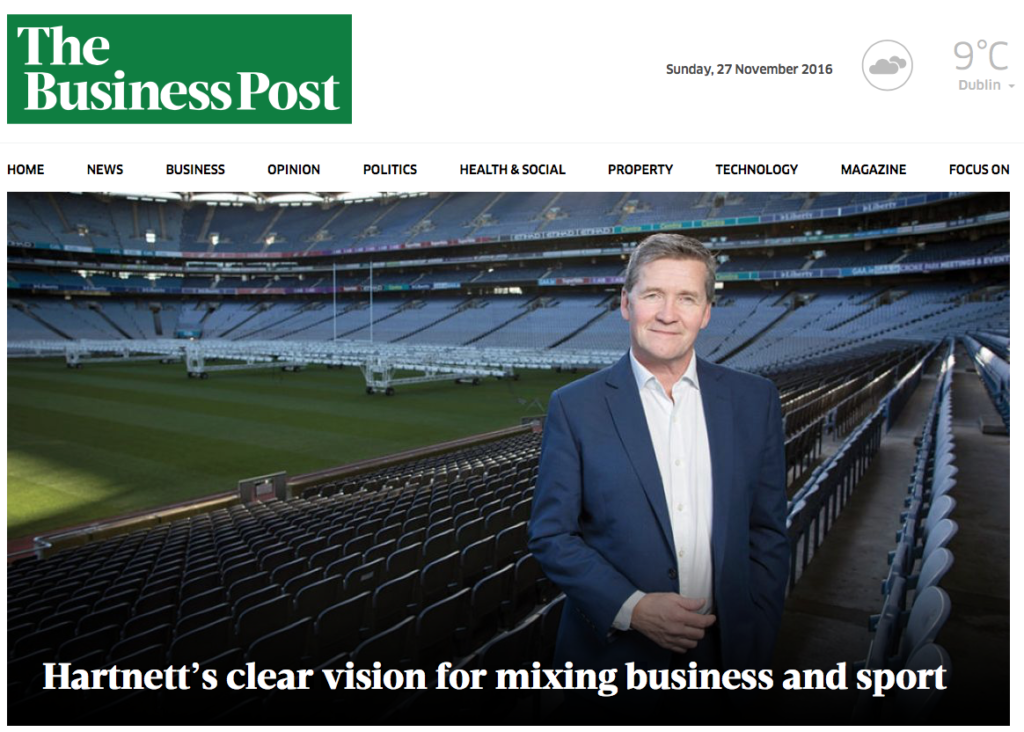
After winning Emerging Sport Business of the Year at the Sport Industry Awards 2016, Rob Hartnett explains how business can take advantage of sport
By Jack Cahill Nov 27, 2016
Rob Hartnett is attempting to corner a niche in the Irish market. The founder and chief executive of Sport For Business believes he has found a way to connect sport and business in a mutually beneficial manner, and he feels that it was always going to be a success because of the nation’s obsession with sport.
“Big business leaders look at their personal lives and recognise that around 80 per cent of their interactions at the water cooler or the boardroom or kitchen on Monday morning will relate to sport from the weekend. We talk about sport and the weather. And sport is more fun than the weather,” he said.
Hartnett launched Sport For Business in 2012, to analyse the world of sport and offer businesses intelligent analysis of what is commercially working well. It is a job that he has immense passion for.
His grandfather was a champion jockey who rode the winner of the Galway Hurdle, and his great-grandfather won the Irish Derby in 1915. His racing heritage would eventually see him enter the world of bookmaking.
Hartnett was born in London, moving to Ireland aged seven. After dismissing fleeting ambitions of becoming a journalist, he got a degree in history and politics from UCD. However, it was sport that would determine his career trajectory.
Returning to England, Hartnett worked at Ladbrokes and Coral before becoming the director of the Tote at just 29. It was, Hartnett said, a comfortable position and one which many would be happy to remain in. But he moved on, citing an ambition to “move to the next stage”.
He said that the lure of Ireland was ever-present, but it was a call from Dermot Desmond and a position within the management team in Betdaq that put him on a plane back to Ireland. “When somebody like that calls, you take the call, and you give it due consideration.”
Hartnett said that Desmond was a big inspiration to him, teaching him that the greatest ideas in the world are worthless without execution.
In 2006, Hartnett was exiting the betting world and moving back to Britain. After the economic crash, he began to question where he could position himself. The answer would emerge from a long-held idea of his: that sport and business were not getting true value out of each other in a way that they should be.
“Sport is such an integral part of our lives now,” he said. “And business is at a point, where coming out of a global recession, it really needs to find new ways of actually engaging with us as consumers, as key influences and opinion makers. I thought this really was a marriage which should be made in heaven.”
The excitement of his work, even four years on, is very much still there for him. “I get up at 5am in the morning. I don’t need much sleep,” he said. He writes a daily digest which informs more than 3,000 subscribers of relevant sport and business insights.
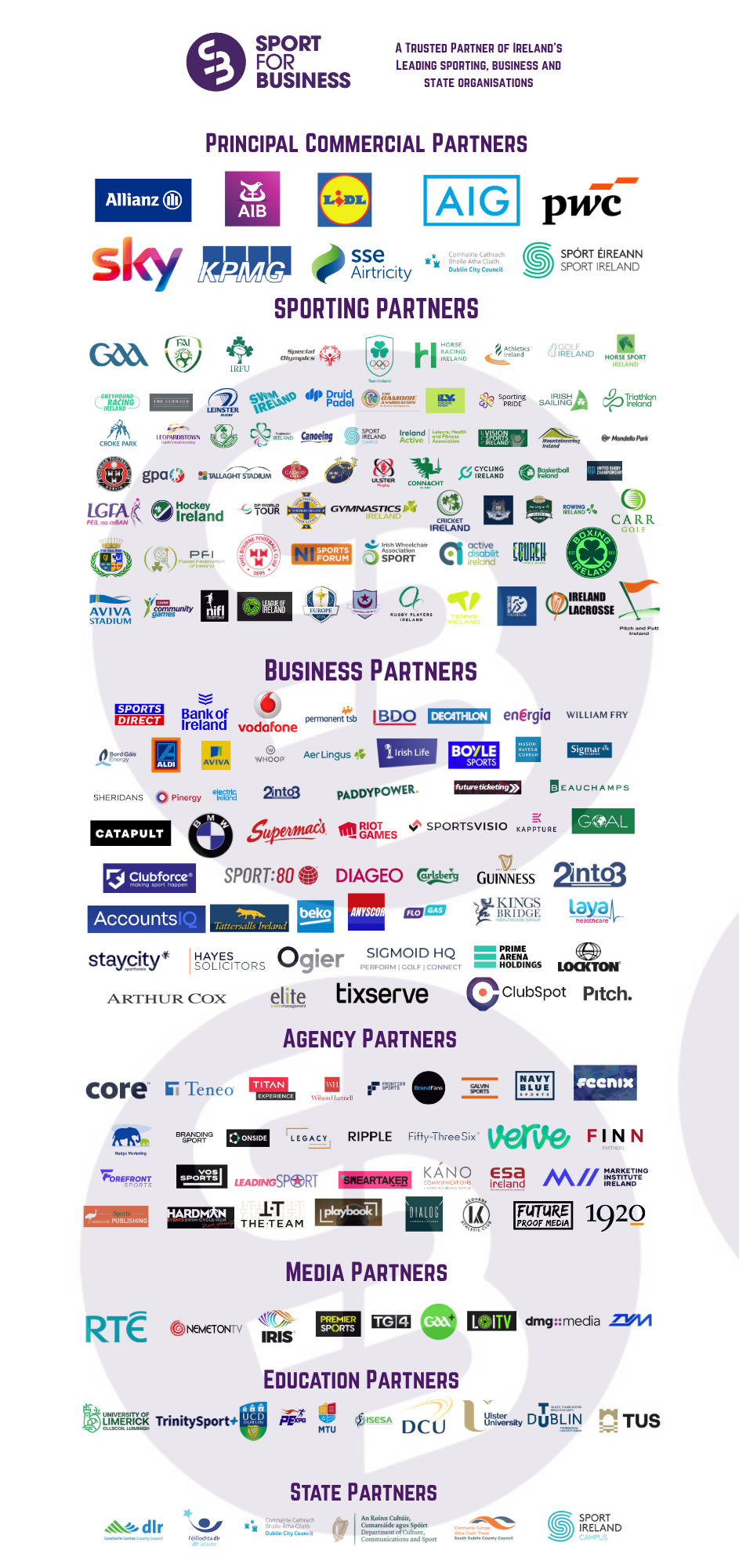
Sport For Business started out with a small number of companies that were willing to stand by it, and today it has more than 70 organisations subscribing, including the likes of PWC and RTE.
“The reaction has been very humbling,” Hartnett said, something proved by the recent Emerging Sport Business of the Year win.
“It was a great honour,” he said. “Especially the reaction afterwards of: ‘Yeah, you deserved it.’ I work on the basis of wild optimism that everyone loves everything I do all of the time, but you never actually hear that. So people saying there’s no surprise and that we’ve done a good job was great.”
Why has it been so successful, and how are businesses using sport to their advantage? Hartnett believes that all the big companies have a sense that sport can play an important role, even if they’re not sure how or why it should be a part of their business.
“The business of sport internationally is worth more than a large proportion of the world’s countries and it’s growing at a faster rate than most sectors,” he said.
“It’s exciting because technology, which is driving so much change in the world, sees sport as being on the cutting edge of where it can develop new things.”
 He pointed to a black band on his wrist. “This tells me analytics for my heart, activity and health. Sport is on the forefront of where companies are looking in order to determine their future, and that’s a great place to be.”
Hartnett said that businesses often felt that they didn’t get the most out of commercial sponsorship deals. “I’m the guy who’s interested in maximising what the sponsor wants to get out of it.”
He corrects his use of the word sponsor. “It’s a partnership,” he said. “And I’m curious about how those partnerships can work best and how I can help them work in a better way.”
Why did he choose Ireland instead of England as a location to set up his business? “Ireland is the perfect country to establish in,” he said. Irish businesses can take advantage of a wide array of sports because the Irish taste in sport is so diverse.
“Irish companies need to appreciate that,” he said. “One fan might watch football on Friday, rugby on Saturday and attend a junior Gaelic football match on Sunday – it makes for an incredibly busy sporting environment that businesses can take advantage of.”
It’s because of this non-stop sport schedule that Hartnett drinks a lot of coffee, a conspicuous admission in the wake of his claim that he doesn’t need much sleep.
So what’s next for him? “We’re exploring opportunities and looking West,” he said. “We’re looking toward a couple of opportunities that may arise in the US and Canada, and also into the Middle and Far East because that’s where sport is travelling.
“We’re going to be watching World Cup finals at 8am instead of prime time, because the East is where the dynamic is shifting to. If I have enough days, weeks and years, then that’s where I can see it expanding.”
Hartnett said his focus primarily lay in doing the best job he can for the people who supported him in the early stages, but said Sport For Business has barely scratched the surface of things they can do and people it can engage with.
With the Emerging Sport Business award behind him and a clear vision for the future ahead, it seems that he has plenty of reasons to be optimistic