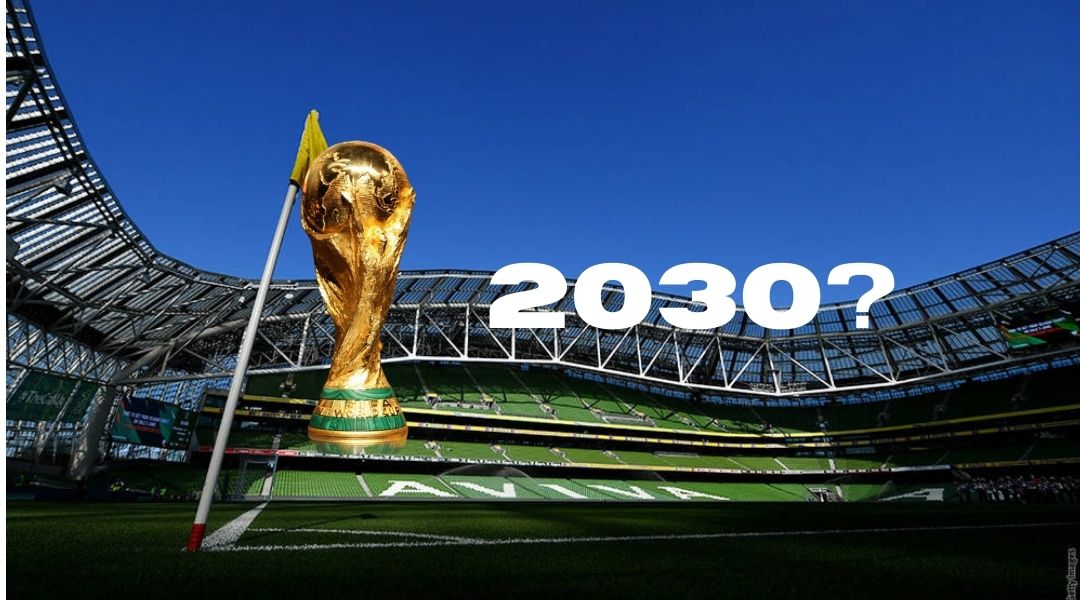
It is the biggest prize in the world of sport and the perfect tonic for a public jaded by Covid and lockdown. At 10:30 last night, the FAI confirmed in a statement that the British Government had given its commitment to support a prospective five association bid to host the 2030 FIFA World Cup.
The FAI has been working on this behind the scenes for a number of years, dating back to the John Delaney era and the bid will be a collective one with the Football Associations of England, Scotland, Wales and Northern Ireland.
“We will continue to undertake feasibility work to assess the viability of a bid before FIFA formally open the process in 2022,” read the FAI statement.
“Staging a FIFA World Cup would provide an incredible opportunity to deliver tangible benefits for our nations. If a decision is made to bid for the event, we look forward to presenting our hosting proposals to FIFA and the wider global football community.”
British Prime Minister Boris Johnson subsequently confirmed that there would be a sum of £2.5 million in Wednesday’s Westminster budget to support the continued work on a feasibility study.
A spokesman for Taoiseach Micheál Martin told the Irish Times that “We look forward to further extensive engagement and collaboration as we seek to refine our hosting proposals in the coming months.
First reports
Sport for Business first reported the potential of a bid in September of 2018.
That was three months before we hosted the draw for the Euro 2020 Championship Finals.
The quality of our bid to win that event, which is still hoped to proceed in June of this year, was hailed at the time as the top of the class and there is no doubt that the country is capable of staging parts of even the biggest events.
The 2026 World Cup will be staged across the United States, Canada and Mexico. The tournament will have expanded by then to 48 teams and 80 matches. It is highly unlikely that a single nation outside of China or Russia could hope to stage a tournament of this scale on their own again.
In 2030 there will be pressure to bring the tournament back to Africa or to China but Europe will want to present a strong case.
Within weeks of the initial story back more than two years ago the previous Government had stated its support.
“Being part of a British-Irish bid would be great for sporting and political co-operation on these islands and hosting the 2030 World Cup would be a once in a lifetime experience,” said Minister of State Brendan Griffin at the time.
News of the bid went quiet as the world struggled with Covid, and there is an element of political flag waving in bringing it out as part of a pre-budget warm-up against a background of mooted threats to the political unity of the United Kingdom but there is a logic to it.
Fevered dreams
Ten years ago we could only have had dreamt, and in fevered fashion at that, of being in such a position.
The reality now though is that we are confident, we have facilities, our infrastructure is strong and our willingness is proven.
Croke Park and the Aviva Stadium would be the only stadia on the island of Ireland with the 50,000 capacity likely to be needed but the lack of a need to build new infrastructure would be a positive in what could be a period of potential restraint in public spending on what might be seen as non-essential projects.
The Government’s ten year National Sports Policy will have been renewed by the time 2030 rolls around.
Could a major part of that be how to plan for the impact and the lasting benefit of hosting Brazil, France or Argentina in the FIFA World Cup?
Sport for Business Partners
[logo_carousel_pro id=”51608″]