Sport Ireland has published the latest snapshot of female representation on the boards of funded National Governing Bodies of Sport and Local Sports Partnerships and other funded bodies.
This is the number that has been long flagged as needing to hit 40 percent of gender balance by the end of this year or for their to be funding implications.
The Minister for Tourism, Culture, Arts, Gaeltacht, Sport and Media, Catherine Martin TD, and the Minister of State for Sport and Physical Education, Thomas Byrne TD, have welcomed the publication which shows that for the first time, there is female representation on the board of every funded sporting organisation in the country.
The overall percentage of women on boards in the sports sector in Ireland now stands at 42%.
Significant progress has been made since the first publication of the snapshot 2019 when females made up an average of only 24% of boards in the sector.
The last snapshot, published in November 2022, had seen this figure increase to 36%, and now the figure is at 41 percent overall for the National Governing Bodies (and other sporting bodies). The overall Local Sports Partnership figure now stands at 43 percent overall, a four percent increase from November 2022.
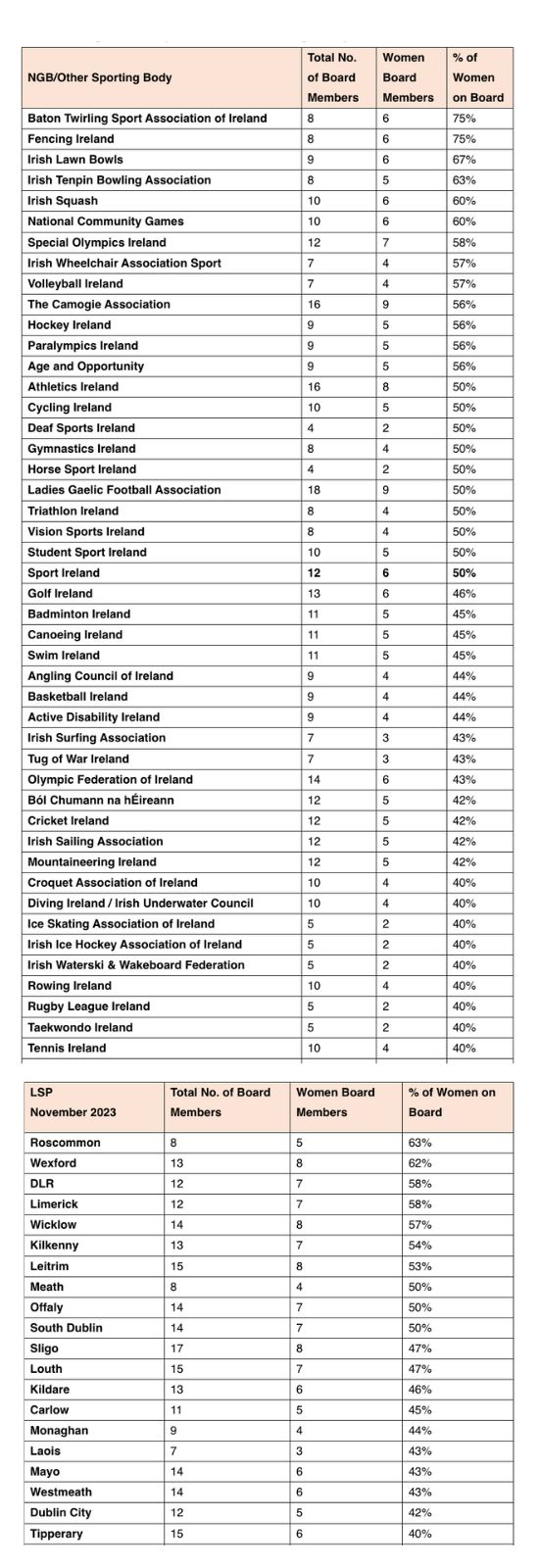
48 NGBs have reached the Government target of 40 percent (or more) females on their board while 20 LSPs have also reached the target.
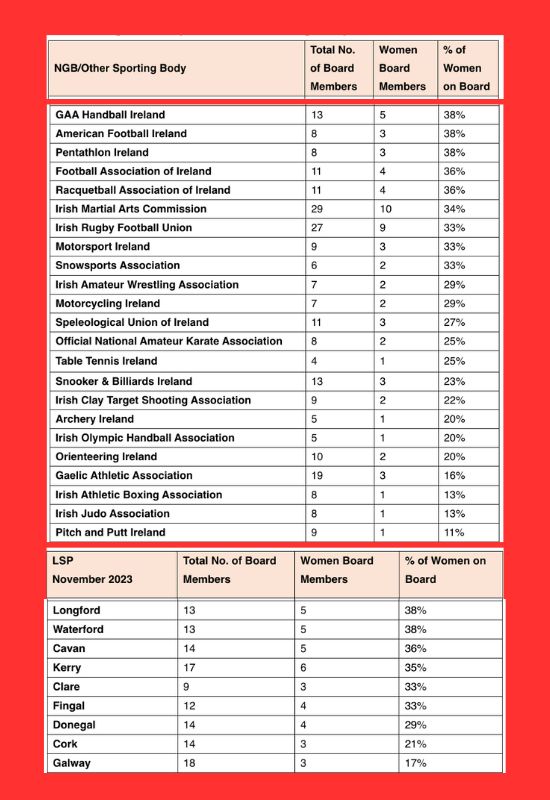
While good progress has been made by some, there is still quite a way to go for others. 23 NGBs have not met the 40 percent target with four of these having less than 20 percent female representation on their boards. Nine LSPs are yet to reach the 40 percent target.
It has been said all along that sporting bodies that do not reach the 40 percent target by the end of the year will have their state funding cut by up to 50 percent with such cuts remaining in place until such time as the 40 percent target is achieved by the sporting body.
It has been noted that a number of the bodies, including the biggest three of the GAA, FAI and IRFU have moves in place to hit the figure in the very near future but any failure of these plans will be treated with serious dissatisfaction and a cut of funding.
The full list of the snapshot is published below first of all with those who have reached the target:
And then with those who have yet to do so:
There is an argument for questioning the four at the top of the list who have an overbalance of female representation, based on the fact that diversity of viewpoint and gender balance cuts both ways.
The 32 organisations that have yet to reach the target need to have a very strong and very fast plan of action to rectify what has been on the horizon for years and which must surely have been raised and discussed at Board level throughout that time.
It is hard to see how greater progress in those towards the bottom of those lists has not been made.
The Ministers took a more conciliatory tone in welcoming the progress.
“We are seeing consistent growth in female representation year on year, and I am pleased to see the average number of females on NGB boards increase from 36% this time last year to 41% now. We also see another key sign of progress with female representation on every board for the first time,” said Minister for Tourism, Culture, Arts, Gaeltacht, Sport and Media, Catherine Martin.
“I would like to reiterate the need for sporting bodies below 40% to make the target an immediate priority. Boardrooms should be representative of our society and reflect modern Ireland, through proportionate gender membership. The 40% target is crucial, because it is important for women to be seen and heard at the decision making table.”
“I want to acknowledge and commend the efforts of many sporting bodies to increase female representation on their boards, and it’s apparent from the latest figures, that many sporting bodies have made this area a priority,” added Minister of State Thomas Byrne.
“Female representation at all levels of sport is crucial if we are to increase female participation and retention in sport. For those organisations who are yet to meet the target, there is still time to do so before the end of the year and I would encourage them all to do so.”
“The decision-making processes in governing bodies should mirror the diverse communities they serve,” said Sport Ireland CEO Dr Una May.
“2023 has been another year of significant progress for female representation in governance and leadership positions, a key objective outlined in Sport Ireland’s updated Women in Sport policy.”
“We appreciate the effort that has gone in by the sector at all levels to deliver this, but there is still a way to go for some National Governing Bodies & Local Sports Partnerships and Sport Ireland will continue to work closely with these organisations to assist them in reaching the 40% target.”
As well as acknowledging the board composition of funded bodies, Sport Ireland is also monitoring the proportion of women in leadership positions within funded bodies.
“It’s important to recognise the positive progress made by sporting organisations over the past year,” said Sport Ireland Women in Sport Lead Nora Stapleton.
“For example, Cricket Ireland has progressed from 25% in November 2022 to 42% in this year’s snapshot, while other sports such as Athletics Ireland, Tennis Ireland, Mountaineering Ireland, Tug of War and Irish Lawn Bowls have all made huge efforts to achieve the 40% target this year.”
“Similarly, we can see positive progress made by the LSPs. For example, South Dublin has progressed from 29% in 2022 to 50% in this year’s snapshot while Louth has increased its female membership from 31% in 2022 to 47% this year.”
It is right to praise those who have but the clock for those who haven’t is now at one minute to midnight and action will be needed to ensure that the efforts of those who succeeded was not seen by some as not having been as important as it actually is.