The power of video to inspire and condemn was evident in clear fashion last night as RTÉ aired The John Delaney Story in prime time.
Last week we finished reading Champagne Football the acclaimed book by Sunday Times journalists Mark Tighe and Paul Rowan.
We have of course been writing and following the story in fine detail since the €100,000 cheque that began unpicking the story in March of last year.
But nothing quite condemns Delaney like the images of his cavorting with fans and underscored by a soundtrack that hinted at devilish intent.
Brian Kerr’s stand out quote comparing him to Di=onald Trump, but that being a bit unfair on Trump, is one of the hundreds he has expressed in print and on-air over the period but taking it in isolation gave it extra heft in making sure that Delaney was to be buried deeper in public terms than the 304 pages of the more detailed book could ever do.
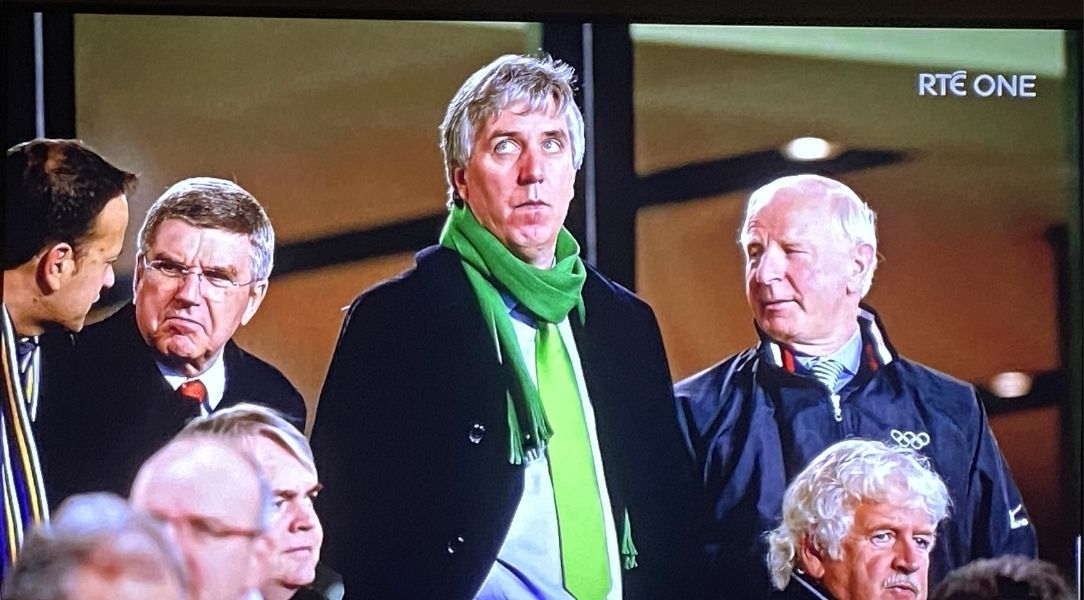
Even the image above, taken from the show which shows Delaney alongside Pat Hickey to his left, Thomas Bach of the IOC and Leo Varadkat to his left, encapsulates the heady context of power and influence that forms the backdrop to the story.
Soundbites and Glances
We live in a world of soundbites and glances and this was full of them. The appearance before the Oireachtas Committee lasted some nine hours when it happened in April. Last night it was encapsulated in a few minutes but it was done to perfection. The reactions of Catherine Murphy, Ruth Coppinger and Jonathon O’Brien were enough, as well as the clear discomfort of the various FAI personnel gathered on the opposite side of the committee room.
The final understated words of Richard Sadlier, “It doesn’t look great,” summed up the sixty minutes that had gone before and while the detail of the TV programme was much lighter than the book, it was enough to ensure that the Delaney era will not be forgotten quickly.
Ultimately he came across as a charming character who would turn with a vengeance when crossed. A being reading of the story could suggest he was a victim of circumstance in terms of drawing up Celtic Tiger plans and revealing them just as Lehman Brothers collapsed and the economy tanked.
It was in his reaction to the disaster of the financing though that was his undoing. A lack of willingness to accept the blatantly obvious may have been guided by the family history of being seen as having failed giving no scope for salvation.
And then there was the lifestyle. From a family man to a playboy with a James Bond themed birthday party is not a path that many could or would travel.
Self-reflection
At what point of self-reflection might Delaney look back and think of one sliding door moment? Or was it cumulative and inevitable that it would end as it has with the ashes of a career now only likely to be stirred again by the shadow of potential legal repercussions?
He still has those who will defend his generosity to clubs around the country. If only he had been doing it with real money rather than a debt that was always going to come home at some point.
Or was it? He had covered his tracks well for a decade, evading the efforts of many journalists who continued to cover the games but could not get under the politics and the finance. It was the actions of a disgruntled former employee that blew the whistle by sending a photocopy of a cheque to a non-football journalist that brought the house of Delaney tumbling down.
But what if the Republic of Ireland had qualified for the 2010 or the 2014 World Cup Finals, or even 2018?
What if?
What if the spirit of Italia ’90 or USA 2004 had continued to hold us in thrall as a sporting nation. If the gamble on ticket sales had proven to be a winner would he have still self-destructed or would he have gotten away with lower standards on the basis of being a man who delivered? After all, he did for the best part of a decade.
The systemic faults that allowed him to bring the FAI to the point of destruction are the ones that have to be addressed.
The comic farce of drinking from shoes, bar tabs and chartered trains is done now.
We just have to make sure that the next time the opportunity arises for a single concentration of power to be wielded so damagingly, that enough people are watching and willing to call a halt.
Join us this Thursday morning, November 12th at 11 AM for an online session with the authors of our monthly Irish Sport on Social media report.
A chance to chat with the authors of the report and look at ways in which sporting bodies and sponsors, as part of the Sport for Business community can maximise their impact across Instagram, Facebook and Twitter.
Sport for Business Partners
[logo_carousel_pro id=”51608″]