This week Sport Ireland published the 2024 Irish Sports Monito, a deep dive look into how we as a population participate in sport and get physically active.
It is always a treasure trove of data and vital for determining policy.
We covered the publication of the report and are in the midst of a series of spotlight features looking at different areas.
To get the inside story on what the authors consider to be the most important elements we sat down with Benny Cullen, Director of Research and Innovation at Sport Ireland.
What are three of the highlights that stand out for you from the latest Irish Sports Monitor?
The first highlight is that in 2023, two million people aged 16 or over played sport weekly.
This equates to 47% of the population, the highest sports participation rate ever recorded and a significant increase from the low of 40% measured during the depths of the pandemic in 2021.
Second must be the progress made concerning the gender gradient. The difference in sports participation rates between men and women was measured at 2.9%, this is the lowest ever recorded and a major improvement on the 16% difference measured in 2007 when the ISM was first introduced.
Third is the difference in sports participation between upper and lower socio-economic groups, which is still significant at 19% but is lower than at any point during the pandemic and much lower than the 34% difference measured in 2017.
And what are some of the numbers that remain stubbornly difficult to shift?
The difference in sports participation rates between people with and without a disability seems resilient to change, it was measured at 20 percentage points in 2023.
The stubborn nature of this gradient is possibly related to the ageing profile of the Irish population. Older people are more likely to have a disability than younger people, which means the number of people with a disability in Ireland is increasing as the population ages.
There is a lot of excellent work happening in the disability sports space from Sports Inclusion Disability Officers in Local Sports Partnerships (LSPs), several disability-focused National Governing Bodies (NGBs) and organisations and disability-specific programme funds, all of which is important to continue resourcing and supporting.
There is also a growing difference in sports participation and club membership emerging among ethnic minorities, which we will need to continue monitoring and ensure that the sports sector is well positioned to address.
Our recently launched European Social Fund programme, Sport for Empowerment, will have a specific focus on engaging with ethnic minorities and migrants.
Are we fully bounced back now from the effects of the Pandemic?
Sports participation rates now exceed the pre-pandemic highs measured in 2019. Event attendance rates have also exceeded 2019 levels, with one in five people (20%) attending sporting events every week.
Although club membership rates (35%) have increased by four percentage points since 2022 (31%), they remain slightly behind levels measured in 2019 (36%).
However, population increases over the same period means that there were more club members in 2023 than ever recorded before at around 1.5 million people.
Similarly, volunteering rates increased by two percentage points since 2022, returning to 11%, which was the baseline figure recorded in 2017.
Like club membership rates, this remains marginally behind 2019 levels (12%), but due to population growth, the overall number of volunteers in 2023 was the same as that measured in 2019.
What are the differences in policy that can be effected through the detailed insight this research gives us?
This research is one of the cornerstones of national sports policy and investment strategies.
It provides the evidence to inform decisions related to major initiatives such as the Women in Sport movement, the resources and supports provided for people with a disability such as the network of Sports Inclusion Disability Officers, as well as investments such as Dormant Accounts and European Social Fund focusing on communities of socio-economic disadvantage.
Furthermore, the research can help us understand areas we are doing well in such as sports participation and event attendance, while also highlighting areas where additional focus may be required such as building club capacity and supporting volunteer development.
Are we ahead of the game in Ireland versus others around the world in diving behind why people participate?
The 2022 Eurobarometer, a Europe-wide survey of sports participation, tells us that Ireland ranks 6th in weekly sports participation of the 27 nations in Europe.
The ISM and Eurobarometer both found that the biggest motivation for sports participation in Ireland are to improve health (55%) and fitness (55%) and that those living in Ireland are more likely than the European average to be motivated to participate in sport by health and fitness, 54% and 43% respectively. In contrast, people living in Ireland (19%) are less likely than the European average (27%) to be motivated by improvements in performance.
The biggest barrier to sports participation reported across Europe and Ireland is a lack of time. People living in Ireland (45%) are more likely to report time being a barrier to sports participation than the European average (41%).
Other major barriers reported to sports participation in Ireland include illness or disability (10%) and general lack of interest or motivation (16%), however, the Eurobarometer found that those living in Ireland are less likely to report these as factors than the rest of Europe (14% and 25% respectively).
What are the main priorities on the list to change now do you think in the remainder of this year?
The first thing I would say is to continue doing the great work that is being done across the country, the numbers are all moving in the right direction since the pandemic.
We need to recognise and acknowledge the work at the local level among clubs and volunteers, at an organisational level across NGBs and LSPs and the investment from Government that has underpinned the positive recovery we now see in sport.
The evidence would suggest we need to continue supporting disability sport initiatives while strengthening partnership approaches with the Department of Health and the HSE. We need to better understand the challenges facing people with different kinds of disability and to find innovative ways to ensure that those who acquire disabilities and chronic illnesses as they age, are provided with the necessary support and services to be physically active.
Continued initiatives and investments such as Dormant Accounts and European Social Funds which target communities of disadvantage are still needed to further reduce the socio-economic gradients in sport.
An area that may need additional attention and further research is capacity at a local level. We need to work with the NGBs and LSPs to ensure sports clubs can take on additional members to the scale required to meet the national sports policy targets.
We must also work with NGBs and LSPs to ensure that sufficient sports volunteers are recruited, supported, and resourced to underpin the growing number of sports participants.
These last two factors around capacity will be critically important in addressing teenage dropout, as the number of teenagers in Ireland will have grown by approximately 20% between the start and the end of the National Sports Policy 2018-2027.
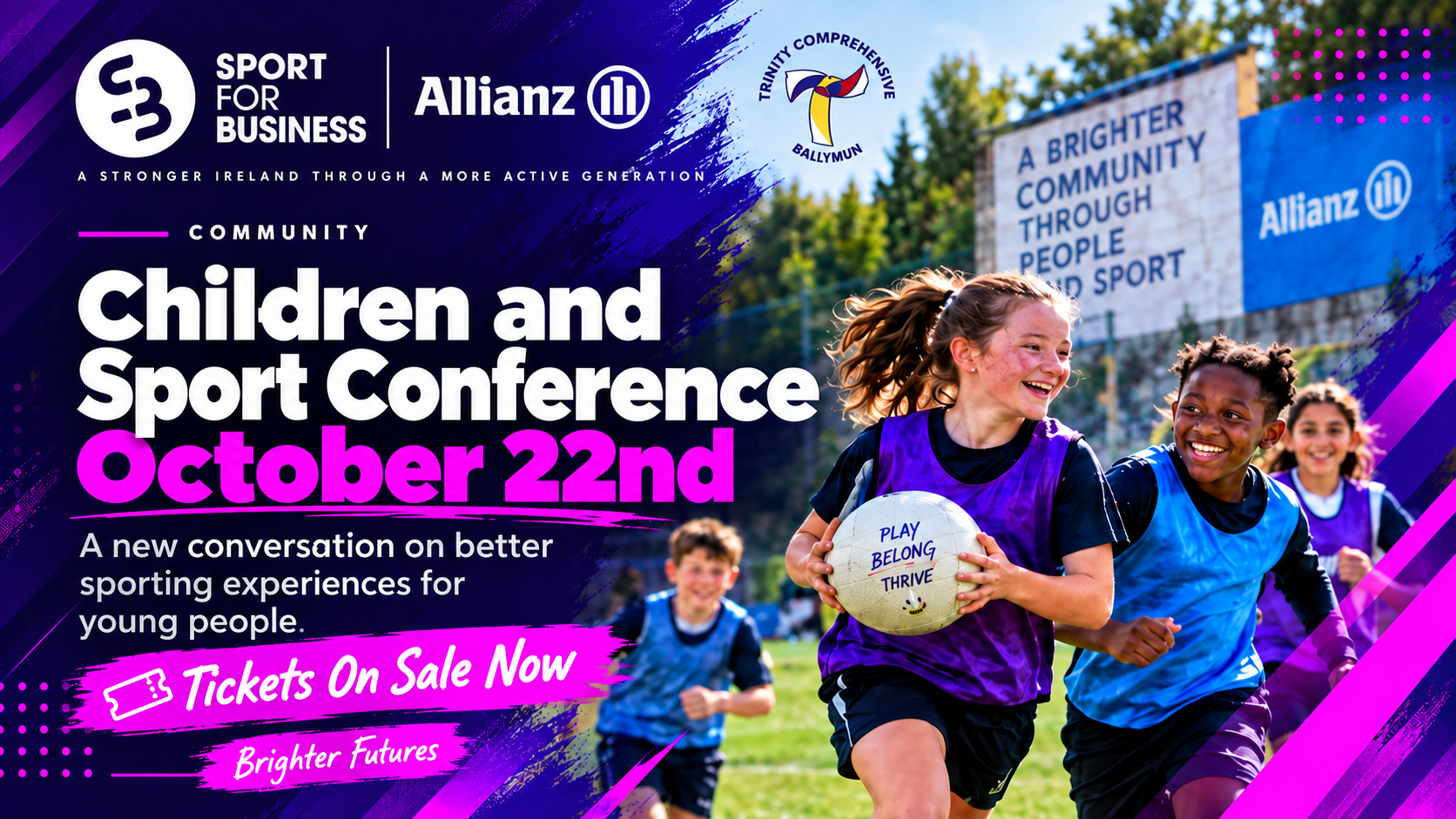
Sport for Business in partnership with Allianz and Sport Ireland will hold the 2024 Sport for Business Children and Sport Conference on Thursday, September 19th.
Register your interest to attend a Sport for Business event here.
The Sport for Business Membership comprises nearly 300 organisations including all the leading sports and sponsors, commercial and state agencies. Sport Ireland are among them.
Find out more about joining us today.

Be part of the biggest community of sporting and business organisations in Ireland by becoming a member of Sport for Business and enjoying a host of benefits.
Check out our upcoming events to discover ways of connecting in person with our membership.