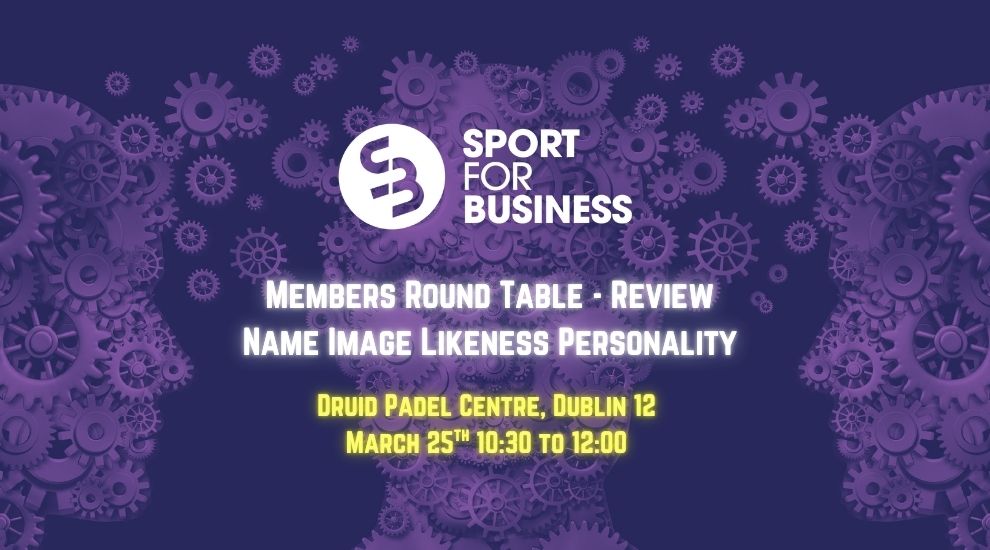
The first Sport for Business Members Round Table of 2026 took place yesterday morning on the subject of Name, Image, Likeness and Personality.
It produced a timely, honest and at times challenging discussion on how Irish sport is adapting to a world in which athletes are no longer simply performers on the field, but increasingly powerful public figures off it as well.
Held at the new Druid Padel Centre in Kimmage, the conversation reflected the practical reality of sport itself: adaptable, informal and grounded in the circumstances at hand. What emerged over the course of the session was not a single answer to the NIL question in Ireland, but a far clearer picture of where the pressures, opportunities and tensions now sit.
The central theme was simple. Irish athletes, particularly in amateur and semi-professional structures, are becoming more aware of the value of their name, image, likeness and personality, while the legal and organisational structures around them are still catching up.
Legal Rights
In the United States, NIL has rapidly transformed the landscape, especially at college level. In Ireland, by contrast, there remains no clear standalone legal right to image or personality. Protection is often derived instead from “passing off”, or registered intellectual property rights, such as trademarks, all of which can work in practice, but which place the burden on the athlete to prove value, ownership or misuse on a case-by-case basis.
That legal grey area was one of the most striking elements of the discussion. It means elite athletes may have some recourse if their image is used without permission, but lesser-known athletes are more vulnerable. It also means that many brands, sports bodies and media actors are operating in a space where convention often runs ahead of law. That uncertainty is manageable for top-tier stars with representation and commercial advice. It is far more problematic for emerging players or amateur athletes who may not yet have the support or confidence to challenge misuse.
The GAA context was especially revealing. There is a growing recognition, driven in part by the GPA and agreed to by the GAA in the recent GAA/GPA Protocol, that inter-county players own their own identity and should have greater control over how it is used. That recognition is not merely theoretical. Players are becoming more commercially aware, more conscious of their rights and more willing to question why their likeness appears on billboards, campaigns or promotional material without permission or payment. Yet the amateur culture of Gaelic games still complicates matters. There remains a suspicion in some quarters of agents, personal branding and overt commercial ambition, even as the sponsorship and media ecosystem around the games becomes ever more professional.
Cultural Contradiction
That cultural contradiction was a recurring theme. In many cases, the room agreed that the real issue is not just name or image, but personality. Brands increasingly want authenticity, relatability and story. They want athletes who fit their values and who can connect with audiences in a meaningful way. The athlete who can speak naturally, engage on social platforms and bring a credible off-field identity may be more valuable than a bigger sporting name who is less open or less suited to the campaign.
That shift feels important. The discussion repeatedly moved away from pure star power and towards personal fit. In rugby, Paralympics, women’s sport and talent management, the strongest commercial opportunities often come not just from medals, caps or headlines, but from the person behind them. Athletes with depth, interests, humour, resilience or a distinctive point of view are increasingly the ones who cut through. Performance may open the door, but personality is what sustains the opportunity.
At the same time, there was no romanticising of this new landscape. Greater visibility brings greater risk. Social media gives athletes direct access to audiences, but it also exposes them to abuse, scrutiny and reputational danger. Several contributors spoke about the need for better education, stronger duty of care and more robust guidance for athletes as they build public profiles. In some cases, a single post, old comment or poorly handled interview can have serious consequences. That creates a clear need not only for commercial support, but for media training, digital auditing and a degree of care.
Relationship Management
There was also an important discussion about the relationship between sports bodies and individual athletes. In professional settings such as rugby, a more established framework exists to balance collective commercial rights with individual opportunity. But even there, tension remains between protecting the value of the team and allowing players to maximise their own identity. In amateur sport, and particularly in the GAA, that balance is less settled. The challenge for the coming years will be to create structures that protect governing body partnerships while also respecting the athlete’s right to control and benefit from their own persona.
Looking ahead, the tone of the room was cautiously optimistic. There was broad agreement that this space will evolve quickly over the next five years. Better education, clearer protocols, improved rate structures and perhaps eventually stronger legal protections all feel necessary. Technology may also play a role in matching athletes and brands more efficiently, though the consensus seemed to be that trust, judgement and human advice will remain essential.
What made the round table valuable was not that it solved the issue, but that it brought together those who are shaping it from different angles: governing bodies, brands, agents, lawyers and commercial managers. The conversation made clear that Irish sport is at an inflection point. Athletes are no longer just representatives of teams and competitions. They are becoming brands, storytellers and rights holders in their own right.
The task now is to ensure the systems around them evolve accordingly.
Our thanks to Druid Padel for hosting us for this debate, and to Derek Kinnevey of Paralympics ireland, David McHugh of The-Team, Joe Mooney, formerly of Aldi, Jordi Murphy of Navy Blue Sports, Paddy Murphy of Ogier, Henry O’Hora of Diverse Sports Agency, Colm O’Mealoid of the GAA and Gaelic Players Association, Mark Russell of Druid Sports, Sean Ryan of the IRFU and Matt Steerman of Wilson Hartnell for contributing to the debate.
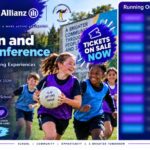
Details of our next Members Round Table on Keeping Children in the Game can be found below.
 If, like all of those in attendance at this event, you would like to be part of the Sport for Business community and see the story of your organisation in our content, on our stages, and in the conversation happening every day around the commercial world of Irish Sport, email us today and let’s see what is possible.
Image Credit: Sport for Business
ABOUT SPORT FOR BUSINESS
Sport for Business is Ireland’s leading platform focused on the commercial, strategic and societal impact of sport. It connects decision-makers across governing bodies, clubs, brands, agencies and public institutions through high-quality content, events and insight. Sport for Business explores how sport drives economic value, participation, inclusion and national identity, and how your story can be part of ours.
Through analysis, storytelling and convening the sector, it helps leaders understand trends, share best practice and make better-informed decisions. Its work positions sport not just as entertainment, but as a vital contributor to Ireland’s social and economic fabric.
Find out more about becoming a member today.
Or sign up for our twice-daily bulletins to get a flavour of the material we cover.
Sign up for our News Bulletins here.
Upcoming Events