One more note on Rory McIlroy’s weekend win of particular interest to the human science and WHOOP obsessives among us.
The physiological data behind his historic Masters triumph, McIlroy’s WHOOP data offers a rare insight into how elite composure and recovery underpinned his performance under pressure.
On the final hole, his metrics told a remarkable story of composure in the face of adversity. After his tee shot found the trees, his heart rate spiked to 135 BPM before dropping to 121 BPM on his recovery shot, a sign of rapid recalibration. It rose again to 136 BPM from the bunker, but then steadily fell through the closing moments: 117 BPM on his first putt and just 105 BPM on the winning putt, despite a maximum heart rate of 150 BPM recorded at the moment of victory.
For performance analysts, the ability to physiologically calm down at the point of greatest pressure is regarded as a hallmark of elite mental control.
The broader tournament data underlines the platform McIlroy built across the week.
His WHOOP Recovery score, which measures daily readiness to perform, remained consistently high, registering 89% on Thursday, 79% on Friday, 94% on Saturday and 87% on Sunday.
Daily strain, WHOOP’s measurement of cardiovascular and muscular exertion, remained elevated throughout the tournament and peaked at 16.8 on Saturday, reflecting the physical and mental demands of sustaining contention over four days.
Sleep, one of the core pillars of performance, also featured prominently in his preparation. McIlroy logged more than nine hours of sleep ahead of Sunday’s final round, equating to 92 per cent sleep performance, and averaged eight and a half hours per night over the course of the tournament.
His resting heart rate remained exceptionally low and stable at between 47 and 49 BPM all week, another indicator of elite conditioning and recovery.
The physical load of tournament golf is often underestimated, but McIlroy recorded more than 24,000 steps on Sunday alone and amassed 91,247 steps across the Masters weekend.
The data provides a compelling look behind the curtain at how modern elite athletes are using performance technology not just to train harder, but to recover better, regulate stress, and execute under pressure.
There can hardly be a better real life example of how biometric performance data is becoming increasingly central to the preparation and optimisation of world-class athletes, and of the rest of us, should we choose to follow a path of knowing our own bodies.
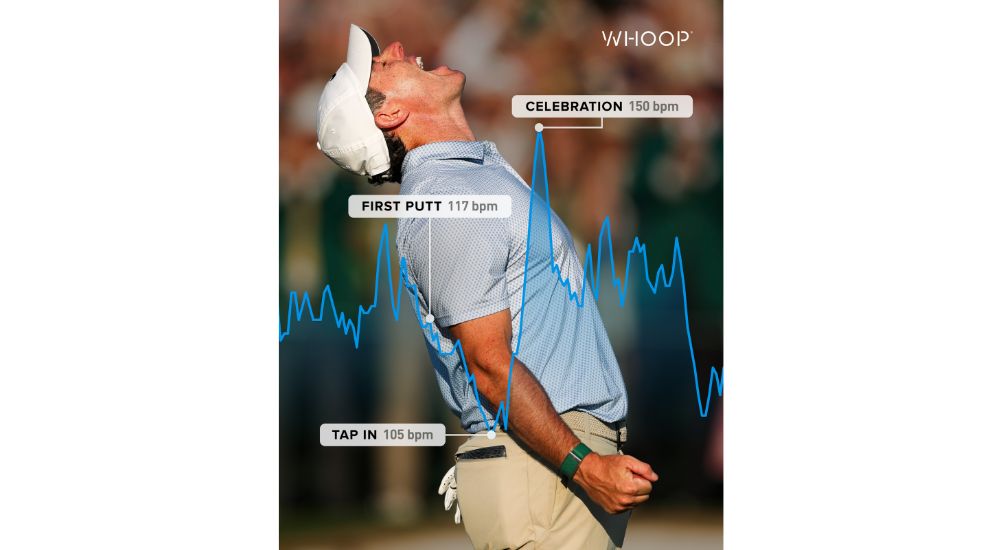
Image Credit: Whoop
 WHOOP and Golf Ireland are full members of Sport for Business. If you would like to join them and see your organisation in our content, on our stages, and in the conversation happening every day around the commercial world of Irish Sport, email us today and let’s see what is possible.
ABOUT SPORT FOR BUSINESS
Sport for Business is Ireland’s leading platform focused on the commercial, strategic and societal impact of sport. It connects decision-makers across governing bodies, clubs, brands, agencies and public institutions through high-quality content, events and insight. Sport for Business explores how sport drives economic value, participation, inclusion and national identity, and how your story can be part of ours.
Through analysis, storytelling and convening the sector, it helps leaders understand trends, share best practice and make better-informed decisions. Its work positions sport not just as entertainment, but as a vital contributor to Ireland’s social and economic fabric.
Find out more about becoming a member today.
Or sign up for our twice-daily bulletins to get a flavour of the material we cover.
Sign up for our News Bulletins here.
Upcoming Events