 We all know how magical sport can be, how important to the physical and mental health of the nation. Sport at the highest level for commercial partners comes with a justifiably high price tag but away from the circus and the hoopla of elite men’s sport, there is a fast growing belief that the next really great opportunity to associate with sport will come in women’s sport.
On Thursday morning, May 31st, in the shadow of Croke Park, a group of twelve individuals joined me in the latest Sport for Business Members’ Round Table to explore the potential, the hurdles to be overcome, and the massive opportunity that women’s sport presents.
There are many hurdles, some internal and some external. There is a huge disparity in the approach to girls and boys playing sport in school. In Britain research shows that girls leave school only half as active in sport as boys. Only 20% of girls and women do enough physical activity to be of benefit to their health yet the rise in confidence that sport brings about in an individual is immense.
Su Carty, Women’s Development Manager at the International Rugby Board will oversee one of the biggest potential advances in international women’s sport when Rugby Sevens makes its Olympic debut in Rio four years from now.
“The IOC would only consider the inclusion of a men’s event if there was a women’s one as well and that has given great energy and credibility to the growth of the sport in a great many countries.”
 “The level of genuine interest in what we are trying to achieve is on a steep upward curve and that will be good for all women’s sport.”
“We have to stand up for the idea that sport is not just seen as an option for women, nor is it for men. It should be seen instead as a human right.”
“The majority of women business executives in the US had participated in sport well beyond their school years and the confidence which participation in sport breeds should not be restricted by gender.”
“The inclusion of 7’s on the Olympic schedule is a real opportunity to build an Irish team that will be competitive and which may bring home a medal,” said Gemma Crowley, Manager of the Irish Women’s Rugby Team in both 15-a-side and 7’s. Gemma is important in showing a pathway for women to play and then manage in sport, one that needs to be enhanced across sports management and governing bodies.
The strong theme coming through was that women are fighting for parity in every facet of society and that we should not accept anything else in sport.
The point was raised that the quality of competition has risen significantly in recent years in many sports and this is critical to gaining acceptance from broadcasters in new or traditional media.
“It is vital to get women’s sport on screens, whether the box in the corner or the laptop in your bag,” said Joan O’Connell, a writer with Beaut.ie the leading online blog.
“We asked that a Women’s international rugby match being broadcast on Sky be put on the TV in a pub recently.”
“When the players ran out many of the men laughed. Within three minutes they had stopped laughing and were grudgingly admitting this was not bad. Within five minutes they were cheering the action in the way they would any top class sport.”
Liz McKeever of McKeever & Associates said that women’s sport can achieve real traction with sponsors by producing imaginative approaches to coverage through social media. “Dare to be different because that is what sponsors are looking for,” she said.
“It is important to try and piggyback events where media may already be present,” said Lúcás Ó’Ceallacháin, General Manager of Olympic Handball. “At a European level we had one nation that was pressed for cash and wanted to change the home and away basis of international competition in order to focus on a single venue round robin tournament.” “They were ruled out by Iceland, a nation of only 200,000 people.” “Why?” “Because Men’s handball draws its community from playing across Europe and so too must Women’s.”
The point of putting on events at the same time was also raised By Eavan Mulligan of Gaelic Handball which is hosting the World Championship in Dublin this year. “We have two great champions in Paul Brady and Fiona Shannon but the success of securing SKY TV coverage of the Men’s Final is tempered by their showing little interest in the women’s event at the same location and the same timeframe. We are working to find a way around that.”
Lesley O’Halloran is a World Champion veteran tennis player. When she returned from her title victory in California there was little or no coverage, other than in Sport for Business but she pointed out that looking to other sports in other jurisdictions would give us some ideas to try. The positive impact of an innovative approach to sponsorship and profiling of Netball in Britain and Australia had revived the sport which was now thriving and would certainly give food for thought.
On the question of media coverage, Paul McDermott of the Irish Sports Council is at the sharp end of trying to get coverage for all sports and all genders. “There are the big five of GAA, Rugby, Soccer, Golf and Horse racing.” “When we are lucky there is a sixth spot but there are lots of equally valid claims on that space.”
“Camogie has employed a full time communications person for the past two years,” said the sports former President Joan O’Flynn. “Our local coverage is good, our national benefits from RTE broadcasts but we also have to reach beyond traditional methods and provide news and opinion through the internet and facebook.”
The importance of media was echoed by Angus Kirkland, CEO of the Irish Hockey Association which maintains a strong relationship on the Women’s side with Electric Ireland. “What we can show through owned as well as earned media is important to sponsors in terms of a measurement of the effectiveness of their investment.”
Donagh Morgan from the Department of Transport, Tourism and Sport stressed that the central government funding of sport was through a combination of the Irish Sports Council and capital grants for facilities. Over €1 million was being spent to build female changing facilities at boxing clubs as a direct result of the growth in the sport through Katie Taylor’s successes. “We have to provide facilities that will encourage girls and then women to feel comfortable in a sporting environment.”
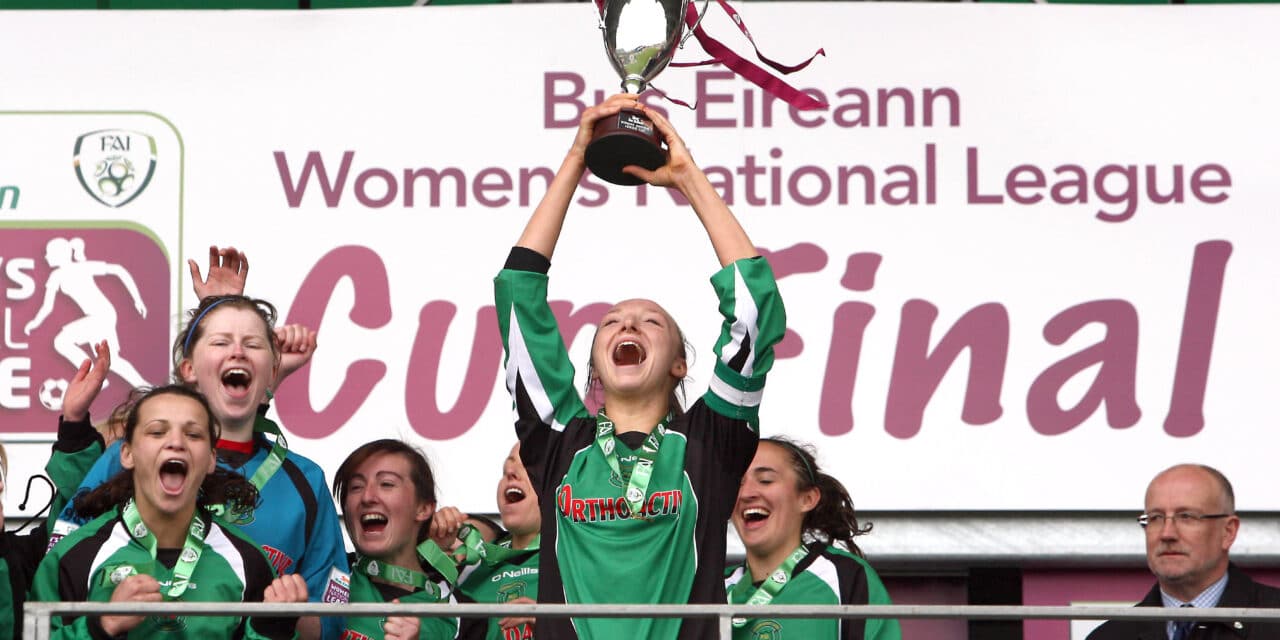
If we can do that we can increase participation and increase the kind of role models like Aileen Morrison pictured on this week’s front cover, Melanie Nocher and Sycerika McMahon, Linda Byrne and Deirdre Ryan, Lisa Kearney and Fiona Coghlan, Ciara Grant and Amy Bottwell.
If you don’t know those names you should make a point to get to know them. Whatever we can do for women’s sport in the current generation, we need to do much, much more to foster a love of sport in younger women. We were joined at the Round Table today by Aoife Coughlan who is studying at UCC and playing Junior Football at county level. She is the kind of sports participant who deserves better facilities, better coverage and a better future for sport.
There are a number of initiatives which we will advance from today’s meeting, including a look at adopting a weekend where everyone with an interest in Women’s sport will encourage friends, relatives and colleagues to attend a Women’s sporting fixture. Where we will ask Fathers and Brothers to bring Daughters and Sisters to see sport being played at a high level by one of their own.
Part of the problem is that girls grow up thinking sport is for boys. I asked my own daughter last night who she thought sport was for. She answered simply that it was for her. We have to ensure that sport is for everyone at each stage of their lives. As Su Carty said “It is their human right.”
“Women can do a lot for sport and sport can do a lot for women,” she added. The same could be said of Women’s Sport and Business. The challenge from this day forward is to find the key to make that happen.
Our sincere thanks to all those who participated in this event whether in person or in advance. This is just the beginning.
Rob Hartnett, CEO Sport for Business
Sport for Business is a community of business and sporting leaders looking to build bridges between the two for the benefit of both.
Business spotlight on Women’s sport