The question of Dodgy Boxes is back in the news with Sky Ireland announcing another warning on end users consuming or stealing streams illegally in Ireland.
Rob Hartnett of Sport for Business appeared on Newstalk’s The Hard Shoulder yesterday with Anton Savage to talk through the issues, bringing in discussion of GAA+, LOITV and others.
Here is a transcript of the conversation.
Anton Savage:
Sky Ireland are warning users of TV dodgy boxes that they may face consequences, as together with the Data Protection Commission, Sky is trying to clamp down on users of illegal streaming services. Up to this point, it was usually the providers who have been targeted. There is, in theory, it’s said, up to 400,000 sets being illegally used to stream TV, sports, and movies in Ireland.
Rob Hartnett is with me; he’s the founder and CEO of Sport for Business. Rob, the practicalities of chasing down people who have a dodgy box, it may be good in theory, but is it possible to do?
Rob Hartnett:
It’s very difficult to imagine, Anton, but you have to keep on fighting the good fight. The Gardaí have said in the past that they have no great attraction towards going after individuals, because this is a commercial crime as opposed to anything other than that.
But at the same time, the impact that everybody who is using a dodgy box — everybody who thinks it’s great craic to take a fire stick and put it into the back of your telly or into your computer — is significant. And it’s not only for the broadcaster, but it also impacts on the sports rights that are being paid.
So sports — and you might think, well, the Premier League, they can afford it. My 25 quid a month isn’t going to make a material difference there. But when you multiply it up by potentially 400,000 in Ireland, and potentially 10 or 12 times that in the UK, it does become material. And the basis on which sport is run is that the money which comes in at the very top does eventually trickle down through the sporting bodies.
GAA Plus is a case in point. So the GAA are streaming their own matches now — fabulous matches this weekend — four of the games that are on in the All-Ireland football preliminary series. And if you’re stealing those by streaming them illegally on a fire stick, then none of the money that would otherwise go to the GAA is going to go down into the counties and the provinces and the clubs.
Anton Savage:
This reminds me a bit of — you’ll remember back in the day where there used to be little symbols on albums that would say, “cassette pirating is ruining the music industry.” And I think an awful lot of people looked at it and said, I think Sony and EMI will be just fine. Is there an element of the same thing here, where people look at it and say, given the amount that Sky can bid for the games, they are not yet living on the clippings of tin?
Rob Hartnett:
They’re not. But then again, neither are we. We live in a consumer environment and we choose what we pay our money towards. I would always liken it to the exchange of fair value.
So people that want to go, for example — if anybody wants to go to the rugby match tomorrow night, the British and Irish Lions against Argentina in the Aviva Stadium — they’ll have paid top dollar to actually go there. And that’s all part of the experience. You can watch tomorrow night’s game on TG4, but if you want to watch the three test matches later on in the summer, that’s going to be on Sky Sports.
And it goes to the very heart of it — of that exchange of value. So Sky have to pay camera people to go. They have to pay sound engineers. They have to pay for studios. They have to pay for talent like yourself. And where that comes from is from the revenue stream, which is built up.
If that’s — and you’re right — maybe it’s not such an existential threat to Sky, but an organisation like Clubber that we spoke about in here before as well, they talked last year about up to 40% of their revenue potentially leaking out through people just stealing what they’ve created in terms of the broadcast of GAA club matches and underage matches around the place. If we want to watch it, we kind of have to pay for it in some way, shape or form. And I’d much rather pay a proper broadcaster and the sport rather than some illegal operator who was…
Anton Savage:
I bet as you said that, there are people thinking, there was once a time where we paid for it through our TV licence fee, and then we got programming free to air and it was an awful lot cheaper. Would it be a bad thing if we got back there through this kind of action?
Rob Hartnett:
It was an awful lot cheaper, but I’m old enough to remember the days when football matches meant the FA Cup final from England and the odd match in World Cups or European Championships — but you never got to see anything like the amount of sport we have now.
Now, if I want to watch Bohemians away to Waterford in the League of Ireland tomorrow, I can watch that on LOITV. I can pay for it to watch it through LOITV. Or if I’m a bad actor, I can pay an equally bad actor down the road who says that he can give it to me for only a fiver a month.
Now, this is one of the arguments that tends to get made around other bootleg services. You say if, for instance, you take something like cigarettes — if you make them sufficiently expensive, you create a black market because there is money to be made. Is there a criticism of Sky and the other streamers in that setting, where people might say, well look, if you weren’t charging an arm and a leg for this service, the delta wouldn’t be so big and people wouldn’t be incentivised to get dodgy boxes?
Rob Hartnett:
It is possible of an argument, but again, we live in a consumer society and it’s a supply and demand. If they were charging too much, then the market would tell them.
Anton Savage:
But is this not the market telling them? If you have one fifth of people buying dodgy boxes, that’s a market response.
Rob Hartnett:
Yeah, they are buying it though. They are paying for it. They’re not paying as much as they would if they were paying it legally to Sky, but they’re still paying for it through other enterprises, which might be just the fellow at the end of the road who decided, “Oh, this is an opportunity here.” Or, as is increasingly the case, it’s through very well-organised, very large-scale international crime. And do we really want to be funding that?
It’s interesting that there’s a lot of people who see that it is wrong, but don’t have a moral problem with it. It’s like saying, charge a responsible price, they’ll be fine. Everything is so expensive — never mind the extra sports occasions — it’s gone so fragmented with so many platforms, it’s driving the increase in dodgy boxes.
Anton Savage:
I don’t have one, but I don’t see a problem with people that do. Another — the biggest theft is the so-called sports stars’ massive wages, the TV presenters’ massive wages. Clean your own house first, and you might see people moving away from dodgy boxes. I love my dodgy box.
Now, whatever about the legality and morality of that sentiment, it would suggest that the campaign to change people’s minds isn’t getting a lot of traction.
Rob Hartnett:
I think undoubtedly the case. That figure of 400,000 came from a survey. So people were — in the general omnibus survey, one in five said that they did use a dodgy box or the equivalent of it. So we don’t know, but the likelihood is that it’s pretty accurate, and it might even be north of that as well. So that would suggest that behavioural change is not happening.
That notion of consequences, which is what J.D. Buckley said from Sky — that people might face consequences without actually addressing what they are — there’s only so far that you can go in the morality clause.
But then again, we might have done that with speeding as well in cars. So people years ago wouldn’t have thought two jigs about whether they were going 20 or 30 miles an hour over the limit. Whereas now, because we’re able to track it and we’re able to actually appeal to people — “Look, you’re putting lives at risk” — now we’re much more likely not to go 20 kilometers over.
Anton Savage:
But if you track that change in attitude and behavior, it did map directly with a vast increase of enforcement and people getting caught, fined, ticketed and penalty points.
Rob Hartnett:
J.D. Buckley is saying this is an important step in our ongoing efforts to combat illegal streaming. We continuously evolve our investigative strategies to crack down on streaming and protect consumers from risks.
Anton Savage:
Do you believe there is a situation where people will be getting knocks on the door saying, “I’m here to inspect you for a dodgy box”?
Rob Hartnett:
The idea is that that will be part of the threat. Now, that requires long-term conversations between Sky, between the government, between Garda Síochána. Sky aren’t going to be able to actually go and ask for entry into your house. But they wouldn’t have said it if there wasn’t something in the backdrop.
Now, I’m not clever enough to understand what that might be. But there must be some way in which they are looking. We live in a very digital world. Every touch leaves a trace, as somebody much cleverer once said.
And the way in which that can be tracked — you can bet your life that every time that you flick on and watch something, somebody knows about it. And you look at what we do with AI now — the world is moving very quickly towards a point where nothing is private, nothing is secret. And if you’re breaking the law, then maybe you will be caught.
Anton Savage:
Rob, thank you very much.
That’s Rob Hartnett, founder and CEO of Sport for Business.
Digital Infrastructure Event

An event with leaders in the field looking at how Irish sporting organisations and sponsors can play at the top of their game in the Digital world. Scheduled for August 29th. Let us know below if you are interested and we will be in touch.
The Latest Sport for Business Podcast
Further Reading for Sport for Business members:
Check out more of our Sport for Business coverage of Sports Technology
SPORT FOR BUSINESS PERSPECTIVE
Using a dodgy box is a theft of sport, of the creative input of those who produce the programming and a chipping away at what it means to live a sound life. If that’s OK with you, then it will be challenging to stop you. Unless of course that line of every touch leaving a trace catches up in the end and you go to jail…
WHAT’S UP NEXT?
Sport for Business is in planning for major events bringing together leaders in Irish Sport and Business across a range of subjects in the second half of the year.
On Thursday, August 29th we will host a special event looking at Digital infrastructure including the use of AI in sport..
Register your interest in joining us for this event above
Find out More about Our Sport for Business Events Programme Here
MEMBERSHIP AND EVENTS
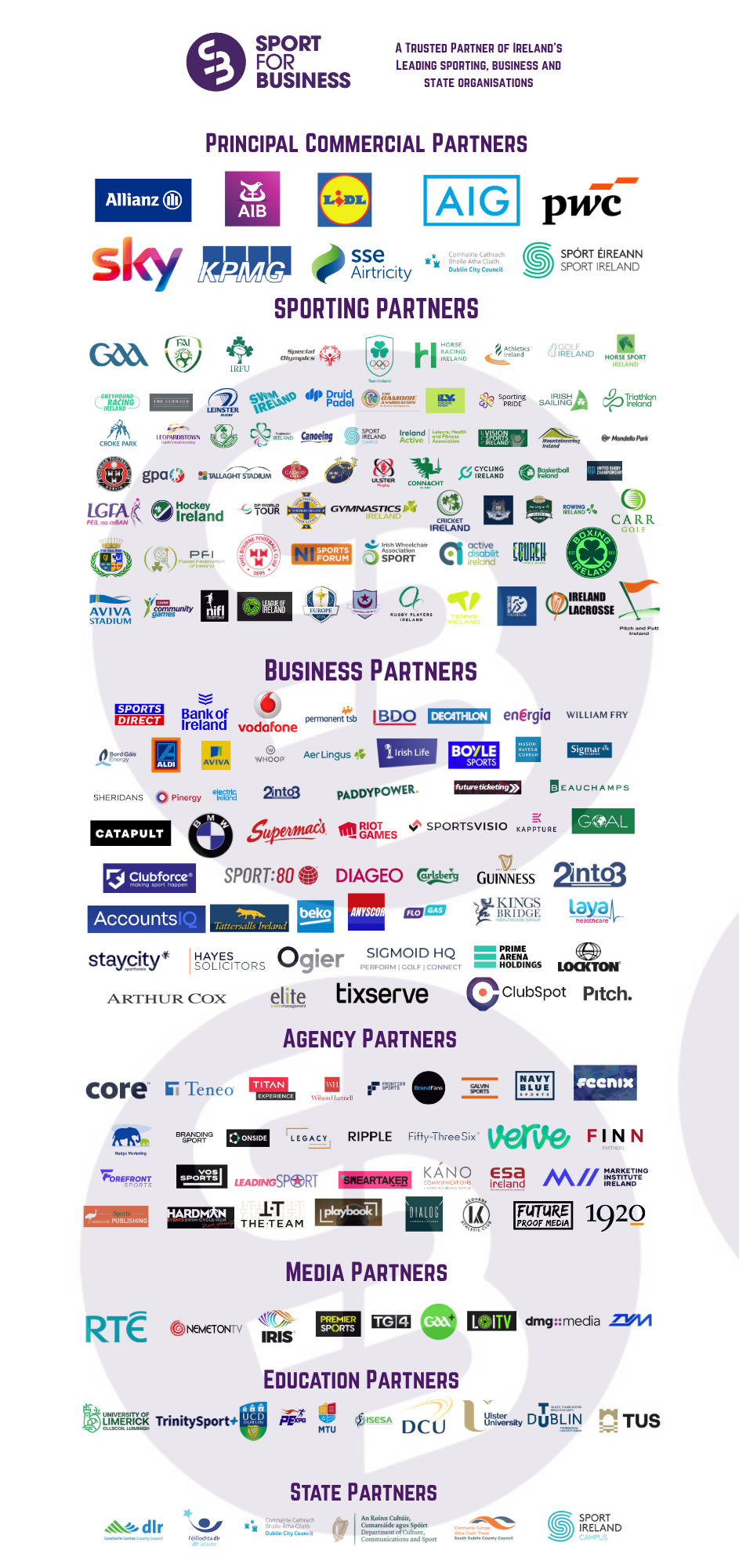
Sky Ireland and all the leading sporting and business organisations in and around the world of sport are among the 300+ members of the Sport for Business community, which includes all of the leading sports and sponsors, as well as commercial and state agencies, individuals interested in our world, and an increasing number from beyond these shores taking a keen interest in Ireland.
Find out more about becoming a member today.
Get the full benefit of a Sport for Business membership by joining us at one of our upcoming events, where sporting and business leadership come together.
Or sign up for our twice-daily bulletins to get a flavour of the material we cover.
Sign up for our News Bulletins here.