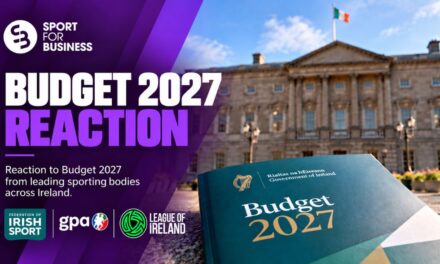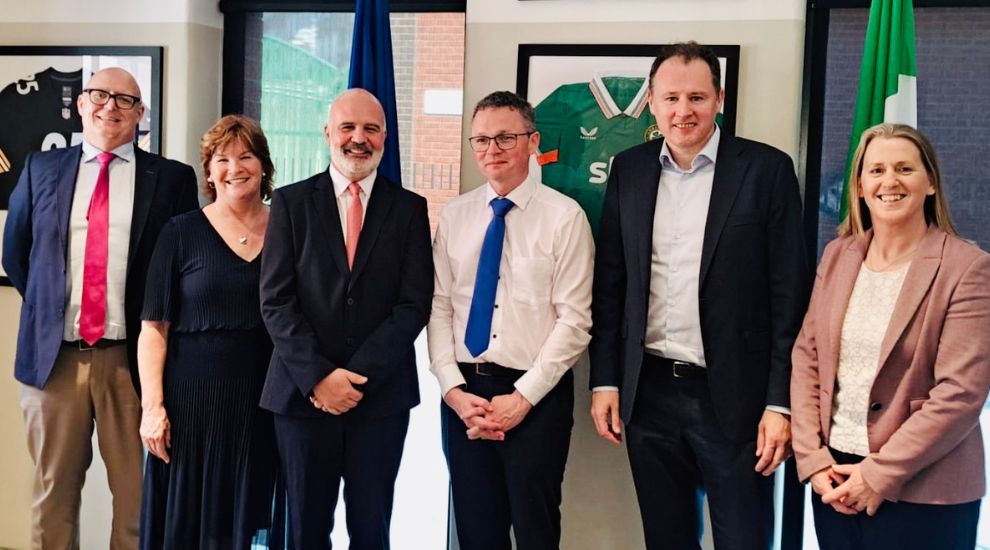
The Federation of Irish Sport has placed the financial sustainability of community sport and the people who deliver it at the heart of its pre-Budget 2027 submission.
It has called for a 10 per cent annual increase in core funding for National Governing Bodies and Local Sports Partnerships over the next three years.
Its pre-Budget submission also proposes a €5,000 PAYE exemption threshold for certain payments within amateur sport and asks the Government to examine an additional one per cent betting levy, potentially generating between €40 million and €50 million annually for participation and community sport.
The proposals are presented as an investment in Ireland’s health, social infrastructure and economy rather than simply as additional spending on sport.
The Federation makes the valid argument that sport and physical activity represent one of the State’s most cost-effective defences against chronic illness, poor mental health and cardiovascular disease.
Research cited in the submission estimates that participation in sport and physical activity prevented 97,000 cases of disease in 2019, saving the State €405 million in healthcare costs. The sector contributes €3.7 billion to the Irish economy, supports 64,000 full-time equivalent jobs and returns up to €195 to the Exchequer for every €100 invested.
Three Years of Increased Core Funding
The first and most direct request is for a 10 per cent annual increase in core funding for NGBs and LSPs across Budgets 2027, 2028 and 2029.
Their combined core allocation in 2026 stands at €32.16 million, comprising €19.5 million for National Governing Bodies and €12.66 million for Local Sports Partnerships.
Applying the proposed uplift would require an additional €3.216 million in 2027, €3.537 million in 2028 and €3.891 million in 2029. That represents €10.6 million in additional investment over three years.
While acknowledging that core funding for NGBs has increased by 80 per cent since the introduction of the National Sports Policy in 2018, the Federation says that costs, staffing pressures, and the demands placed on sporting organisations are also continuing to grow.
It believes multi-annual funding would allow organisations to retain qualified personnel, develop sustainable programmes and plan beyond short-term annual funding cycles.
“A fundamental step-change in sports funding is required in Budget 2027,” said Federation CEO Mary O’Connor.
“To build enduring programmes, retain vital personnel, and attract professional and volunteer talent, we must pivot away from short-term financial cycles.
“We urge the adoption of a multi-annual funding model built on an annual uplift of 10 per cent over the next three consecutive years. This will empower the sector with the strategic certainty and financial security required to deliver long-term, meaningful outcomes for the State.”
The move towards multi-annual funding is already underway in High Performance funding, and establishing this precedent within the sector should be helpful.
Participation Growth Masking Wider Challenges
The Federation’s case is strengthened by the scale of participation in Irish sport. Sport Ireland figures show that 2.12 million adults now participate regularly, with the weekly participation rate reaching 48 per cent.
However, the submission argues that this positive headline masks a more challenging picture.
One in five adults is now classified as sedentary, while recreational walking has fallen by four percentage points. The participation gap between higher- and lower-income groups has widened to 22 percentage points, with a 19-point gap between people with and without disabilities.
The Federation warns that sport risks becoming less accessible to those who stand to benefit most from it. It wants additional investment directed towards interventions in disadvantaged communities, disability inclusion, affordable access and programmes capable of reversing the rise in sedentary lifestyles.
Addressing the Impact of the Karshan Ruling
The most immediate operational challenge identified in the submission concerns the Supreme Court’s Karshan decision and its implications for the employment status of coaches, tutors, referees, and officials.
Although the ruling arose from a commercial gig-economy case involving Domino’s Pizza, the Federation says its application across amateur sport has created disproportionate administrative and financial obligations.
Sporting bodies are now being required to treat people receiving relatively small, irregular or seasonal payments as PAYE employees.
The Federation says this is already reducing the number of programmes that organisations can deliver.
A survey covering 26 of Ireland’s 29 Local Sports Partnerships found that approximately 85 per cent had reduced programmes, training initiatives or events during 2026. Some reported operating at less than half their previous delivery capacity.
The effects have been most strongly felt in programmes for people with disabilities, older adults, children, women and girls, minority communities and people living in rural areas.
This was obviously never the intention, but it is the reality.
Historic liabilities arising from the classification of contractors have typically ranged from €10,000 to €50,000, with some organisations reporting liabilities exceeding €100,000. More than 70 per cent of the NGBs surveyed also reported ongoing additional compliance expenditure.
The Federation is proposing a statutory €5,000 threshold under which qualifying sporting organisations would not have to operate PAYE on payments to people undertaking ancillary, part-time, occasional or seasonal work.
The proposal would not make the income tax-free. Individuals would remain responsible for declaring it, while payments above the threshold would still be subject to PAYE treatment. Substantive employment positions would also remain outside the exemption.
The aim is to protect legitimate employment standards while preventing low-value community engagements from becoming too expensive or administratively complex to continue.
Betting Levy Could Create New Sports Fund
The third proposal is more exploratory but potentially more financially significant.
The Federation wants the Government to commission and publish a report within six to nine months on increasing the existing betting duty from two to three per cent, with the additional one per cent ringfenced for participation and community sport.
It estimates that the measure could generate between €40 million and €50 million each year.
Rather than seeking an immediate change in Budget 2027, it is asking for an interdepartmental review led by the Departments of Finance and Culture, Communications and Sport, working with Sport Ireland and other stakeholders.
The review would examine the legal, fiscal and ethical implications, as well as the possible creation of a dedicated Sports Investment Fund.
The proposal reflects a long-running argument that sporting organisations should receive a direct return from betting activity based on their competitions. The Federation points to funding models in France and Portugal, while acknowledging that any Irish system would need safeguards around distribution, accountability and the potential impact on smaller bookmakers.
Sport for Business Perspective
The three proposals address different aspects of the same challenge: that sport cannot expand its contribution to health, inclusion and community life without sustainable investment in the organisations and people delivering that work.
The funding request is relatively modest compared with the €405 million in annual healthcare savings attributed to physical activity. The PAYE proposal is likely to attract closer scrutiny but responds to a real problem already reducing programme delivery across the country.
The betting levy review would be the most politically complex element. It is also the proposal best positioned to create the most transformative new funding stream.
Budget 2027 will provide an early indication of whether the financial arms of Government accept the Federation’s central argument: that spending on participation is not a discretionary leisure expense but an investment in preventative health, stronger communities and reduced future pressure on the State.


 The Federation of Irish Sport, Sport Ireland and the Department of Culture, Communications and Sport are full members of Sport for Business. Dublin City Council are our Partner in Community Sport Coverage
If you would like to be part of the Sport for Business community and see your organisation in our content, on our stages, and in the conversation happening every day around the commercial world of Irish Sport, email us today and let’s see what is possible.
Image Credit: Federation of Irish Sport
ABOUT SPORT FOR BUSINESS
Sport for Business is Ireland’s leading platform focused on the commercial, strategic and societal impact of sport. It connects decision-makers across governing bodies, clubs, brands, agencies, and public institutions through high-quality content, events, and insights.
Sport for Business explores how sport drives economic value, participation, inclusion and national identity, and how your story can be part of ours.
Through analysis, storytelling and convening the sector, it helps leaders understand trends, share best practices, and make better-informed decisions. It positions sport not just as entertainment but as a vital contributor to Ireland’s social and economic fabric.
Find out more about becoming a member today.
Or sign up for our Daily Sport for Business Snapshot email bulletins to get a flavour of the material we cover.
Sign up for our News Bulletins here.