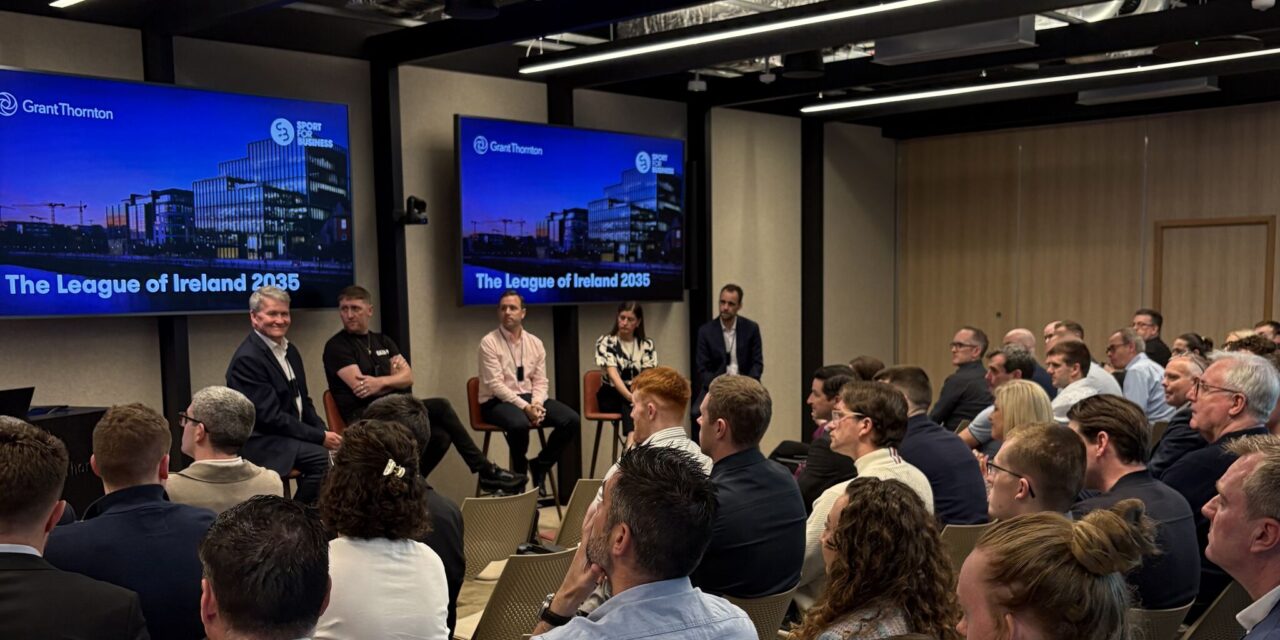
The ‘League of Ireland Towards 2035’ event, hosted by Sport for Business at Grant Thornton, brought together key figures from across Irish football to reflect on the League’s current trajectory and to discuss how it might evolve over the next decade.
Our audience consisted of 100 leaders from the world of business and finance, most with an existing interest in the domestic game, and many seeking ways to become more involved.
Chaired by Rob Hartnett, the morning’s conversation was introduced by a personal and passionate introduction from Conor Hoey of Drogheda United. Hoey is also the Managing Director of CapGem in Ireland and came to us with the idea of speaking to this group initially ahead of Drogheda’s Sports Direct FAI Cup Final last November.
The interest that sparked continues to grow, and yesterday was the next step in broadening the base of those with whom we want to speak.
Hoey opened with a raw account of Drogheda’s recent rollercoaster of regulation and emotion. A triumphant FAI Cup win was followed by painful exclusion from European competition due to a missed administrative deadline under UEFA’s multi-club ownership rules.
His analogy of a vulnerable child being expelled on their first day at a new school resonated and will place the UEFA decision-making around other clubs in a cold spotlight.
But the doubling down of new owners, the Trivela Group, could yet see positives emerge from the tears of a lost opportunity to
From there, attention turned to the future, with Rob Hartnett introducing the panel of John Martin (Shamrock Rovers), Jill Downey (DLR Waves), Mark Scanlon (FAI League of Ireland Director), and Dan Lambert (Bohemians).
Together, they painted a picture of a league in the midst of real momentum — but also one that still faces fundamental challenges.
A League on the Rise
John Martin was unequivocal in his belief that the League of Ireland is in a better place than ever. He spoke of packed stadiums and a renewed public enthusiasm, particularly around Friday night fixtures, which are now embedded in the footballing culture.
Citing sell-out derbies and the increased visibility of League games, Martin emphasised that football is reclaiming its cultural space, not just in Dublin, but across the country.
Dan Lambert echoed that optimism but offered a note of caution.
While crowds have returned and the atmosphere around clubs like Bohemians is electric, it’s fragile.
“We had great crowds in the League of Ireland for a long time, and then we lost them,” he cautioned.
His view is that League of Ireland clubs have found their place as community anchors, especially for young people disillusioned with the hyper-commercialisation of other entertainment outlets.
The Challenge for the Women’s Game
Jill Downey’s first contribution was a sobering one. Representing DLR Waves, but also with a business lens through her leadership of Core Sponsorship, she spoke candidly about the disparity between the men’s and women’s leagues.
Despite positive momentum at international level, the domestic women’s game remains under-supported and under-promoted. Without a step-change in ambition and investment, she warned, many women’s clubs may not survive until 2035.
Mark Scanlon acknowledged the gap and outlined steps being taken by the FAI to support integration.
He noted the importance of branding parity, of ensuring women’s teams carry the same club names as their male counterparts, and their equal inclusion in the overall branding and promotion of the League and stressed the need for continued government and commercial investment to retain top players in Ireland.
SSE Airtricity were called out for their commitment across the three current divisions, two in the Men’s Game and the one in the Women’s.
Infrastructure and Identity
Stadium infrastructure remains a persistent theme across the league. Dan Lambert and John Martin both underlined the importance of investment in facilities, not only to meet growing demand but also to preserve the matchday experience.
Dalymount Park is due a major redevelopment, but Lambert was clear that the magic of the old ground must be retained in any new design.
Martin reflected on the evolution of Tallaght Stadium as a model of successful local authority partnership, noting that clubs on their own cannot fund or maintain such facilities, and that councils benefit economically and socially from having thriving football grounds at their heart.
Scanlon added to this with solid data, speaking to the day jobs of those in the room.
He spoke of the report last year that showed the League of Ireland contributing €167 million to the Irish economy each year.
He highlighted that Football is not just a game, it’s an industry, and a serious one.
Where Would €1 Million Go?
The final portion of the panel saw Hartnett posing the question of how a notional €1 Million investment might best be spent.
The consensus leaned toward long-term investment in people and structures. For Lambert there was the added importance of telling the story of a League that has plenty to differentiate and celebrate on a much bigger scale.
For Downey, marketing and brand development for the women’s game were key.
For Martin the important elements were academies and staff — from coaches to operations to commercial.
For Scanlon, it was similarly about growing the football industry itself, putting skilled professionals into clubs to build capacity.
In closing, the panel touched on broader opportunities — from North-South collaboration to multi-sport stadiums — with a shared emphasis on inclusivity and progress.
The phrase “we’ll go further if we go together” summed up the sentiment.
With tangible energy around the league, strong leadership in clubs and the FAI, and a growing community of fans and stakeholders, the vision for 2035 is ambitious and, increasingly, realistic.
But, as was noted more than once, the passion of League of Ireland fans will only carry things so far.
Sustained investment and strategic collaboration must do the rest. The planning and preparation for the next in this series of engagement was already beginning in the hum of conversation around the room as the microphones were laid down.
Sport for Social Good Conference

The annual look at initiatives and ideas that are helping keep sport at the forefront of inclusion and equality will return in the second week of October, with more details to follow shortly.
Find out More about Our Sport for Business Events Programme Here
The Latest Sport for Business Podcasts
Further Reading for Sport for Business members:
Check out more of our Sport for Business coverage of Olympics
WHAT’S UP NEXT?
Sport for Business is in planning for major events bringing together leaders in Irish Sport and Business across a range of subjects in the second half of the year.
On Thursday, August 29th we will host a special event looking at Future Proofing Irish Sport including the use of AI in sport.
Find out More about Our Sport for Business Events Programme Here
MEMBERSHIP AND EVENTS
The FAI, League of Ireland, Grant Thornton, Drogheda United, Bohemians, Shelbourne, Shamrock Rovers and many others in Football, as well as all the leading sporting and business organisations in and around the world of sport are among the 300+ members of the Sport for Business community.
This includes all of the leading sports and sponsors, as well as commercial and state agencies, individuals interested in our world, and an increasing number from beyond these shores taking a keen interest in Ireland.
Find out more about becoming a member today.
Get the full benefit of a Sport for Business membership by joining us at one of our upcoming events, where sporting and business leadership come together.
Or sign up for our twice-daily bulletins to get a flavour of the material we cover.
Sign up for our News Bulletins here.