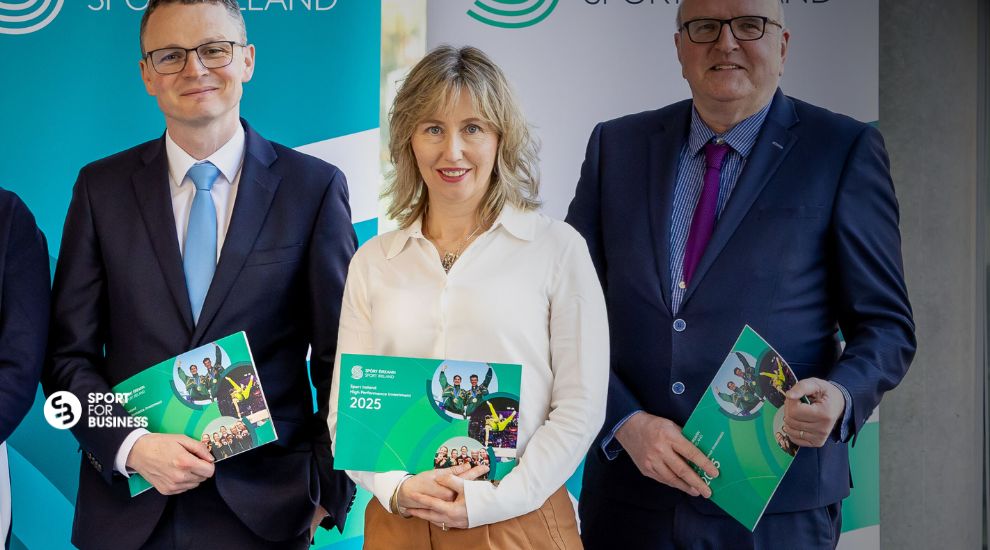
After announcing Sport Ireland’s High-Performance Funding plans for 2025, we sat down with Olympian Olive Loughnane, the chair of the high-performance committee.
We covered a lot of ground regarding high-performance funding in Irish sport, particularly in the post-Paris Olympic cycle and the lead-up to Los Angeles 2028. Among the key takeaways were:
Past Performance Matters – Sports that demonstrated strong governance, results, and private sector confidence were rewarded in the funding decisions. However, past success doesn’t automatically guarantee future investment.
Funding Adjustments & Challenges – Some sports saw funding shifts due to changes in their competitive pipeline, athlete numbers, or perceived long-term viability.
Athlete Transition Support – The funding model is demand-driven, meaning if more athletes retire, the transition support fund grows accordingly. There’s a clear commitment to ensuring athletes aren’t left in difficult situations post-career.
Governance & Business Models – Sports that demonstrate strong governance and financial acumen, including attracting private investment, are viewed as more sustainable and likely to succeed.
SfB: So the high-performance programme is out now for 2025. We are in year one of an Olympic cycle, which is always something more of a challenge, but the money continues to rise. When looking at the money going forward, how much influence did what has happened in the past have on the decision-making?
We don’t know who will be the stars of Los Angeles, but we have to plan.
OL: There are markers there. You know, when sports are going well. There is a robust system there to evaluate ongoing progress.
There is a matrix there with different indicators feeding into a model. Now, I don’t personally see the data going in, but I see the executive’s proposals coming out. Good athletes come out of well-run sports in the main.
I didn’t appreciate governance as an athlete, but I do now. If an organisation is well governed, they’re set up for success.
They also need the athletes to enter the pipeline, but if they have a strong business model, you know, it shows that they’re doing things right. And when I talk a bit about a business model, that’s about NGBs that can attract private sector funding as well, which shows a vote of confidence in them.
SfB: On the carding side of it, it’s easier for the public to get their heads around the fact that if an athlete has done well, he or she will progress to the next level of funding. But when it comes to, you know, Swim Ireland and Athletics Island, rather than it being one high-performance programme, they would describe it as being, well, multiple separate programmes. And of course every federation would like more money.
SfB: On the carding side of it, it’s easier for the public to get their heads around the fact that if an athlete has done well, he or she will progress to the next level of funding. But when it comes to, you know, swim Island and Athletics Island, rather than it being one high-performance programme, they would describe it as multiple high-performance programmes. Of course, every federation would like more money.
OL: That is the challenge. I referred to it in my speech when I spoke about those hard conversations that need to happen at different times.
The money comes with a real level of confidence that it will generate results.
Yes, the executives have the flexibility to support people in terms of doing things slightly differently or revising approaches.
But the focus must be on confidence, and it’s a high bar.
However, it is the people rise to that high bar, challenge themselves, and change how they do things to ensure they achieve the results that regularly appear at the top.
SfB: There were 19 organisations that had high performance funding in the Paris cycle. We’re down to 16 at the top level now. I know that the other three have gone into a separate grouping, but was that difficult?
OL: Yeah, it was, and they are difficult deliberations, but it is about recognising where different governing bodies are at and what the most appropriate form of support for them is.
So like, if you’re in the high performance category, the bar is gonna be really high and you know, it’s gonna, it is more appropriate for some organisations step back to a development or a pathway level and come back stronfer once the pipeline of talent is there.
SfB: Pentathlon as an example was a shining sport when Natalya Coyle and Arthur Lanigan O’Keeffe were there competing. They’ve gone now from €1.3 million across the four years of the last Games cycle to to having €150,000 for next year. TaeKwonDo with Jack Woolley, who is very high profile and very young, you would imagine is gonna be heading for Los Angeles, but they had 700,000 in the Paris cycle towards funding to having €75,000 in 2025 and no guarantee of it going on from there.
I know a lot of the work and a lot of the nuance and that goes in at the executive level and comes to you. But is that something which you tease out and pore over as a committee?
OL: Absolutely. The most important thing is that Jack Woolley is supported and that if another Jack Woolley arrives in TaeKwonDo that there is the flexibility in the system to support that athlete, whoever they may be too.
But in practical terms you have to have boundaries and targets to be achieved within the system, not just for one athlete. You have to have tiers.
I would be very confident as chair of the High Performance Committee, that Jack Woolley will be looked after and that if there is another Jack Woolley, or there are 15 Jack Wooley’s, that they will also be supported.
We want to give support to people and programmes where they’re most appropriate and can be most effective.
SfB: There was one other change that I saw as well, from ’21 to ’22 after Tokyo the high performance program money went up, but the athlete transition funding dipped. This time around it’s gone in the reverse. Is that because we’ve got more athletes retiring after Paris and a longer run to LA?
OL: That’s right. There’s a process there. And if 20 athletes retire, you know, that fund will have to, to adjust accordingly. There’s a really strong commitment to athlete transition and we’ve done some really good stuff in terms of building an athlete friendly employer network; bringing the third level institutions and being more holistic.
Success is great but we don’t want broken minds and broken bodies as a by-product.
You know, this is not a win at all cost system. This is a holistic system where don’t always get it right, but when we don’t we learn and we continue to grow.
SfB: One last one, in the day job you are overseeing transformation. How does what you’re doing nine to five, Monday to Friday translate into leading a high-performance set up.
OL: It’s not so much transformation as advancement, maybe in the Sport Ireland environment stuff, but the principles of a culture that supports development where people are willing to learn. that’s completely transferrable across whatever industry you’re in.
Further Reading for Sport for Business members: Sport Ireland Core Funding for 2025
SPORT FOR BUSINESS PERSPECTIVE
With a finite budget, infinite potential has to be tempered by the athletes and the programmes most likely to succeed. There will always be room to support individual talent, but if the sport they are competing in is not the best place to bring them to the top, then that is a harsh reality at the elite level.
WHAT’S UP NEXT?
Our twice-daily news bulletins land Monday to Friday, 50 weeks of the year.
MEMBERSHIP AND EVENTS
The Department of Arts, Media, Communications, Culture and Sport, and Sport Ireland, as well as 15 of the 16 National Governing Bodies on the High-Performance Programme, are among the 300+ members of the Sport for Business Community. Our community brings together leaders in sport and business and spotlights their work.

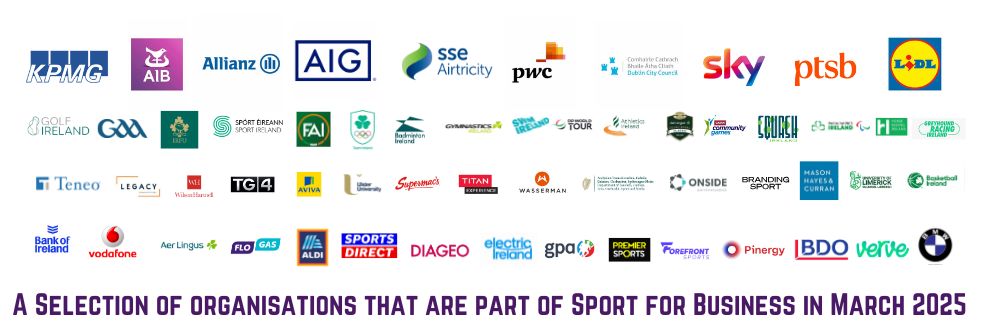
The Sport for Business Membership comprises over 300 organisations, including all the leading sports and sponsors, as well as commercial and state agencies.