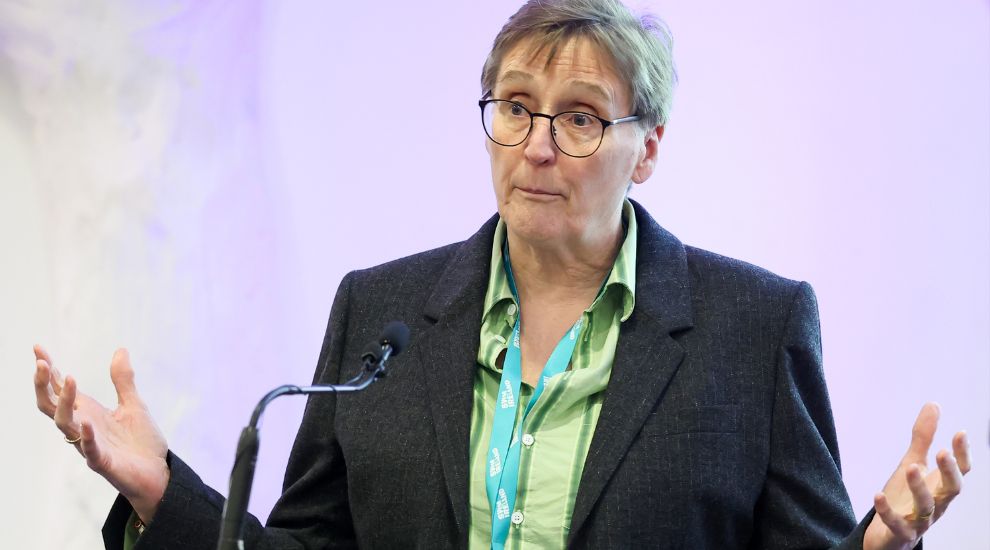
Dr Kate Hills of Swim Ireland delivered a compelling and deeply informed address on safeguarding at the European Aquatics Conference in Dublin on Friday, arguing that safeguarding cannot be treated as a compliance exercise but must instead become a central and permanent part of sporting culture.
Drawing on two decades of experience as a safeguarding lead, Hills challenged sports organisations, federations and governing bodies across Europe to rethink how they structure, support and value safeguarding roles.
Hills described the safeguarding lead as “a critical person in the ecosystem of a sports organisation” and warned against treating the role as an add-on responsibility or something that can be outsourced.
“The safeguarding lead has to stand alone, has to be independent,” she said. “The moment you give them other roles to do, it eats away at that independence and eats away at their time and also eats away at their resilience.”
Speaking candidly about her own role within Swim Ireland, Hills noted that until recently she had effectively been “a department of one”. She also reflected on the perception that safeguarding officers are only present when something has gone wrong.
“I turn up on the inside, and people will look around and say, ‘What’s she doing here? What have we done wrong?” she said.
Instead, she argued, safeguarding should be woven through every layer of an organisation.
Hills outlined the structure that Swim Ireland has developed, in which club children’s officers maintain direct links with national safeguarding structures through regional representatives and a Child Welfare Committee. She described this as a vital system of touchpoints that ensures safeguarding remains connected at every level of the sport.
“At every point in our organisation where we have a club that has under-18s, they have a touchpoint with a national safeguarding lead,” she said.
A major focus of the address was the qualities required of effective safeguarding leads. Hills stressed that experience within sport itself is not always the most important factor.
Recalling an early experience with an Irish national team, she remembered overhearing staff question why she had been hired because “she knows nothing about swimming.” In hindsight, she believes that independence from the sport’s internal allegiances was one of her greatest strengths.
“I knew a lot about safeguarding, but I knew nothing about swimming,” she said. “I was able to come in as an independent person and work within a sport.”
Hills identified resilience, compassion, honesty, integrity and fairness as essential characteristics for safeguarding professionals, alongside specific safeguarding expertise and ongoing education.
“There is still no set standard of qualification for a safeguarding lead,” she said.
To strengthen her own practice, Hills completed a Master’s in Child Protection and Welfare and later a doctorate in Childhood Studies. Continuous learning, she argued, is essential for safeguarding professionals because every case, every policy, every investigation and every conference contributes to improved practice.
One of the strongest themes running through the presentation was organisational culture. Hills warned that safeguarding systems will only ever be as effective as the culture surrounding them.
“If you have an organisation that looks at safeguarding as a bolt-on, a tick box, something that must be done, you’re not going to be effective,” she said. “And who are the people that are going to know that? Your athletes.”
She described safeguarding as something that should influence every department and every decision within a governing body, rather than existing separately from the organisation’s day-to-day work.
Hills also spoke powerfully about the emotional burden carried by safeguarding professionals themselves, highlighting the often-overlooked issue of vicarious trauma.
Safeguarding leads, she explained, routinely deal with retrospective abuse cases, investigations, reports to statutory authorities and highly distressing disclosures from athletes.
“No matter how resilient your safeguarding lead is, no matter how compassionate they are, what they’re actually dealing with are retrospective cases, non-recent cases, statutory authority reports, investigations and concerns,” she said.
She urged organisations to provide external support structures to help safeguarding staff manage the psychological impact of the role.
Turning to reporting structures and investigations, Hills encouraged federations across Europe to fully understand the legal and safeguarding frameworks within their own jurisdictions, particularly where athletes and teams travel internationally.
She stressed the importance of moving beyond criminal standards of proof when assessing safeguarding concerns.
“Beyond a reasonable doubt is a criminal threshold,” she said. “That’s not the threshold we should be looking at.”
Instead, she argued for a more athlete-centred approach that prioritises listening, understanding and protecting individuals from harm.
In her closing remarks, Hills returned repeatedly to the importance of integrity and action.
“Listen to those and focus on those who are harmed,” she said.
“Always ask yourself, what is the right thing to do? Not what am I legally obliged to do, but what is the right thing to do?”
“Well-meaning is not good enough,” Hills said. “Safeguarding must be constant, and it must be consistent, and it must be considerate.”

 Swim Ireland are full members of Sport for Business.
If you would like to be part of the Sport for Business community and see your organisation in our content, on our stages, and in the conversation happening every day around the commercial world of Irish Sport, email us today and let’s see what is possible.
Image Credit: Sport for Business
ABOUT SPORT FOR BUSINESS
Sport for Business is Ireland’s leading platform focused on the commercial, strategic and societal impact of sport. It connects decision-makers across governing bodies, clubs, brands, agencies, and public institutions through high-quality content, events, and insights.
Sport for Business explores how sport drives economic value, participation, inclusion and national identity, and how your story can be part of ours.
Through analysis, storytelling and convening the sector, it helps leaders understand trends, share best practice and make better-informed decisions. It positions sport not just as entertainment but as a vital contributor to Ireland’s social and economic fabric.
Find out more about becoming a member today.
Or sign up for our twice-daily bulletins to get a flavour of the material we cover.
Sign up for our News Bulletins here.
Upcoming Events