Welcome to the first article of The Sport Economy series.
With over 12,000 clubs and over 100 national governing bodies and local area sports partnerships, sport in Ireland makes a substantial economic and employment contribution.
Over the coming weeks and months, we will dive deeper into the economic figures to explain how and why the sport sector operates here in Ireland and how it compares to others around the world.
Our guide on this journey will be Conor Foley, a Finance expert and graduate of Trinity College and DCU who has advised clients around the world in Ireland, Britain and the Middle East.
The first edition of The Sport Economy shines a light on sport employment by explaining the basis of the official economic statistics and identifying employment trends within the sector over the past decade.
We will follow this up in the second article of this series by outlining financial trends of revenue, purchases, and wages within the sector.
Once the platform has been set and we have a deeper understanding of the Irish Sport Economy and its evolution, We will then look abroad comparing Ireland to international peers to see what information can be observed and what lessons can be brought home.
Determining Sport and Sport Related Activities
Because of inadequate data and uncertain definition of what constitutes sport and sport-related activities, accurate identification of sport employment and economic output is challenging. Various official estimates of each exist.
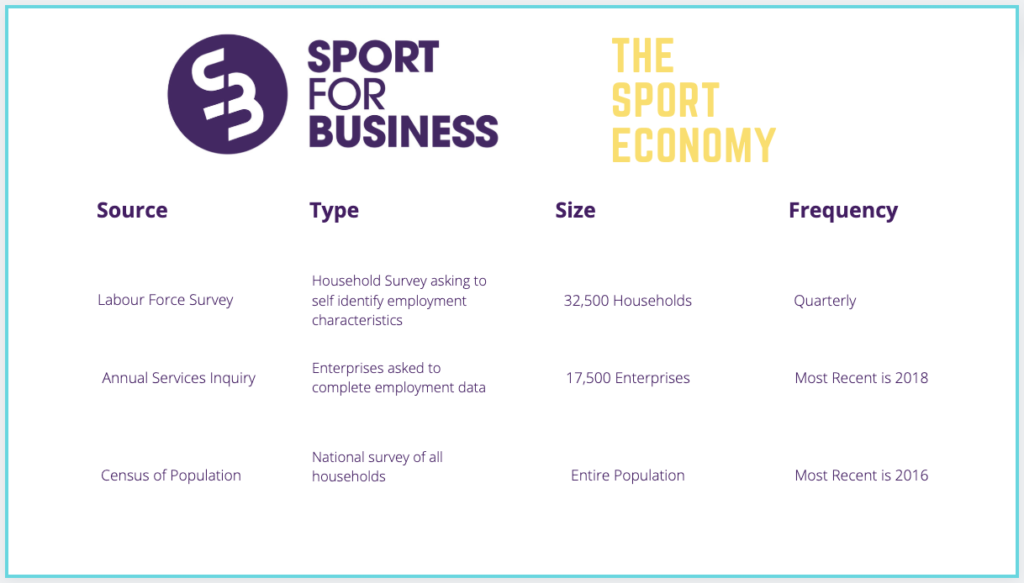
Within Ireland, there are three main official economic statistics sources which we will use within the broad sport sector.
Economic and business activities in the European Union are divided into different classifications for statistical purposes according to the NACE code. That stands for the Nomenclature Statistique des Activités Économiques.
Within this, there are a number of key elements that will form our analysis.
The Labour Force Survey (LFS) provides up to date employment statistics for the Nace classification 93, which is an aggregate of sports activities (93.1) and amusement and recreation activities (93.2). An individual sports activities figure is not published but the large majority of Nace 93 are sports activities.
The Annual Services Inquiry (ASI) is less up to date than the LFS but contains a substantial amount of financial and economic data on sports activities including the number of enterprises, turnover, purchases, labour costs, employment and gross value added.
The third source is the Census of Population which deals with labour force characteristics.
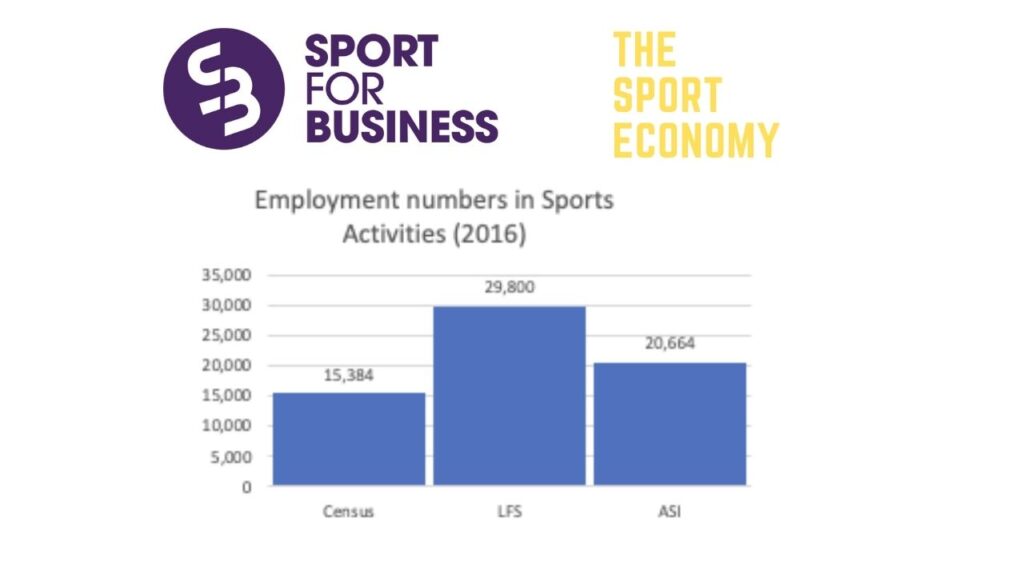
Unfortunately, the different official sources result in different estimates of employment in sport activities due to different data collection systems. Care should be taken in interpreting the different figures.
For example, the Census of Population employment figures refer to what the person considers to be their principal status. The Labour Force Survey employment definition refers to if any paid work was done in the past week even if only one hour.
Consequently, a full-time student with a part-time job would be included in the employment totals.
The part-time worker who is principally a student would describe herself as a student in the Census of Population and at work in the Labour Force Survey.
Sporting Activities and the wider Sport Economy
We have seen so far then that there are issues in comparing data sets.
Quantifying those employed in sport is further complicated by the fact that sporting activities (Nace 93.1), which we have been looking at so far, are not the full sports economy.
Sporting activities refer to,
- operation of sports facilities (Nace 9311),
- activities of sports clubs and sports bodies (Nace 9312),
- fitness facilities (Nace 9313)
- other sports activities such as horse training and the seeking of sponsorship (Nace 9319).
Sport also generates employment in many other areas including the production and sale of sporting goods, sports publications and elsewhere that is measured as part of several other sectors.
Sporting activities directly create employment in areas like ground maintenance, printing, utilities, catering supplies, insurance, professional services and travel which indirectly generate employment in other sectors.
There are also sectors which would not operate at the same activity level without sport such as media and betting.
These additional contributions to the sports economy are included in a variety of different economic statistical classifications. However, the available data refer to either sporting activities (Nace 931) or sporting activities plus amusement and recreation activities (Nace 93).
Trends in Sport Employment 2008 to 2018
When looking at trends in Irish sport employment it is useful to consider first the wider economy (shown below) which performed badly between 2008 and 2011 when total employment declined each year. Following a tiny increase in 2012, there were solid annual increases in employment from 2013 to 2019.

The Annual Services Inquiry provides annual sports activities employment back to 2008 (employment figures shown below). Previously a slightly different statistical classification was in place.
Within the ASI two indicators are used, the persons engaged and the number of employees. The difference between the two refers to self-employed and owner-managers.

In 2008 employees were 92.1% of the total employment. In 2018 the figure was relatively unchanged at 91.3%. Employment in sporting activities increased slightly in 2009 and then declined in 2010 and 2011. There were small annual increases in 2012 to 2015. Substantial increases occurred in 2016 and 2017 followed by a smaller increase in 2018.
The 2009 sporting activities employment level was not regained until 2016.
Overall, compared to the total employment performance, sports activities employment was slow to recover from the 2010 decline initially but in the more recent 2015 to 2018 period sports employment increased by 13.3% which exceeded the total employment increase of 9.4%.
Within this in both 2016 and 2017 sports activities employment increased at a stronger pace than total employment but in 2015 lagged versus the wider economy.
One caveat to the above assessment is the use of two different data sources but only the growth rates within each dataset are being used for comparison.
In 2018 sport activities employment was 8.4% greater than its 2008 level. The equivalent figure for total employment was 6.3%.
Conclusion and takeaway
What can we take away from the above assessment?
First to take care with the data. There are different definitions of employment and different data collection methodologies.
There are substantial differences in the various official measures of sports activities employment.
Using the ASI sports activities employment estimate and comparing this with total LFS employment performance we see that sports employment growth outperformed total employment in the recent 2015 to 2018 period.
On an individual year basis, sports growth was above total employment growth in 2016 and 2017 and almost the same in 2018.
Join us again on Thursday, October 22nd when we will be looking at the data on Revenue and expenditure within the Irish Sport Economy.
 Conor Foley has a business degree from Trinity College Dublin, an MSc in finance from DCU and is a Chartered Financial Analyst. Over a 12-year professional career, Conor has experience of advising clients such as institutions, charities and bodies in the areas of global strategy, project management, asset allocation and financial structure. Conor will be working with Sport For Business to produce The Sport Economy, a regular piece, offering insights from the domestic and international sporting worlds of finance, economics and business, aims to bring Sport For Business members lessons and information from around the world to aid you in your strategy, financial affairs and business decisions. Conor has worked in leading financial institutions both at home and abroad and is committed to the growth and development of professional and amateur sport in Ireland.