Sport for Business Member Patrick O’Brien from DMC has given us an insight into a chapter of the career of Diego Maradona that will not have made it into the many tributes paid him over the past 36 hours. We are happy to share it with you here today.
Emirati goalkeeper Majed Naser has never lacked ability. A proficient shot-stopper despite standing just over 5’ 9’, he’s been first choice for United Arab Emirates Pro League side Al Wasl since making his debut aged 21. It’s not always his match-saving reflexes that land him headlines, however. A 17-game domestic suspension for hitting Al Alhi manager Quique Sánchez Flores is the latest in a lengthening list of hot-headed incidents. For Naser, showcasing his talent is rather difficult sitting in the stands.
His manager, Diego Armando Maradona, could write the book on many of those traits after his own brilliant, tainted career, but this is neither the time nor the place to do so. It’s the last game of Maradona’s debut season, the GCC Champions League Final, and Wasl hold a commanding 3–1 aggregate lead over Bahrain’s Al-Muharraq. With the second leg in front of The Cheetahs’ home supporters, ending a disappointing season with a trophy in Maradona’s hands seems all but guaranteed…
—
Zabeel Stadium sits on the dusty fringes of Dubai’s old town. Once upon a time, the nearby port and souk were the focal point for its 50,000 inhabitants but, following the discovery of oil in the 1960s, all bets in this gambling-free city were off. Now, seven-star hotels and 10 lane motorways lead to Zabeel as the expatriate-heavy population has risen to over three million. Occasionally more than half full to its 18,000 capacity, the home stadium of Al Wasl hosts seasonal derbies against Al Nasr and Shabab Al Ahli. In summer 2011, the club found itself on the global football map overnight. The world’s one-time greatest footballer — greatest ever, according to some — landed in town.
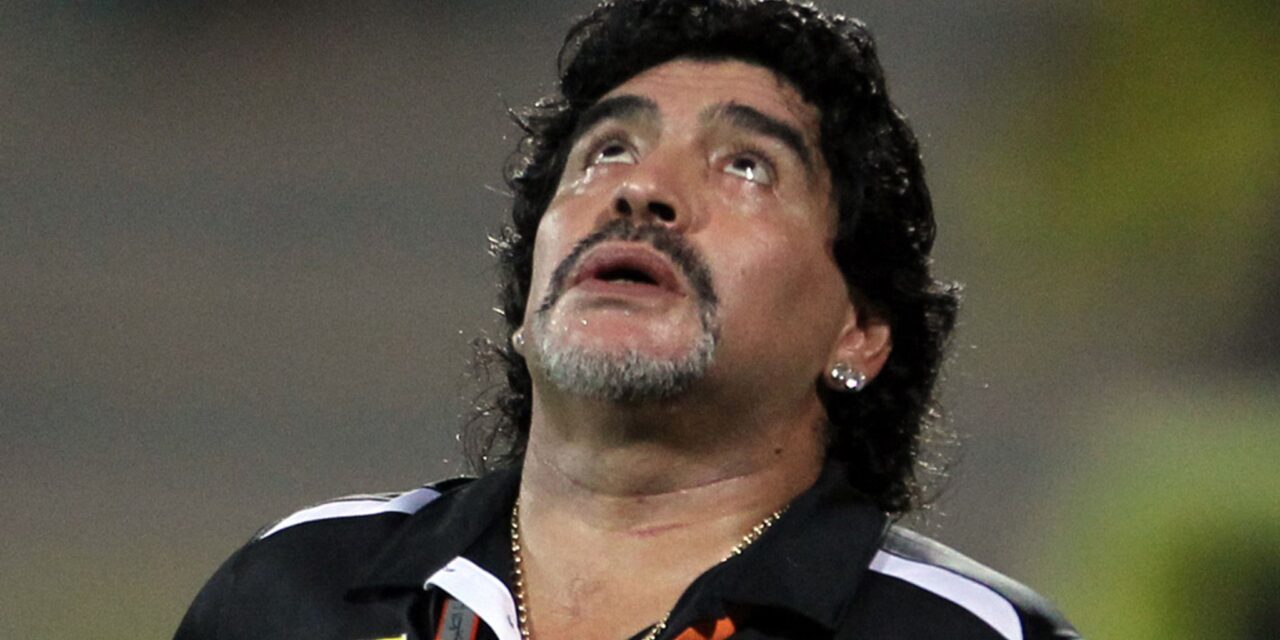
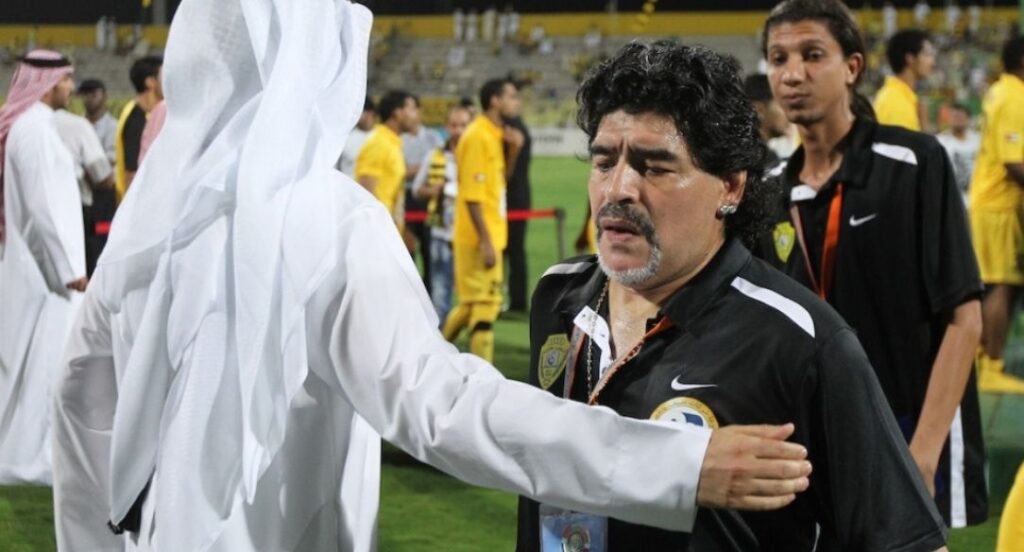
Diego Maradona arrived at the Jumeirah Zabeel Saray Hotel on Dubai’s palm island exactly as you’d expect him to — almost an hour late and flanked by an entourage longer than Sheikh Zayed Road. The UAE Pro League is where great careers go to rest so there was giddy curiosity in the air of the venue, moved from Zabeel Stadium to accommodate the hundreds of journalists in attendance.
The biggest names in this corner of the Gulf go by Asamoah Gyan, on loan from Sunderland, and 11-time Brazil international Ricardo Oliveira. Not anymore. Maradona’s diminutive figure shuffled into the hotel conference room; packed to capacity and beyond. This doesn’t quite feel real. He processed every question, which must be translated from the language of the many expatriate journalists present into Arabic and then into Spanish, meticulously. He speaks softly, jumping between topics like the prized performer he is. He’s here; he is among us.
“I feel good to have this challenge. I did not expect it. I feel the same way as when I was coach of my national team, Argentina.” Maradona paused. He stared intently into the distance, those ferocious eyes betraying the me-against-the-world ethos that fuelled his entire life. “I will tell the players that if they do not commit themselves to the team, there is no point in playing. I want to guarantee to the people that we will win matches. The players I will sign will bring passion and will show it on the field. I will go for youth, not old players. I do not want the club to be a graveyard for white elephants,” he stated.
The white elephant could have been a self-referral; dismissed by his beloved Argentina following a 4–0 defeat to Germany at the 2010 World Cup, no elite club considered him, as much for his lack of managerial pedigree as the baggage he drags. Yet there he was, gifted to us on that strange May afternoon on a man-made island, annexed in the Persian Gulf.
Journalists have a duty to impartiality and to not cheerlead; straightforward when covering the Pro League which was less than 40 years old and came without the frenzied hysteria of every goal and referee error of an English Premier League game. But, it was almost impossible not to want El Pelusa to succeed. The big question went unasked — what on earth was he doing here?
—
“Maradona doesn’t always have a clear mind because of his life. I don’t take drugs. My life is clear. I don’t do anything … Who is Maradona as a coach? He should respect his work and never come to matches wearing short pants.” — Cosmin Olăroiu
The searing hot Arab summer gave way to a barely cooler autumn and after a promising league start — Al Wasl taking seven points from their opening three games — bad results rolled in like one of the dust storms that frequently engulf the nearby skyscrapers. Seven-time UAE champions, Wasl’s expectations were to challenge for the title. 29-year-old Uruguay striker Juan Manuel Olivera was recruited to get those prize goals.
It wasn’t to be. Two points from five league games mid-season saw The Cheetahs out of contention, and the darkening of their manager’s mood. A spat with Al Ain boss Cosmin Olăroiu resulted in Maradona’s refusal to shake hands with the Romanian following a 2–0 defeat. Not to be intimidated by his rival’s reputation in the game, Olăroiu bit back. Who is Maradona as a coach?
Verbals, while frequent, weren’t the only headlines the World Cup winner generated during that turbulent 2011–12 season. Early in the year, a Wasl fan was the victim of a blow from Maradona’s famous left foot, after encroaching on a photoshoot at the stadium. An apology followed: “I am emotional, this is my nature. I’ve always been like this as a player and coach.”
Predictably unpredictable, during a 2–0 away defeat at Al Shabab, Maradona was captured on live TV climbing into the VIP area of the stands to remonstrate with home supporters, pursued by a number of yellow-shirted Al Wasl players in what was later explained as the home fans verbally abusing Maradona’s girlfriend, Veronica Ojeda. “We accept everything in football but do not accept men swearing at women,” he exclaimed, passionately. “They are cowards.” Awaydays weren’t the only sources of crowd trouble — Al Wasl were forced to play six home games at Ajman and Al Nasr; a result of disturbances of their own.
—
“Perhaps he (Pelé) mixed up his morning pill with his night pill.”
Maradona’s press conferences provided the most fascinating insight into the soul of a passionate, fiery, anguished man. Nondescript game previews were jolted into life at the mere mention of his mortal enemies — Pelé and England.
In late January 2012, the night before a hard-fought 2–1 away win at Sharjah, prominent UK journalist Martin Samuel sat in on Maradona’s pre-match briefing. While initially unclear as to why he was in attendance, Samuel began asking a number of questions about Maradona’s life and career, provoking some memorable responses.
“I think Pelé’s comments are down to old age affecting his mind,’’ Maradona began, following criticism of Lionel Messi by the Brazil legend. “You can’t blame the guy. He hasn’t done anything for 20 years, not even go to the supermarket, so then suddenly a journalist gives him a chance to speak, and he thinks he has to create stories.
Usually, the only time you see him is at awards ceremonies next to the president of FIFA, looking like a doll moved by remote control.”
And then, the coup de grâce: “Perhaps he mixed up his morning pill with his night pill.”
The outburst was typical of Maradona but, on that occasion, the extra emotion is excused — his beloved mother had passed away a week previous. A desperate dash back to Argentina, having been informed of her ailing health on the Wasl team bus, was in vain; Maradona was unable to say a final goodbye to the woman who helped him become the darling of their nation.
Dalma Salvadora Franco de Maradona, or ‘Dona Tota’ according to the tattoo engraved on Maradona’s back, was the driving force behind the often-impossible task of keeping her son on the right path. A minute’s silence impeccably observed at Boca Juniors’ La Bombonera following her passing was a testament to her standing in Argentina — only the chosen few bring La Boca’s raucous pit to a standstill.
Dona Tota’s influence didn’t end when her son conquered the football world; he did so in spite of a lifestyle that would find approval from neither a sports nutritionist nor an anti-doping agency. Maradona almost died of a cocaine overdose in January 2000, and of heart failure in 2004. He celebrated his birthday the following year in Buenos Aires with the apt words, “I’m 45…and I’m alive”. Mother and daughters had intervened; Maradona needed to rigorously alter his lifestyle.
Which began to answer the lingering question from his inaugural press conference: Dubai’s ultra-strict illegal substance policy may have been good for Maradona. Drying out is easier in the desert. And, he was good for Dubai, too. Maradona is what Dubai does. The biggest names, the best cars, the tallest buildings; Dubai’s self-conscious image exists by showing off. Having the Burj Khalifa of footballers made sense, regardless of results.
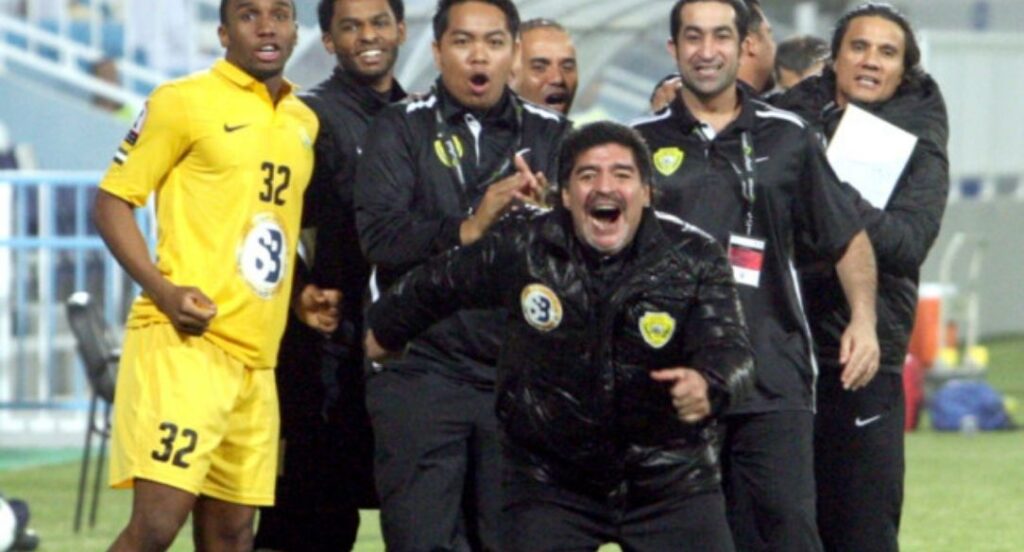
Maradona arrived back in the desert for Wasl’s next match, still grieving the loss of his guardian angel. “It’s a very emotional time. But as soon as I buried my mother, the first thought that came to my mind was coming back to team. I owe it to them. They showed me a lot of support. They are showing excellent form.’’
—
Sadly, for Maradona, that form deserted his team towards the back end of the season. Al Wasl finished eighth in a 12-team league, the club’s joint worst-ever performance. The GCC Champions League — a Europa League-level competition for Arab clubs — was the final shot at redemption. A 3–1 away win in Bahrain meant Maradona would surely hoist yet another trophy high into the sky.
His goalkeeper had other ideas; Naser was given a 10th minute red card for headbutting a Muharraq player. Incredibly, his team-mate Rashid Essa followed in the 78th minute for the same offence and nine-man Wasl were beaten in a penalty shootout on a boiling hot summer’s evening in front of their stunned supporters.
“The circumstances tonight didn’t help and I couldn’t have done any better,” Maradona wistfully relayed to the waiting media. “I don’t regret anything I did this season. We did all we can and I will continue (to coach the team). I have a commitment with Al Wasl and preparations are already underway for next season.” As he was speaking, Naser was escorted out the back gate of Zabeel Stadium, under police guard, as a gang of fans congregated at the main entrance. A fitting end to a season only Diego Armando Maradona could conjure.
Epilogue
The board who hired Maradona resigned and with the new members came a new coach — Bruno Metsu, who led Senegal to the quarter-finals of the 2002 World Cup. Maradona penned an open letter on his personal website, hoping for a deal to be agreed where he could return to Zabeel. It was to no avail.
He worked for Dubai Sports Council for a year before returning to Argentina with Deportivo Riestra. Majed Naser never played for Al Wasl again — suspended for the entire 2012–13 season following the headbutt, he then signed for Dubai neighbours Al Ahli.
Sport for Business Partners
[logo_carousel_pro id=”51608″]